
1,800 Miles Down: Scientists Uncover Mysterious Movements at the Edge of Earth’s Core
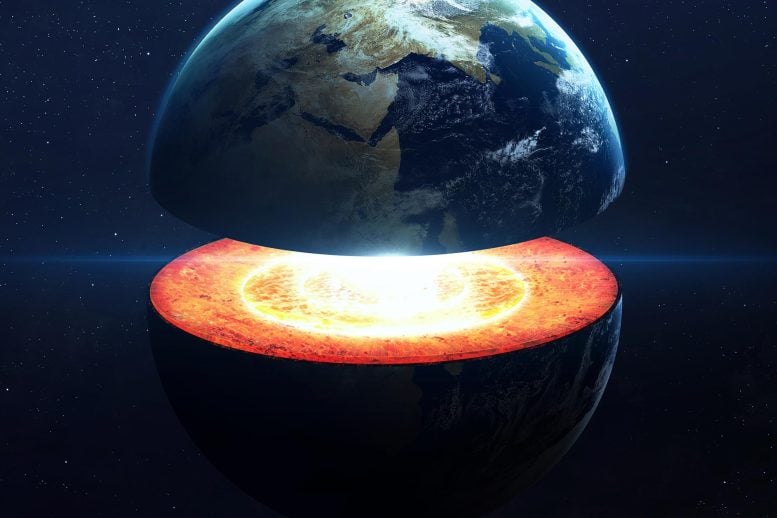
1,800 Miles Down: Scientists Uncover Mysterious Movements at the Edge of Earth’s Core
Deep within Earth, subtle variations in how seismic waves travel are revealing a hidden pattern of deformation in the planet’s lowest mantle layer. This groundbreaking discovery, made by an international team of geophysicists, offers unprecedented insight into the dynamic processes shaping our planet from the inside out.
Earth’s interior is a realm of extremes. Temperatures soar to over 5,000 degrees Celsius, and pressures are millions of times greater than at the surface. Yet, even in this hostile environment, the planet is alive with motion. The mantle, a thick layer of hot, semi-solid rock sandwiched between the crust and the core, is in constant motion. Vast currents of slowly circulating rock, driven by heat from the planet’s interior, help move tectonic plates across the surface, fueling earthquakes, volcanic eruptions, and the creation of mountains.
But what happens at the very bottom of the mantle, where it meets the outer core, has long been a mystery. This boundary, located approximately 1,800 miles (2,900 kilometers) beneath our feet, is a region of intense heat and pressure. It is here that scientists have now detected subtle but significant variations in the behavior of seismic waves—ripples of energy generated by earthquakes that travel through the Earth.
By analyzing these seismic waves, researchers have uncovered evidence of a previously unknown pattern of deformation in the lowermost mantle. This deformation appears to be driven by complex interactions between the mantle and the outer core, a swirling ocean of liquid iron that generates Earth’s magnetic field. The findings suggest that the boundary between the mantle and the core is far more dynamic and intricate than previously thought.
“This is a game-changer,” said Dr. Samantha Hansen, a geophysicist at the University of Alabama and lead author of the study. “We’ve always known that the mantle is moving, but now we’re seeing how that movement is influenced by the core. It’s like discovering a new layer of complexity in a system we thought we understood.”
The discovery was made possible by advances in seismic imaging technology, which allow scientists to create detailed maps of Earth’s interior. By studying how seismic waves travel through different layers of the planet, researchers can infer the properties of those layers, such as their temperature, composition, and structure.
In this case, the team focused on a region known as the D” layer, a thin but critical zone at the base of the mantle. The D” layer is thought to play a key role in the transfer of heat from the core to the mantle, which in turn drives the planet’s geodynamic processes. The new findings suggest that this layer is not uniform but instead contains regions of varying density and structure, likely caused by the movement of material between the mantle and the core.
“These variations could have profound implications for our understanding of Earth’s evolution,” said Dr. Hansen. “They suggest that the mantle and core are more interconnected than we realized, and that their interactions may play a crucial role in shaping the planet’s surface over geological timescales.”
The discovery also raises new questions about the nature of the mantle-core boundary. For example, how does material move between the two layers? What role do these movements play in generating Earth’s magnetic field? And how do they influence the behavior of tectonic plates?
To answer these questions, scientists will need to continue refining their models of Earth’s interior and collecting more seismic data. Future missions, such as the proposed EarthScope project, could provide even greater insights into the planet’s inner workings.
As we delve deeper into the mysteries of Earth’s core, one thing is clear: our planet is far more dynamic and complex than we ever imagined. From the slow churn of the mantle to the turbulent flow of the outer core, Earth is a living, breathing entity, constantly reshaping itself in ways we are only beginning to understand.
Tags and Viral Phrases:
- Earth’s core mysteries
- Mantle-core boundary dynamics
- Seismic wave revelations
- Deep Earth deformation
- Geophysics breakthrough
- Earth’s inner workings
- Tectonic plate drivers
- Liquid iron ocean
- D” layer secrets
- Geodynamic processes
- Earth’s magnetic field
- Planetary evolution
- Seismic imaging technology
- Mantle-core interactions
- EarthScope project
- Living, breathing planet
- Hidden patterns in Earth
- Heat transfer in Earth
- Geological timescales
- Extreme environments
- Semi-solid rock currents
- Core-mantle boundary
- Earth’s interior complexity
- Tectonic plate movements
- Volcanic eruptions origins
- Mountain formation drivers
- 1,800 miles beneath us
- Earth’s inner core secrets
- Heat from Earth’s interior
- Dynamic Earth processes
,


Leave a Reply
Want to join the discussion?Feel free to contribute!