
3 Things China’s Military Has That The US Doesn’t
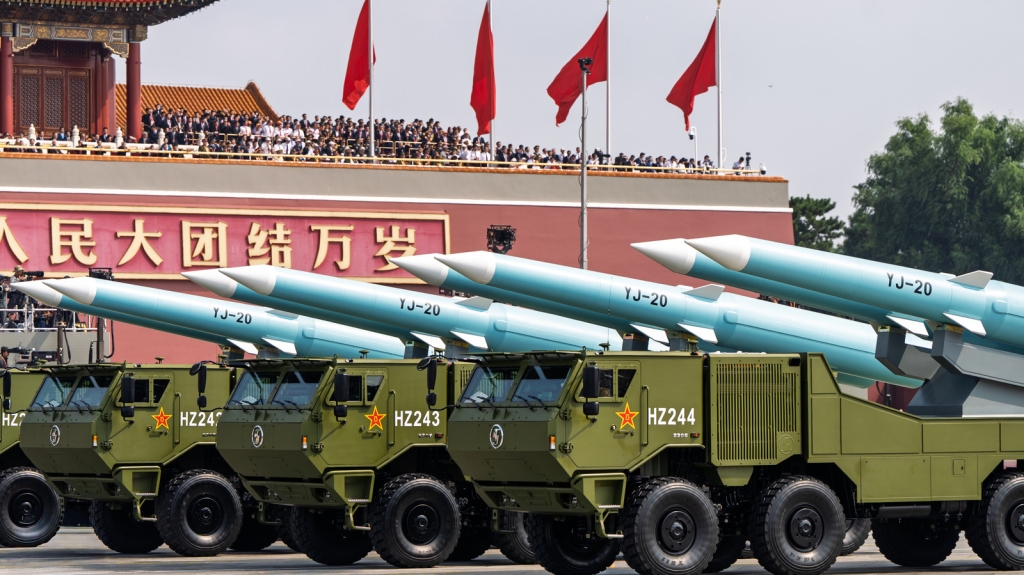
China’s Military Tech Edge: 3 Game-Changing Systems the U.S. Doesn’t Have
China has rapidly transformed its military into a formidable force, closing the gap with the United States in terms of capability, technology, and combat readiness. While the U.S. still maintains a significant advantage in many areas, China has developed several unique military technologies that the American military currently lacks. These differences stem not from technological limitations, but from fundamentally different strategic priorities and geographic realities.
China’s massive defense budget—second only to the United States—has fueled an aggressive modernization program that has produced weapons systems specifically designed to counter U.S. military advantages in the Pacific region. These systems reflect China’s focus on becoming a dominant regional power, particularly in the East and South China Seas, rather than projecting global power like the United States.
The three most notable capabilities that China possesses but the U.S. does not include anti-ship ballistic missiles (ASBMs), land-based intermediate-range ballistic missiles (IRBMs), and a comprehensive land-based coastal missile network. Each of these systems represents a significant technological achievement and poses unique challenges to U.S. military planning in the Pacific theater.
China’s Anti-Ship Ballistic Missiles: A Game-Changer for Naval Warfare
China stands alone as the only nation to have successfully deployed anti-ship ballistic missiles, representing a revolutionary development in naval warfare. These missiles are specifically engineered to track and destroy moving warships from extreme distances, fundamentally altering the calculus of naval power projection.
The Chinese arsenal includes several variants with impressive ranges. The YJ-21 boasts a 1,500 km range, while the DF-21D can strike targets up to 2,150 km away. The DF-26D extends this reach to 4,000 km, and the most advanced variant, the DF-27, can hit targets up to 8,000 km distant—putting U.S. naval assets as far away as Guam, Alaska, and even Hawaii within striking range from Chinese territory.
These weapons fundamentally change naval strategy by forcing U.S. aircraft carriers to operate much farther from potential conflict zones, reducing their operational effectiveness and increasing the complexity of power projection in the Pacific. The ability to launch these missiles from deep within Chinese territory, or from mobile platforms including aircraft and ships, creates a multi-layered threat that is extremely difficult to counter.
The United States has historically not pursued ASBMs because they were not strategically necessary. Unlike China, which faces constant pressure from U.S. naval presence in the Pacific and contested waters, the U.S. has not needed to develop weapons specifically designed to counter a peer naval competitor in its immediate vicinity. However, this technological gap represents a significant vulnerability that the U.S. military is actively working to address through alternative means, including advanced missile defense systems and new operational concepts.
Land-Based Intermediate Range Ballistic Missiles: China’s Regional Deterrent
China has developed an extensive arsenal of land-based intermediate-range ballistic missiles (IRBMs) that the United States cannot match, primarily due to historical arms control agreements. For over three decades, the U.S. was bound by the Intermediate-Range Nuclear Forces (INF) Treaty with the Soviet Union and later Russia, which prohibited the development and deployment of ground-based ballistic and cruise missiles with ranges between 500 and 5,500 km.
This treaty effectively prevented the U.S. from developing a land-based missile force in this crucial range category, while China, unbound by these restrictions, invested heavily in such capabilities. The Chinese missile arsenal includes the DF-21 medium-range ballistic missile, the DF-26 intermediate-range ballistic missile with a range of up to 4,000 km, the DF-17 hypersonic glide vehicle, and various land-attack cruise missiles like the CJ-10 and CJ-100.
These systems provide China with the ability to strike regional targets quickly and with devastating precision from land-based launchers. The range coverage of 1,500 to 4,000 km effectively encompasses all of China’s immediate neighbors and potential adversaries, creating a powerful deterrent against any military action in the region.
The strategic calculus is straightforward: while the United States faces no immediate regional threats that would justify such a missile force, China must be prepared to defend its interests against multiple potential adversaries in its neighborhood, including India, Japan, and various Southeast Asian nations with whom it has territorial disputes. The withdrawal from the INF Treaty in 2019 has opened the door for the U.S. to develop similar capabilities, but significant technological and operational gaps remain.
China’s Land-Based Coastal Missile Network: Fortress China
Perhaps most impressively, China has developed a comprehensive land-based coastal missile network that the United States completely lacks. This system goes beyond individual missile types to create an integrated coastal defense architecture that transforms China’s coastline into a formidable defensive barrier.
The network primarily employs anti-ship cruise missiles (ASCMs) mounted on highly mobile truck platforms, allowing for rapid deployment and relocation to avoid counterstrikes. Key systems include the YJ-62 and YJ-12B missiles, which can be positioned along China’s extensive coastline or on strategic island outposts throughout the South China Sea. These missiles, while having shorter ranges than the ballistic variants, are still capable of striking targets hundreds of miles from shore.
The 333rd Coastal Defense Brigade of China’s Northern Theater Command has demonstrated these capabilities in real-world exercises, showcasing the operational readiness and effectiveness of this integrated defense network. This represents a fundamental difference in military philosophy: while the U.S. focuses on power projection and maintaining freedom of navigation, China has invested heavily in denying access to its littoral regions.
The United States has experimented with similar concepts, with the Marine Corps testing deployable Naval Strike Missile truck units, but these efforts have been limited in scope and were never intended to create a comprehensive coastal defense network. The U.S. military philosophy emphasizes mobility and global reach rather than static coastal defense, reflecting the different strategic priorities of the two nations.
These technological gaps highlight the evolving nature of military competition between the United States and China. While the U.S. maintains significant advantages in areas such as aircraft carrier operations, stealth technology, and global power projection, China’s focused investment in region-specific capabilities has created vulnerabilities that the U.S. military must now address.
The development of these systems represents more than just technological achievement; they reflect a fundamental shift in the balance of power in the Pacific region. As China continues to refine and expand these capabilities, the United States faces increasing challenges in maintaining its traditional military dominance in the region. This technological competition is likely to intensify in the coming years, driving further innovation and potentially reshaping the strategic landscape of the Pacific theater.
The gap in these specific capabilities also underscores the importance of understanding that military power is not simply about having the most advanced technology, but about having the right capabilities for your strategic objectives. China’s investment in these particular systems reflects a clear-eyed assessment of its security needs and a willingness to invest in capabilities that directly address its perceived vulnerabilities.
As both nations continue to develop their military capabilities, the technological competition between the United States and China will likely produce new innovations and capabilities that could reshape warfare in the 21st century. The current gap in these specific areas serves as a reminder that technological superiority is relative and that focused investment in the right capabilities can create significant strategic advantages, even against a more technologically advanced opponent.
China military technology, US military disadvantage, anti-ship ballistic missiles, intermediate-range ballistic missiles, coastal missile defense, PLA modernization, Pacific military balance, ASBM technology, IRBM capabilities, Chinese military innovation, U.S. military gaps, regional power projection, missile technology race, strategic military capabilities, defense technology competition
China’s military has U.S.-beating tech you’ve never heard of, The weapons America doesn’t have but China does, Game-changing Chinese military systems, Why China’s missiles scare the Pentagon, The tech gap that could change Pacific warfare, China’s secret military advantage over America, Three Chinese weapons the U.S. can’t match, How China leapfrogged U.S. military technology, The missiles that could sink American carriers, China’s military revolution you need to know about
,


Leave a Reply
Want to join the discussion?Feel free to contribute!