
3I/ATLAS Spraying Something as It Exits the Solar System
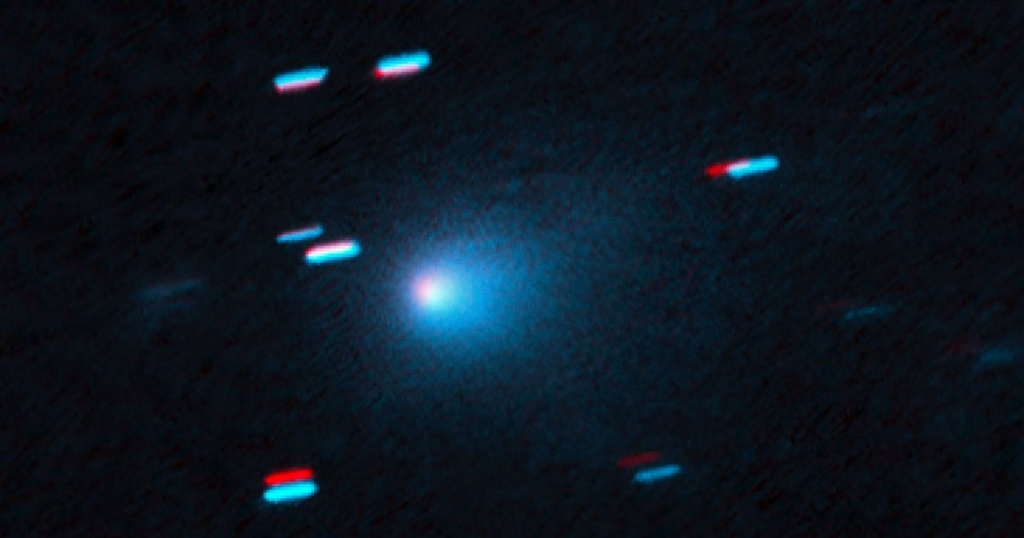
NASA’s SPHEREx Reveals Interstellar Comet 3I/ATLAS Spewing Ancient Water and Cosmic Secrets as It Leaves the Solar System
In a discovery that feels like something out of a science fiction epic, NASA’s SPHEREx space observatory has captured breathtaking new details about 3I/ATLAS, the interstellar comet that has fascinated astronomers since its dramatic appearance in our solar system. As this rare cosmic visitor hurtles back into the depths of space, never to return, scientists are uncovering astonishing evidence that it’s not just passing through—it’s erupting with ancient water and primordial materials from the dawn of planetary formation.
The comet, only the third interstellar object ever detected within our solar system, made its closest approach to the Sun in October 2025. But it wasn’t until December that SPHEREx—NASA’s cutting-edge near-infrared space telescope launched just six months earlier—registered a sudden and dramatic brightening. The cause? A massive outburst of water vapor and carbon-rich compounds blasting into space as the Sun’s heat penetrated the comet’s icy crust.
“Comet 3I/ATLAS was full-on erupting into space in December 2025, after its close flyby of the Sun, causing it to significantly brighten,” said Carey Lisse, astronomer at Johns Hopkins University and lead author of the recent study published in the Astrophysical Journal Letters. “Even water ice was quickly sublimating into gas in interplanetary space.”
But this wasn’t just any water. The outburst released an abundance of new material—organic molecules, soot, and rock dust—that had remained locked beneath the surface for billions of years. These are the very same materials that make up the early solar system, preserved in the cold, radiation-blasted environment of interstellar space.
“Since comets consist of about one-third bulk water ice, it was releasing an abundance of new, carbon-rich material that had remained locked in ice deep below the surface,” Lisse explained. “We are now seeing the usual range of early solar system materials, including organic molecules, soot, and rock dust, that are typically emitted by a comet.”
What makes 3I/ATLAS particularly intriguing is its long journey through interstellar space. Unlike comets from our own solar system, this visitor has spent eons drifting between the stars, exposed to intense cosmic radiation. This bombardment likely formed a hardened, processed crust on its surface—a kind of cosmic armor that protected the pristine ices below.
“The comet has spent ages traversing interstellar space, being bombarded by highly energetic cosmic rays, and has likely formed a crust that’s been processed by that radiation,” said Phil Korngut, SPHEREx instrument scientist. “But now that the Sun’s energy has had time to penetrate deep into the comet, the pristine ices below the surface are warming up and erupting, releasing a cocktail of chemicals that haven’t been exposed to space for billions of years.”
This revelation offers a rare glimpse into the building blocks of planetary systems beyond our own. The materials being ejected by 3I/ATLAS are not just scientifically valuable—they’re cosmic time capsules, offering clues about the chemistry and conditions that shaped worlds in other star systems.
SPHEREx, short for Spectro-Photometer for the History of the Universe, Epoch of Reionization and Ices Explorer, was designed to map the entire sky in 102 infrared color bands. Its ability to detect subtle changes in brightness and composition made it the perfect tool to track 3I/ATLAS’s transformation as it swung around the Sun.
The findings are already reshaping our understanding of interstellar objects. While previous visitors like ‘Oumuamua and 2I/Borisov provided valuable data, 3I/ATLAS is unique in its activity level and the richness of its chemical signature. Its outburst suggests that many interstellar comets may be far more dynamic and chemically complex than previously thought.
As 3I/ATLAS continues its one-way journey out of the solar system, astronomers will continue to monitor its fading glow, hoping to capture every last detail before it vanishes into the cosmic dark. For now, it stands as a testament to the power of modern space observatories and the endless surprises waiting in the depths of space.
Tags & Viral Phrases:
interstellar comet 3I/ATLAS, NASA SPHEREx, cosmic water eruption, interstellar visitor, ancient space materials, organic molecules in space, comet outburst, solar system secrets, cosmic time capsule, interstellar chemistry, space science breakthrough, rare celestial event, NASA discovery, Johns Hopkins astronomy, space exploration 2025, cosmic radiation effects, planetary formation clues, interstellar object study, SPHEREx telescope, space science viral, astronomy news 2025
,


Leave a Reply
Want to join the discussion?Feel free to contribute!