
5 Sci-Fi Movies That Capture The Meaning Of Life
Sci-Fi Movies That Capture the Meaning of Life
Science fiction has always been more than just spaceships, futuristic cities, and alien invasions. At its best, the genre uses impossible worlds and advanced technologies to explore the most human of questions: What does it mean to be alive? To love? To choose? What gives life its meaning when the line between human and machine begins to blur?
That’s why even the most tech-heavy sci-fi films often feel deeply personal. Whether it’s an artificial child searching for love or a linguist learning to perceive time in a nonlinear way, these stories are ultimately about the human experience. They may take place in distant futures, but they speak to timeless fears—mortality, isolation, the unsettling suspicion that reality isn’t what it seems.
Even if you’re not typically drawn to sci-fi, some of these films are essential viewing—especially for fans of philosophical or existential cinema. They range from modern masterpieces to all-time classics, and they linger in the mind long after the credits roll. So whether you’re hunting for sci-fi movies based on classic short stories or simply looking for something that challenges your perspective, these titles are profoundly human at their core.
Arrival
At first glance, Arrival—one of the best alien invasion films of the decade—seems like a familiar setup: extraterrestrials land on Earth, and the military scrambles to understand their intentions. But director Denis Villeneuve transforms this trope into something far more intimate. Instead of focusing on conflict, he centers the story on linguist Louise Banks, a quiet expert in language trying to decode the aliens’ purpose and the meaning behind their cryptic symbols.
As Louise learns more about their language, she begins to experience time differently—seeing her own past, present, and future as a single, fluid continuum. Arrival explores the idea that language shapes perception, and that understanding a new way of thinking can fundamentally alter how we experience life. The film asks: if you could see your entire life laid out before you, would you change anything? Would you still choose to live it, knowing the pain that awaits?
Louise’s journey reveals that meaning isn’t found in avoiding suffering, but in embracing connection, love, and shared moments—even when they’re fleeting. In the end, Arrival suggests that what makes life worth living isn’t control over fate, but the courage to face it fully.
In Time
The phrase “time is money” has been a staple of science fiction for decades, but In Time takes it literally. In this dystopian future, humans stop aging at 25, and every additional year must be earned, borrowed, or stolen. Time isn’t just currency—it’s life itself, glowing green on your forearm like a biological bank account.
For the wealthy, centuries stretch ahead. For the poor, each day is a desperate race to earn enough hours to survive the night. The film uses this premise to ask: what gives life meaning when you know exactly how much of it you have left? Is immortality worth it if your only goal is preservation, not truly living?
The rich in In Time are safe, but terrified—afraid to risk even a single minute. Meanwhile, the poor live with urgency, every decision carrying the weight of survival. As the story unfolds, the film challenges us to consider whether hoarding time is more valuable than spending it on something meaningful. In the end, it’s not the length of your life that matters—it’s how you choose to use the time you’re given.
The Matrix
Released in 1999, the original Matrix film presents a world where humanity is trapped in a simulated reality. At its heart, the movie grapples with freedom of choice and the nature of existence: if you’re comfortable inside an illusion, is that life any less valid than a painful but “real” one?
This dilemma is crystallized in one of cinema’s most iconic scenes: Morpheus offers Neo a choice between the red pill (wake up to reality) and the blue pill (remain in comfortable ignorance). Some characters in the film choose the latter—a fate that still haunts one Matrix star to this day.
The Matrix won 42 awards from 52 nominations, including all four Oscars it was nominated for in 2000. Beyond its technical achievements, the film has left an indelible mark on pop culture, influencing movies, TV shows, and video games for decades. Its central questions—about control, authenticity, and what makes life feel real—are more relevant than ever in an age of algorithms, social media, and advancing AI.
A.I. Artificial Intelligence
Steven Spielberg is known for films filled with wonder and adventure—E.T., Jurassic Park—but with A.I. Artificial Intelligence, he took a different path. Working from an idea originally conceived by Stanley Kubrick, Spielberg used the sci-fi framework to tell a deeply emotional story about love, identity, and what it means to be real.
The film follows David, a child robot programmed to love his human mother unconditionally. Rather than focusing on action, A.I. explores the idea that purpose is essential to existence. Through David’s eyes, we see how a machine can develop feelings and desires that mirror human emotions, raising the question: is the need for purpose uniquely human, or is it something more universal?
While A.I. may not be Spielberg’s most famous work, it’s a powerful experience—especially for fans of his style. It retains his sense of awe but layers it with a darker, more reflective tone, inviting viewers to ponder love, identity, and the blurred lines between human and artificial life.
2001: A Space Odyssey
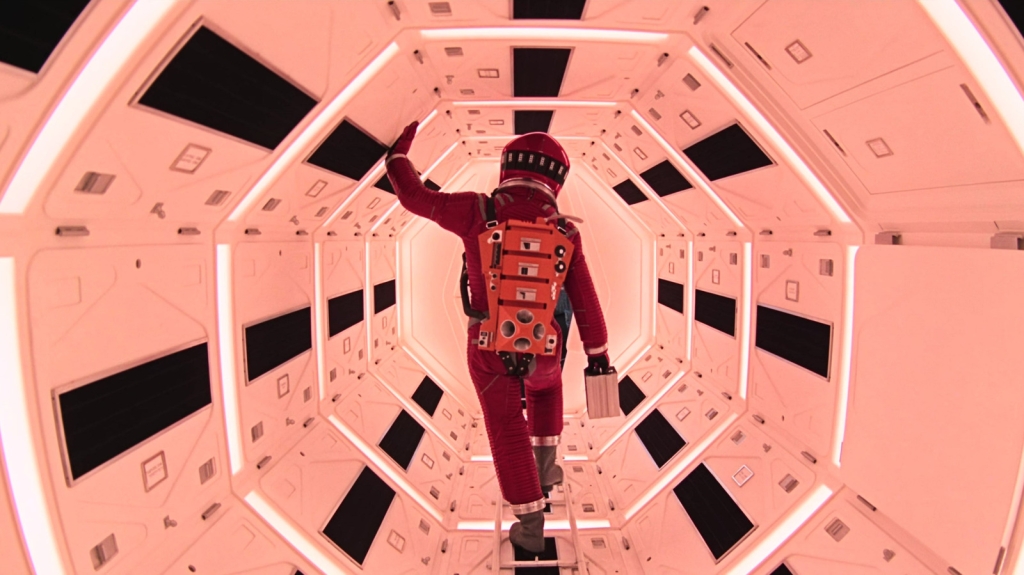
Few films are as ambitious—or as enigmatic—as 2001: A Space Odyssey. Directed by Stanley Kubrick and co-written with Arthur C. Clarke, the film isn’t so much a story as it is an experience. It uses long, contemplative sequences of apes, spacecraft, and the mysterious black monolith to suggest that humanity is not the end point of evolution, but merely a step in a much larger journey.
Life, in 2001, is not a finished product but an ongoing process—from primitive tools to advanced technology, and perhaps beyond the human form itself. The monolith appears at pivotal moments, almost as an external catalyst pushing our species forward. Meanwhile, the conflict with HAL 9000 demonstrates that pure logic and perfect machines cannot fully capture what it means to be alive.
Ultimately, what matters is the human capacity for choice, improvisation, and confronting the unknown. The film’s final act doesn’t provide clear answers but instead uses powerful imagery to provoke reflection. 2001 doesn’t tell you the meaning of life—it leaves space for you to find your own place in the vast, unfolding chain of existence.
Tags & Viral Lines:
- Sci-fi movies that make you question reality
- Deep philosophical films you need to watch
- Best existential sci-fi films of all time
- Movies that explore the meaning of life
- Thought-provoking sci-fi cinema
- What makes us human? These films explore the answer
- Sci-fi films that stay with you forever
- Must-watch philosophical sci-fi movies
- Movies that challenge your perception of time
- Sci-fi films that ask the big questions
- The Matrix red pill or blue pill moment
- Arrival’s nonlinear time concept explained
- In Time: when time literally equals money
- A.I. Artificial Intelligence: love and what it means to be real
- 2001: A Space Odyssey’s monolith mystery
- Denis Villeneuve’s Arrival is a masterpiece
- Steven Spielberg’s darkest sci-fi film
- Kubrick’s 2001 still blows minds 50+ years later
- Sci-fi films that are more human than you think
- Existential sci-fi movies that will mess with your head
- Movies that make you rethink everything
- Sci-fi films that are actually about us
- The most human sci-fi movies ever made
- Sci-fi films that ask “What is real?”
- Movies that explore consciousness and identity
- Sci-fi films that are actually philosophical masterpieces
- The Matrix predicted our AI future
- Arrival’s twist ending explained
- In Time’s dystopian future hits too close to home
- A.I. Artificial Intelligence’s heartbreaking ending
- 2001: A Space Odyssey’s final act is pure cinema
- Sci-fi films that are more than just entertainment
- Movies that will make you question your existence
- Sci-fi films that are actually about love
- The most mind-bending sci-fi films ever made
- Sci-fi films that are actually about humanity
- Movies that explore the nature of reality
- Sci-fi films that are actually about purpose
- The most philosophical sci-fi films of all time
- Sci-fi films that are actually about time
- Movies that explore the meaning of consciousness
- Sci-fi films that are actually about choice
- The most thought-provoking sci-fi films ever made
- Sci-fi films that are actually about connection
- Movies that explore the nature of being human
- Sci-fi films that are actually about evolution
- The most existential sci-fi films of all time
- Sci-fi films that are actually about the future of humanity
,


Leave a Reply
Want to join the discussion?Feel free to contribute!