
Something Far Darker Than a Black Hole Could Hide in The Heart of The Milky Way : ScienceAlert
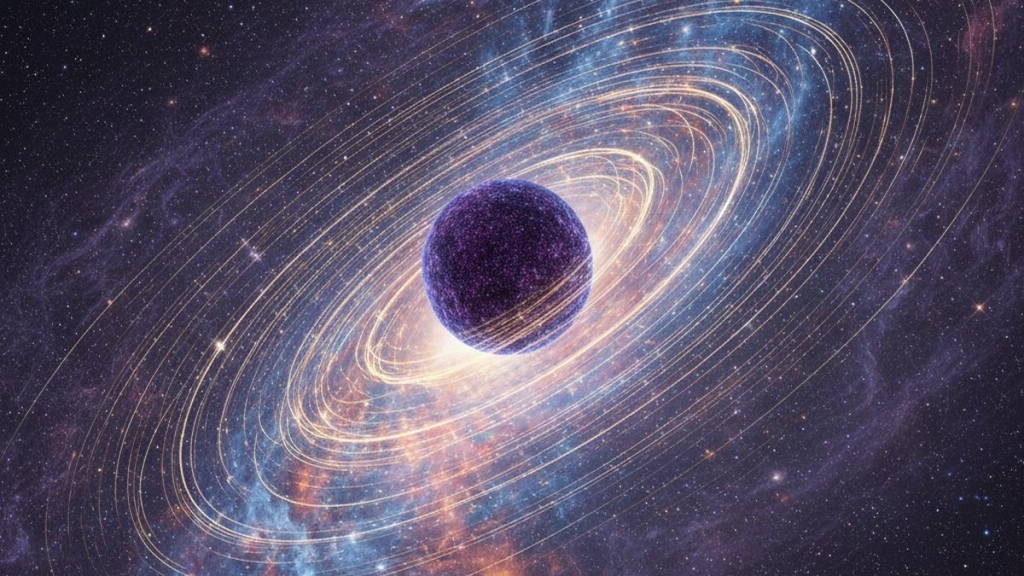
Milky Way’s Galactic Heart: A Supermassive Black Hole or a Dark Matter Mystery?
The heart of the Milky Way has long been thought to harbor a supermassive black hole, but a groundbreaking new study suggests that the truth might be far stranger. Could the mysterious object at the galactic center be a dense, compact blob of fermionic dark matter instead? This provocative idea challenges our understanding of the cosmos and could unlock new insights into the nature of dark matter itself.
For decades, astronomers have been studying the gravitational influence of an object at the center of our galaxy, known as Sagittarius A (Sgr A). All evidence points to a massive, dense object—about 4 million times the mass of the Sun—that behaves like a supermassive black hole. However, a team of researchers led by astrophysicist Carlos Argüelles of the Institute of Astrophysics La Plata in Argentina proposes a radical alternative: what if Sgr A* is not a black hole at all, but a giant, stable clump of fermionic dark matter?
Dark matter is one of the universe’s greatest enigmas. It doesn’t emit, absorb, or reflect light, yet its gravitational pull is undeniable. In fact, dark matter makes up roughly 84% of the universe’s matter, shaping the structure of galaxies and the cosmos itself. The new study suggests that the dark matter halo surrounding the Milky Way and the dense object at its center could be two manifestations of the same substance—a continuous, fermionic dark matter core.
The researchers used data from the orbits of stars near the galactic center, particularly a star called S2, which completes its orbit every 16 years. By modeling the behavior of S2 under both the black hole and dark matter scenarios, they found that both models could explain the star’s motion with near-identical accuracy. This means that, with current observational tools, we cannot definitively say whether Sgr A* is a black hole or a dark matter core.
However, the study also highlights a potential advantage of the dark matter hypothesis. Observations from the Gaia spacecraft suggest that the Milky Way’s rotation slows down at greater distances from the galactic center—a phenomenon that aligns more closely with a fermionic dark matter halo than with other dark matter models.
While this discovery doesn’t prove that Sgr A* is dark matter, it opens up exciting new possibilities for understanding the nature of dark matter and the structure of our galaxy. Future observations, including long-term studies of stellar orbits and high-resolution images from the Event Horizon Telescope, may provide the clues needed to solve this cosmic mystery.
As Argüelles puts it, “This is the first time a dark matter model has successfully bridged these vastly different scales and various object orbits, including modern rotation curve and central stars data.” The implications of this research could be profound, reshaping our understanding of the universe and the invisible forces that govern it.
Tags:
Milky Way, supermassive black hole, dark matter, Sagittarius A*, fermionic dark matter, galactic center, Event Horizon Telescope, Gaia spacecraft, astrophysics, cosmic mystery, space exploration, scientific discovery, gravity, stellar orbits, dark matter halo, universe, cosmology, black hole alternative, groundbreaking research, space science.
Viral Sentences:
- “Is the Milky Way’s heart a black hole or a dark matter mystery? Scientists are rethinking the cosmos!”
- “84% of the universe is dark matter—could it be hiding in plain sight at the galactic center?”
- “S2 star’s 16-year orbit could hold the key to unraveling the universe’s greatest enigma.”
- “Forget black holes—fermionic dark matter might be the true ruler of the Milky Way!”
- “The Event Horizon Telescope’s next images could rewrite the story of our galaxy’s heart.”
- “Dark matter: the invisible force shaping the universe, now under the microscope!”
- “Could the Milky Way’s core be a giant, stable clump of dark matter? The answer could change everything.”
- “Scientists propose a radical new theory: the galactic center is not what we thought!”
- “The universe’s greatest mystery just got a little less mysterious—thanks to fermionic dark matter.”
- “From black holes to dark matter: the cosmic debate that could redefine astrophysics.”
,

Leave a Reply
Want to join the discussion?Feel free to contribute!