
New RCSI exhibition gets to the heart of cardiovascular research
Heart Health Takes Center Stage: RCSI’s ‘More Than a Beat’ Exhibition Blends Cutting-Edge Science with Powerful Human Stories
Dublin’s RCSI University of Medicine and Health Sciences has unveiled a groundbreaking new exhibition that’s capturing hearts and minds across Ireland. The ‘Heart: More Than a Beat’ showcase, housed in the innovative Humanarium space, represents a seismic shift in how medical research connects with the public—transforming cold statistics into living, breathing narratives of hope, innovation, and survival.
The Silent Killer That Claims 9,000 Irish Lives Annually
Cardiovascular disease continues its reign as Ireland’s most formidable health adversary, claiming nearly 9,000 lives each year according to the latest data. The staggering reality? Health experts estimate that a full 80% of these deaths could be prevented through early intervention, lifestyle changes, and advanced medical care. This exhibition emerges at a critical juncture when public awareness about heart health has never been more vital.
The Humanarium: Where Science Meets Storytelling
Nestled within RCSI’s state-of-the-art research and education building on Dublin’s prestigious St Stephen’s Green, the Humanarium represents a revolutionary approach to medical education. This newly opened space has been designed specifically to bridge the gap between complex scientific research and public understanding, hosting a dynamic program of events that bring health sciences to life.
Dr. Alison Boyle, the Humanarium’s visionary director, articulated the exhibition’s core mission during the opening ceremony on February 10th: “We’re here to reveal the science and stories behind every heartbeat.” Her words resonated throughout the space as she welcomed Ciarán Sloan to the podium—a father whose personal journey would become the emotional cornerstone of the entire exhibition.
From Ultrasound Shock to Surgical Triumph
Ciarán Sloan’s story reads like a medical drama, yet it’s painfully real. At their 20-week pregnancy scan, Sloan and his partner Cara McAreavey received devastating news: their unborn son James had serious heart abnormalities that would require immediate and complex intervention after birth. What followed was a rollercoaster of emotions, medical appointments, and ultimately, a life-saving surgical procedure at Our Lady’s Children’s Hospital in Crumlin.
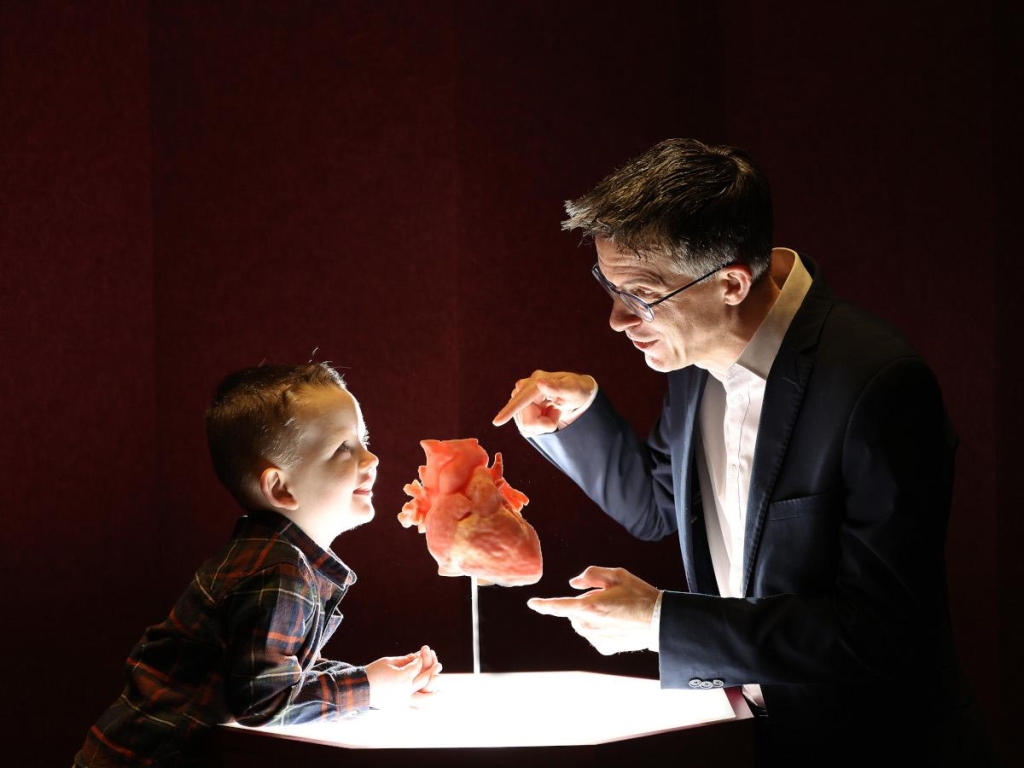
The exhibition features a remarkable artifact that symbolizes this journey—a 3D-printed model of James’s heart that consultant surgeon Mr. Jonathan McGuinness used to meticulously plan the intricate procedure. Sloan’s voice cracked with emotion as he described McGuinness as nothing short of a hero to their family. “This exhibition isn’t just about the medical procedures,” Sloan emphasized. “It shows the human side of what families go through.”
The Waiting Game: When Hope Meets Reality
Cara McAreavey’s account of their family’s experience provides a raw, unfiltered glimpse into the emotional toll of pediatric cardiac care. The family, traveling from Belfast to Dublin, experienced the gut-wrenching disappointment of having surgery cancelled twice at the last minute—each time to accommodate emergency cases. Yet rather than bitterness, McAreavey expressed profound gratitude that James wasn’t an emergency case himself.
“Being blindsided by the initial diagnosis was overwhelming,” she recalled. “But then you realize how incredibly fortunate you are that treatment exists.” Her description of three-year-old James as “incredibly resilient” was proven true as he played energetically in the exhibition space during our conversation—a living testament to medical advancement and human tenacity.
Innovation at the Cellular Level: The Future of Heart Treatment
Dr. Aamir Hameed, senior anatomy lecturer at RCSI, represents the brilliant minds pushing cardiovascular medicine into uncharted territory. His research into mechanical heart support devices for small children has garnered significant attention, including recent funding under Research Ireland’s prestigious Frontier for the Future program.
Hameed’s work with Pumpinheart, an RCSI spin-out company, showcases a prototype device designed to treat advanced heart failure—a condition that affects millions worldwide. The technology addresses diastolic heart failure, where stiffened heart muscles prevent the left ventricle from filling properly, reducing blood flow and causing dangerous fluid buildup.
The implantable pump Hameed’s team developed works by reducing pressure in the left ventricle and improving blood circulation. While still in early development stages, the device has already secured €700,000 in seed funding, with Pumpinheart now seeking €2.5 million to advance to preclinical studies. Hameed’s ambitious timeline aims for human trials within two years.
Smart Technology Meets Cardiac Care
Perhaps most intriguingly, Hameed is developing biosensors to complement the pump device. These sensors would provide real-time data about the device’s function, helping prevent complications and reduce hospital readmissions. The innovation emerged from a simple yet profound question from one of Hameed’s students: “What happens if a patient forgets to charge the device?”
This question sparked the development of alert systems that would notify patients and medical teams about low power levels or potential malfunctions. It’s this blend of cutting-edge technology and practical problem-solving that characterizes the exhibition’s approach to medical innovation.
The Public Awareness Gap: A Ticking Time Bomb
A recent report from the National Office of Clinical Audit, highlighted by RTÉ, reveals a disturbing trend: fewer people are calling emergency services within the critical first hour of experiencing heart attack symptoms. This decline has prompted urgent calls for renewed public education about recognizing early warning signs.
Hameed emphasized that misconceptions about heart attack victims contribute to delayed treatment. “People often think they can’t be having a heart attack because they don’t fit the stereotype,” he explained. “This is particularly problematic for younger patients who might dismiss symptoms.”
Women’s Heart Health: The Silent Crisis
Journalist Maura Derrane, serving as an ambassador for the Irish Heart Foundation, brought crucial attention to gender disparities in cardiac care. Women, she noted, often ignore symptoms or attribute them to other conditions like menopause. “We need to take personal responsibility for our health,” Derrane urged, sharing that she’s become more proactive about cholesterol screening since turning 50.
Her message resonated particularly strongly given research showing that women are more likely to experience atypical heart attack symptoms and face longer delays in seeking treatment compared to men.
The Exhibition’s Broader Impact
The ‘Heart: More Than a Beat’ exhibition represents more than just an educational initiative—it’s a cultural shift in how medical research engages with the public. By combining cutting-edge technology displays with deeply personal human stories, the exhibition creates an emotional connection that pure data cannot achieve.
The Humanarium’s funding partners—Blackrock Health, AIB, Lanas, and HSE Healthy Ireland—recognize the importance of this public engagement in driving both awareness and research advancement. Their support ensures that this innovative space will continue to host exhibitions that make complex medical science accessible to everyone.
A Call to Action
As visitors walk through the exhibition, they’re not just passive observers but active participants in a broader conversation about health, research, and community responsibility. The displays challenge visitors to consider their own heart health, recognize warning signs, and understand the incredible scientific work being done to combat cardiovascular disease.
For those unable to visit in person, the Humanarium website provides extensive resources and information about ongoing exhibitions and research initiatives. The space represents a new model for medical education—one that recognizes that understanding complex health issues requires both scientific knowledge and human connection.
The exhibition runs throughout the year, with rotating displays ensuring that repeat visitors will always discover something new. Whether you’re a medical professional, a patient, or simply someone interested in understanding more about heart health, ‘Heart: More Than a Beat’ offers an unparalleled opportunity to engage with one of medicine’s most critical frontiers.
Tags: heart health, cardiovascular disease, RCSI, medical innovation, pediatric cardiology, heart surgery, medical research, Dublin exhibition, heart failure treatment, biosensors, public health awareness, women’s heart health, medical technology, cardiovascular research, heart attack prevention, medical education, health sciences, medical startups, implantable devices, cardiac care
Viral Sentences:
- 80% of heart disease deaths are preventable – are you taking your heart health seriously?
- This 3D-printed heart model saved a baby’s life – the future of surgery is here
- Women ignore heart attack symptoms twice as often as men – know the signs
- The €2.5M device that could revolutionize pediatric heart failure treatment
- Why calling emergency services within 1 hour of heart attack symptoms saves lives
- The startup developing implantable pumps for children with heart failure
- How one father’s story is changing how we think about heart disease
- The exhibition that’s making medical research accessible to everyone
- Smart sensors that alert you before your heart device fails
- The silent killer claiming 9,000 Irish lives every year – and how to fight back
,

Leave a Reply
Want to join the discussion?Feel free to contribute!