
Motorola Signature vs. Samsung Galaxy S25 Ultra: When flagships collide
Motorola Signature vs. Samsung Galaxy S25 Ultra: A Detailed Tech Showdown
Introduction: The Battle of Flagship Titans
The smartphone landscape in 2026 has taken an intriguing turn as Motorola makes its boldest move yet into the premium segment with the all-new Signature, directly challenging Samsung’s established dominance with the Galaxy S25 Ultra. This comprehensive comparison dives deep into every aspect of these flagship powerhouses, helping you determine which device deserves your hard-earned money.
Pricing and Market Availability: The Elephant in the Room
The Motorola Signature launched in select European markets at €999 (approximately $1,193), positioning itself as a competitive alternative to Samsung’s premium offering. However, availability presents a significant hurdle—Motorola has explicitly stated no immediate plans to bring the Signature to the United States market.
The Galaxy S25 Ultra, meanwhile, commands a base price of around $1,050 (currently discounted) through Samsung’s official channels in the US. This price difference becomes even more pronounced when considering regional variations. In markets like India, the Signature retails for approximately $760, making it significantly more affordable than the S25 Ultra’s $1,410 price tag.
For US consumers, the import route presents complications including potential carrier compatibility issues, warranty concerns, and additional shipping costs. Until Motorola confirms US availability, the Galaxy S25 Ultra remains the practical choice for American buyers despite its higher price point.
Design Philosophy: Industrial Elegance vs. Textile Innovation
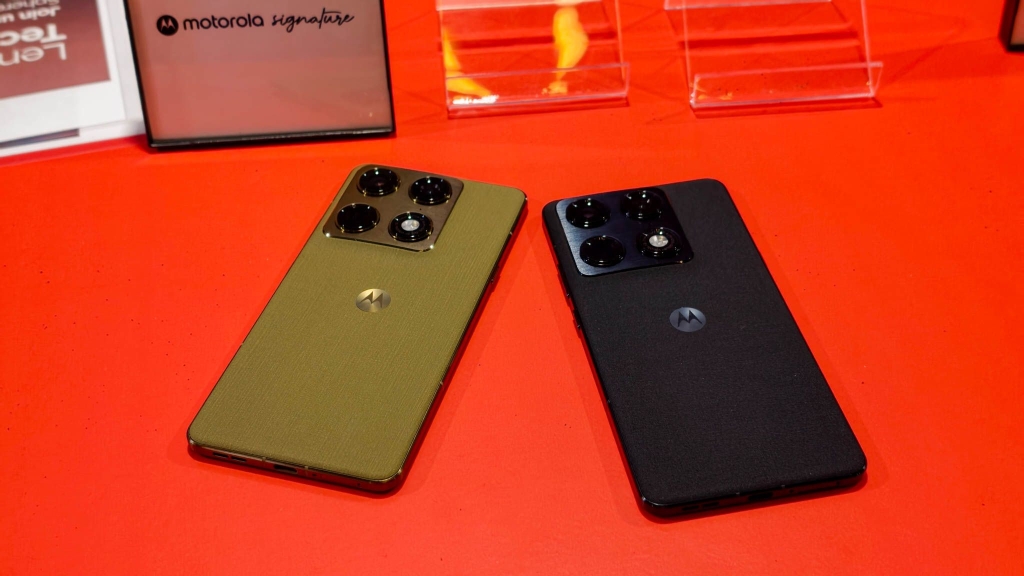
Motorola has crafted the Signature as a design masterpiece, featuring an aircraft-grade aluminum frame measuring just 6.9mm thick—making it one of the slimmest flagship smartphones available. The standout feature is undoubtedly the fabric-like back panel available in twill or linen finishes, providing both visual appeal and exceptional grip comfort. The brushed metal camera housing adds a touch of sophistication that elevates the overall aesthetic.
Samsung takes a different approach with the Galaxy S25 Ultra’s 8.2mm titanium frame and Gorilla Glass Victus 2 back panel. The industrial design language appeals to users who prefer a more traditional premium smartphone appearance. The vertically arranged camera lenses maintain Samsung’s signature look while the flat display with anti-glare coating prioritizes practicality.
Weight differences are substantial—the Signature weighs 186g compared to the S25 Ultra’s 218g. Both devices achieve IP68 ratings, but Motorola goes further with IP69 certification for high-temperature water jet resistance and military-grade durability compliance.
Display Technology: Brightness Wars and Refresh Rate Battles
The Signature boasts a 6.8-inch LTPO AMOLED display with a staggering 165Hz refresh rate and peak brightness reaching 6,200 nits—figures that push the boundaries of current display technology. The slightly curved edges create an immersive viewing experience that flows seamlessly into the frame.
Samsung’s offering features a 6.9-inch flat Dynamic AMOLED panel with LTPO technology, 120Hz refresh rate, and 2,600 nits peak brightness. While these specifications appear less impressive on paper, the anti-glare coating and S-Pen integration provide practical advantages that many users value highly.
Both displays utilize premium protection—Gorilla Glass Victus 2 on the Signature versus the more advanced Gorilla Armor 2 on the S25 Ultra, offering superior scratch resistance and durability.
Performance Hardware: Generational Gap or Practical Parity?
The most significant hardware distinction lies in the processor choices. Samsung equips the S25 Ultra with the latest Snapdragon 8 Elite chipset, representing cutting-edge mobile computing technology. Motorola, however, opts for the Snapdragon 8 Gen 5—a two-generation-old processor that still delivers flagship-level performance.
Both devices offer identical memory configurations with up to 16GB RAM and 1TB storage options. The performance gap between these chipsets may be noticeable in synthetic benchmarks but remains minimal for everyday usage scenarios including gaming, multitasking, and productivity applications.
Connectivity features are comprehensive on both devices, including Wi-Fi 7, multi-band 5G, Bluetooth 6.0 (Signature) versus 5.4 (S25 Ultra), NFC, UWB, and USB-C 3.2 with DisplayPort functionality.
Camera Systems: Evolution vs. Revolution
Samsung maintains consistency with its camera approach, featuring a 200MP primary sensor complemented by 10MP 3x telephoto, 50MP 5x periscope telephoto, and 50MP ultrawide lenses. This versatile quad-camera system has proven capable of delivering exceptional results across various lighting conditions.
Motorola introduces a complete camera overhaul with Sony sensors across its triple-lens setup: 50MP main, 50MP periscope telephoto with 3x optical zoom, and 50MP ultrawide. The inclusion of 8K video recording capabilities on both devices ensures future-proofing for content creators.
Front-facing cameras differ significantly—the Signature features a 50MP wide-angle selfie camera, while the S25 Ultra settles for a 12MP sensor. This represents a substantial upgrade for video calls and social media content creation on the Motorola device.
Software Experience and Update Commitment
Both manufacturers promise seven years of OS and security updates, marking a significant shift in Motorola’s traditionally weak software support. The Galaxy S25 Ultra ships with Android 15 and Samsung’s refined One UI, while the Signature launches with Android 16.
Samsung’s update track record provides confidence in long-term software support, whereas Motorola’s commitment remains untested. Both devices incorporate extensive AI features—Samsung’s Galaxy AI suite versus Motorola’s Moto AI implementation—offering similar functionality for productivity, photography, and system optimization.
Battery Technology and Charging Capabilities
Battery specifications reveal Motorola’s technological advantage. The Signature houses a 5,200mAh Silicon-Carbon battery within its ultra-slim profile, while the S25 Ultra utilizes a 5,000mAh conventional lithium-ion battery. This represents Motorola’s early adoption of next-generation battery technology that promises improved energy density and longevity.
Charging speeds demonstrate even more dramatic differences. The Signature supports 90W wired charging and 50W wireless charging, capable of fully charging the device in under 30 minutes. Samsung’s 45W wired and 15W wireless charging appear antiquated by comparison, often requiring over an hour for complete charging cycles.
The Verdict: Choosing Your Flagship Champion
The decision between these devices ultimately hinges on individual priorities and geographic location. For users in regions where the Signature offers significant price advantages, it represents exceptional value—combining cutting-edge design, superior charging speeds, innovative battery technology, and competitive camera capabilities at a lower price point than traditional flagship offerings.
However, US consumers face practical limitations that make the Galaxy S25 Ultra the sensible choice despite its higher cost. The combination of guaranteed carrier compatibility, proven software support, S-Pen functionality, and Samsung’s established service network outweighs the Signature’s theoretical advantages when import complications arise.
The Signature emerges as Motorola’s most compelling flagship to date, successfully challenging Samsung’s premium positioning through innovative design choices and technological advancements. Meanwhile, the Galaxy S25 Ultra maintains its status as the comprehensive flagship choice, offering reliability, ecosystem integration, and feature completeness that justifies its premium positioning for users prioritizing peace of mind over cutting-edge specifications.
Viral Tags and Phrases
- “Flagship killer at half the price”
- “Motorola’s comeback is real”
- “Samsung finally has competition”
- “The thinnest premium phone ever”
- “90W charging changes everything”
- “Fabric back that feels amazing”
- “Seven years of updates from Motorola?”
- “S-Pen vs. ultra-fast charging”
- “Titanium vs. aluminum showdown”
- “Silicon-Carbon battery breakthrough”
- “165Hz display madness”
- “Camera specs that impress”
- “Import headaches worth it?”
- “The future of Android flagships”
- “Design innovation meets practicality”
- “Performance that punches above its weight”
- “Value flagship that doesn’t compromise”
- “Premium features at mid-range prices”
- “The smartphone wars heat up”
,

Leave a Reply
Want to join the discussion?Feel free to contribute!