
Scientists Propose Surprising Link Between Space Weather and Earthquakes
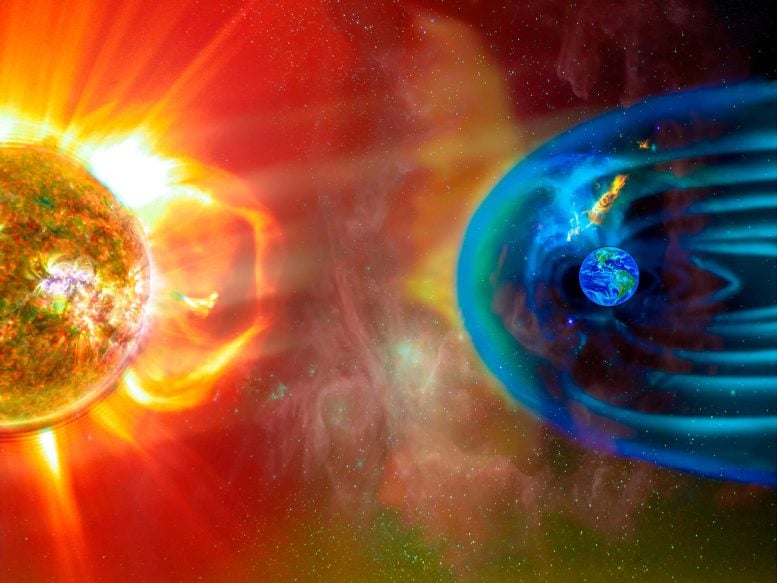
A new theoretical study is exploring how activity high above Earth could subtly influence processes deep within the planet’s crust. Researchers at Kyoto University are advancing a new idea about how space weather might intersect with earthquake physics. Their model asks whether changes in the ionosphere could, in rare situations, apply additional electrical forces to already stressed fault lines—potentially nudging them toward rupture.
Space weather, in this context, refers to disturbances in the upper atmosphere caused by solar activity, such as solar flares and coronal mass ejections. These events can trigger geomagnetic storms, which in turn generate fluctuations in the ionosphere—a layer of Earth’s atmosphere filled with charged particles. While scientists have long known that these disturbances can disrupt communications, navigation systems, and even power grids, the notion that they could influence seismic activity is a radical departure from conventional thinking.
The research team’s approach hinges on the idea that the ionosphere and the solid Earth are not as isolated as once believed. During intense geomagnetic storms, electric currents in the ionosphere can induce secondary currents in the ground, a phenomenon known as geomagnetically induced currents (GICs). These currents, though typically associated with technological disruptions, might—under specific conditions—exert mechanical stress on geological faults.
Faults are fractures in the Earth’s crust where blocks of rock have moved past each other. Earthquakes occur when the stress on a fault overcomes the friction holding the rocks together. Most earthquakes are triggered by tectonic forces—the slow, relentless movement of Earth’s plates. However, the Kyoto University researchers propose that, in some cases, the additional electrical stress from space weather could act as a catalyst, pushing a fault that is already near its breaking point over the edge.
This hypothesis is not without precedent. There have been anecdotal reports of unusual animal behavior, electromagnetic anomalies, and even luminous phenomena in the sky prior to major earthquakes. While many of these observations remain unexplained, they hint at the possibility of a connection between the atmosphere and the solid Earth. The new study seeks to provide a theoretical framework for understanding how such a connection might work.
The researchers used computer simulations to model the interaction between ionospheric currents and the Earth’s crust. Their results suggest that, under certain conditions—such as a highly stressed fault located in an area with high electrical conductivity—the additional forces from space weather could be enough to trigger an earthquake. However, they emphasize that this is a rare scenario and that the vast majority of earthquakes are still caused by tectonic forces alone.
One of the challenges in studying this phenomenon is the difficulty of isolating the effects of space weather from other factors that influence seismic activity. Earthquakes are complex events, and their timing and location depend on a multitude of variables. To test their hypothesis, the researchers propose a series of observational studies, including monitoring changes in the ionosphere before and after earthquakes, as well as measuring ground conductivity in seismically active regions.
If the link between space weather and earthquakes can be confirmed, it could have significant implications for earthquake prediction and preparedness. While it is unlikely that space weather alone could be used to predict earthquakes—given the many other factors involved—it could serve as an additional piece of the puzzle. For example, if a major geomagnetic storm is forecast, authorities in seismically active regions might choose to increase monitoring or issue precautionary advisories.
The idea also raises intriguing questions about the interconnectedness of Earth’s systems. The atmosphere, the solid Earth, and even the sun are all part of a vast, dynamic network. Changes in one part of the system can have far-reaching effects, sometimes in ways that are not immediately obvious. The study by Kyoto University is a reminder that, even in an age of advanced technology and scientific understanding, there is still much to learn about the planet we call home.
Critics of the hypothesis point out that the forces involved in space weather are generally much weaker than those generated by tectonic activity. They argue that, while the idea is intriguing, more evidence is needed to establish a causal link between ionospheric disturbances and earthquakes. The researchers acknowledge these concerns and stress that their work is still in the early stages. They hope that their theoretical model will inspire further research and, ultimately, a better understanding of the complex processes that shape our planet.
In the meantime, the study has captured the imagination of both scientists and the public. The notion that events millions of kilometers away in space could influence the ground beneath our feet is both humbling and awe-inspiring. It underscores the fragility and complexity of the Earth system, and the need for continued exploration and discovery.
As research in this area progresses, it will be important to approach the findings with both curiosity and caution. The intersection of space weather and earthquake physics is a frontier of science, and like all frontiers, it is filled with both promise and uncertainty. What is clear, however, is that the more we learn about the connections between Earth and space, the better equipped we will be to understand and respond to the challenges of living on a dynamic planet.
Tags and Viral Phrases:
space weather earthquakes, ionosphere fault lines, geomagnetic storms seismic activity, solar flares earthquake triggers, Earth crust ionosphere connection, Kyoto University earthquake research, space weather earthquake prediction, atmospheric electrical currents, tectonic forces space weather, Earth systems interconnectedness, coronal mass ejections earthquakes, geomagnetically induced currents, earthquake physics ionosphere, solar activity ground currents, Earth atmosphere space link, seismic monitoring space weather, ionosphere earthquake hypothesis, Earth crust electrical stress, space weather geological faults, earthquake science breakthroughs, ionosphere ground interaction, space weather tectonic activity, Earth dynamic systems, earthquake prediction ionosphere, space weather research earthquakes, ionosphere earthquake theory, Earth space weather connection, seismic activity atmospheric disturbances, space weather earthquake studies, ionosphere earthquake link, Earth crust space influence, earthquake forecasting space weather, ionosphere geological processes, space weather earthquake science, Earth systems research, ionosphere earthquake monitoring, space weather seismic events, earthquake ionosphere connection, Earth atmosphere earthquake link, space weather geological research, ionosphere earthquake phenomena, Earth space weather studies, earthquake ionosphere science, space weather ground effects, ionosphere earthquake investigation, Earth systems earthquake research, space weather seismic monitoring, ionosphere earthquake discovery, Earth space earthquake connection.
,

Leave a Reply
Want to join the discussion?Feel free to contribute!