
Astronomers Are Closing In on the Kuiper Belt’s Secrets
Unlocking the Secrets of the Kuiper Belt: How Next-Gen Telescopes Are Poised to Revolutionize Our Understanding of the Solar System’s Final Frontier
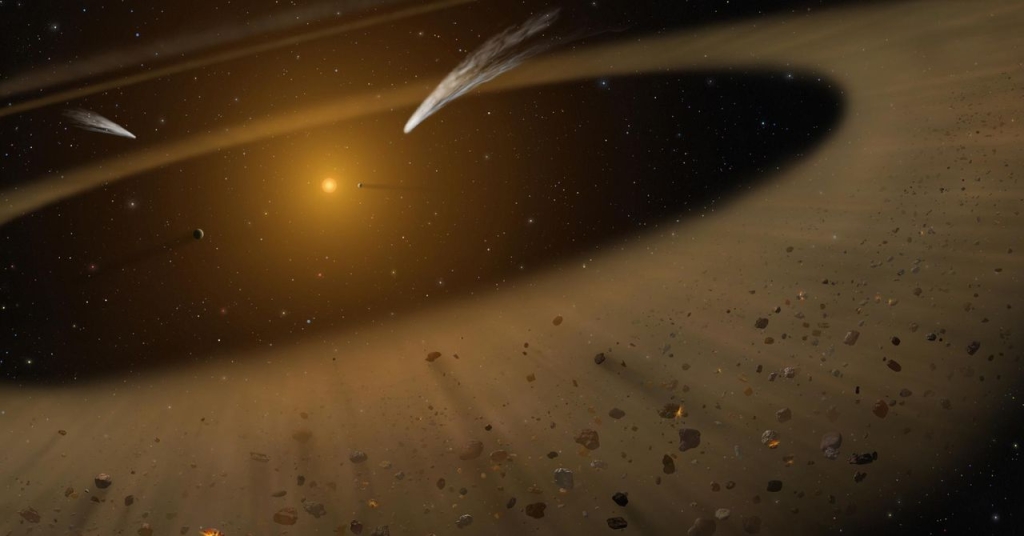
Beyond the orbit of Neptune, where sunlight dims to a faint whisper and temperatures plunge to unimaginable depths, lies one of the solar system’s most enigmatic regions—the Kuiper Belt. This vast expanse of frozen relics, dynamical oddities, and perhaps even hidden worlds represents both a time capsule from our solar system’s violent birth and a frontier that may hold answers to some of astronomy’s most profound questions.
For decades, this region has remained shrouded in mystery, visible only as a collection of scattered dots against the cosmic backdrop. But now, with the advent of revolutionary observatories like the Vera C. Rubin Observatory and the James Webb Space Telescope, astronomers stand on the precipice of a discovery boom that could transform our understanding of the outer solar system.
A Patchwork of Knowledge Waiting to Be Completed
“The Kuiper Belt represents one of the last uncharted territories in our solar system,” explains Renu Malhotra, Louise Foucar Marshall Science Research Professor and Regents Professor of Planetary Sciences at the University of Arizona. “Beyond Neptune, we have a census of what’s out there, but it’s a patchwork of surveys, and it leaves a lot of room for things that might be there that have been missed.”
Currently, astronomers have cataloged approximately 4,000 Kuiper Belt objects (KBOs), ranging from dwarf planets like Pluto and Eris to countless smaller icy bodies and comets. However, this number represents merely the tip of the iceberg. The Vera C. Rubin Observatory, which began its Legacy Survey of Space and Time (LSST) project last year, is expected to increase this catalog tenfold in the coming years.
“I think that’s the big thing that Rubin is going to do—fill out the gaps in our knowledge of the contents of the solar system,” Malhotra adds. “It’s going to greatly advance our census and our knowledge of the contents of the Kuiper Belt.”
The Dawn of a New Era in Kuiper Belt Research
The anticipation among astronomers is palpable. “I think this will become a very hot field very soon, because of LSST,” predicts Amir Siraj, a graduate student at Princeton University who specializes in Kuiper Belt studies. This sentiment is shared across the astronomical community, as researchers prepare for an influx of data that could answer questions that have lingered for decades.
The Kuiper Belt serves as a cosmic graveyard—a repository of planetary odds and ends scattered far from the sun during the messy birth of our solar system some 4.6 billion years ago. Pluto, discovered in 1930, was actually the first Kuiper Belt object ever spotted, though it took another half-century before astronomers realized they had found the first member of this distant population.
Since the 1990s, when the Kuiper Belt was officially recognized, astronomers have discovered a handful of other dwarf planets, including Eris and Sedna, along with thousands of smaller objects. But these discoveries have been sporadic, limited by the capabilities of existing telescopes and the sheer vastness of the region being studied.
A Time Capsule from the Solar System’s Violent Youth
What makes the Kuiper Belt particularly fascinating is its role as a largely intact time capsule from the early solar system. Unlike the inner planets, which have been reshaped by billions of years of geological activity, or the gas giants, which have undergone significant atmospheric changes, the objects in the Kuiper Belt have remained relatively unchanged since their formation.
This preservation makes the Kuiper Belt an invaluable resource for understanding how planets form and evolve. Each object, from the largest dwarf planets to the smallest icy fragments, carries information about the conditions that existed when our solar system was young and chaotic.
The Mystery of the “Kernel” and Neptune’s Bumpy Ride
Among the many puzzles that astronomers hope to solve is the origin of peculiar structures within the Kuiper Belt. One particularly intriguing feature is a cluster of objects known as the “kernel,” located at approximately 44 astronomical units (AU) from the sun, where one AU represents the distance between Earth and the sun—about 93 million miles.
The kernel consists of objects called cold classicals, which follow relatively circular orbits and are thought to have formed in their current locations. But how did this specific cluster come to be? The answer may lie in one of the most dramatic episodes in our solar system’s history: Neptune’s outward migration.
“The jumping Neptune scenario suggests that Neptune’s migration through the solar system wasn’t smooth but rather involved sudden jumps,” explains Wes Fraser, an astronomer at the Dominion Astrophysical Observatory, National Research Council of Canada. “Neptune got jiggled by the rest of the gas giants and did a bit of a jump.”
This hypothesis, developed by astronomer David Nesvorný, proposes that the gravitational interactions between the giant planets caused Neptune to migrate outward in a series of jumps rather than a continuous motion. During these jumps, Neptune could have captured or influenced the orbits of objects that now form the kernel structure.
Hidden Planets and Interstellar Visitors
Beyond understanding the belt’s structure and history, astronomers are also searching for evidence of planets that may be lurking within or beyond the Kuiper Belt. The mysterious orbits of some distant objects have led some researchers to propose the existence of a “Planet Nine”—a massive world that could be influencing the trajectories of smaller bodies through its gravitational pull.
But Planet Nine isn’t the only possibility. Some astronomers speculate that there could be multiple undiscovered planets in the outer reaches of the solar system, each potentially offering new insights into planetary formation and the dynamics of our cosmic neighborhood.
The Kuiper Belt may also hold evidence of encounters with objects from beyond our solar system. Interstellar visitors, like the recently discovered ‘Oumuamua and Comet Borisov, raise the possibility that other star systems have deposited their own debris in our cosmic backyard. Studying the composition and orbits of Kuiper Belt objects could reveal traces of such ancient encounters.
The Technological Revolution Enabling Discovery
The upcoming boom in Kuiper Belt discoveries is made possible by a convergence of technological advances. The Vera C. Rubin Observatory’s LSST will conduct a decade-long survey of the entire visible sky every few nights, creating an unprecedented movie of the changing universe. Its 8.4-meter telescope and 3,200-megapixel camera will be capable of detecting objects millions of times fainter than what the human eye can see.
Meanwhile, the James Webb Space Telescope provides another powerful tool for Kuiper Belt exploration. With its infrared capabilities, JWST can peer through dust and gas to study the composition of distant objects, potentially revealing their chemical makeup and providing clues about where they formed and how they’ve evolved.
Other next-generation observatories, both ground-based and space-based, will contribute to this effort, creating a multi-wavelength approach to understanding the Kuiper Belt that was previously impossible.
Implications Beyond the Kuiper Belt
The discoveries awaiting us in the Kuiper Belt have implications that extend far beyond our own solar system. Understanding how our planetary system formed and evolved provides crucial context for interpreting observations of exoplanetary systems around other stars.
“Many of the exoplanets we’ve discovered orbit very close to their stars, unlike our own system,” notes Malhotra. “Studying the Kuiper Belt helps us understand why our solar system evolved the way it did, and whether our configuration is common or unusual in the galactic context.”
Furthermore, the Kuiper Belt may hold clues about the delivery of water and organic compounds to the inner solar system—materials that were crucial for the development of life on Earth. By analyzing the composition of Kuiper Belt objects, scientists can trace the pathways by which these essential ingredients were distributed throughout the early solar system.
A Golden Age of Discovery
As we stand on the threshold of this new era of Kuiper Belt exploration, the excitement among astronomers is matched only by the potential for transformative discoveries. From uncovering hidden planets to understanding the solar system’s formative years, from detecting evidence of interstellar encounters to placing our own cosmic history in a broader galactic context, the Kuiper Belt promises to yield insights that could reshape our understanding of planetary science.
The next decade will likely see the Kuiper Belt transform from a sparsely mapped region of scattered dots into a richly detailed landscape of worlds, each with its own story to tell about the solar system’s past and perhaps hints about the possibilities for planetary systems throughout the universe.
As Siraj suggests, we are indeed entering a “very hot field very soon,” one that combines cutting-edge technology, profound scientific questions, and the enduring human drive to explore the unknown. The Kuiper Belt, once a distant and mysterious region, is about to come into sharp focus—and with it, our understanding of where we come from and how our cosmic neighborhood came to be.
Tags: Kuiper Belt, outer solar system, Vera C. Rubin Observatory, LSST, James Webb Space Telescope, dwarf planets, planetary formation, Neptune migration, Planet Nine, interstellar objects, solar system evolution, astronomical discovery, cosmic time capsule, cold classicals, kernel structure, jumping Neptune scenario, astronomical surveys, space exploration, planetary science, cosmic archaeology
Viral Sentences:
- The Kuiper Belt could hold the key to finding hidden planets in our solar system
- Next-gen telescopes are about to reveal thousands of new worlds beyond Neptune
- Scientists believe Neptune’s migration may have created mysterious structures in the Kuiper Belt
- The Kuiper Belt is a time capsule preserving the solar system’s violent birth
- Pluto was the first Kuiper Belt object discovered—50 years before we knew the belt existed
- The Vera C. Rubin Observatory will increase our catalog of Kuiper Belt objects tenfold
- Some astronomers think the Kuiper Belt contains evidence of ancient interstellar visitors
- The “jumping Neptune” scenario could explain the mysterious kernel structure
- Kuiper Belt discoveries could help us understand why our solar system is so different from others
- The James Webb Space Telescope will reveal the chemical secrets of distant icy worlds
- Scientists are racing to map the Kuiper Belt before it yields its biggest secrets
- The Kuiper Belt may contain clues about how water and life’s building blocks reached Earth
- We might discover multiple hidden planets lurking in the outer solar system
- The next decade could be the golden age of Kuiper Belt exploration
- Each Kuiper Belt object is a fossil from the solar system’s earliest days
,


Leave a Reply
Want to join the discussion?Feel free to contribute!