
How Computers Powered by Light Could Help With AI’s Energy Problem
AI’s New Frontier: How Light-Based Computing Could Slash Energy Costs and Supercharge Artificial Intelligence
In a technological breakthrough that sounds straight out of science fiction, researchers have unveiled a revolutionary approach to computing that could dramatically reduce the energy consumption of artificial intelligence systems while dramatically increasing their processing speed.
The concept of optical computers—machines that harness light instead of electricity to perform calculations—has been circulating in research circles since the 1960s. Now, a team from Penn State University has published groundbreaking research in Science Advances that could bring this futuristic technology into the mainstream of AI development.
The Power Problem Plaguing AI
As artificial intelligence continues its explosive growth across industries, a critical challenge has emerged: the staggering energy costs associated with running these systems. Every time you interact with ChatGPT or any other AI service, massive data centers consume enormous amounts of electricity to process your request.
The International Energy Agency reports that data centers already account for approximately 1.5% of global energy consumption, with consumption growing at 12% annually over the past five years. More concerning, the IEA projects that data center energy use could double by 2030, potentially straining power grids and driving up utility costs for communities hosting these facilities.
This energy crisis has created an urgent need for more efficient computing methods, and optical computing appears to offer a compelling solution.
Rethinking Light: From Straight Lines to Complex Calculations
Traditional optical computing has faced a fundamental limitation: light naturally travels in straight lines, making it difficult to create the nonlinear functions required for neural networks and other AI processes. Previous approaches often required high-power lasers or specialized materials that negated the energy efficiency benefits.
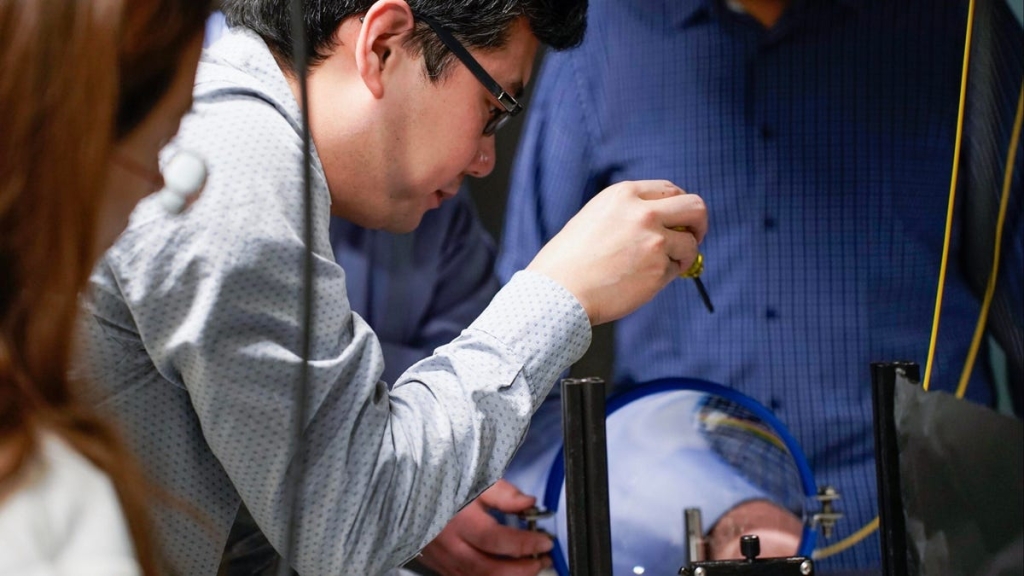
Professor Xingjie Ni and his team at Penn State have developed an ingenious workaround. Their prototype employs what they call an “infinity mirror” setup—a system of tiny optical elements that loop light beams through carefully designed pathways. This creates a nonlinear relationship over time, effectively teaching light to perform the complex calculations that AI systems require.
“Think of it as teaching light to dance in patterns that encode information,” explains Ni. “By letting light reverberate through our system, we generate the nonlinear mapping that AI needs while keeping the hardware simple, low power, and incredibly fast.”
How It Works: The Science Behind the Magic
The Penn State team’s approach is elegantly simple yet profoundly effective. Light is focused into a tiny processing unit where it bounces between lenses and other optical devices. With each reflection, the light carries more complex information, encoded directly into the beams themselves.
A microscopic camera then captures these light patterns, providing a simplified output that contains the results of sophisticated computations. The system essentially uses the natural properties of light—its speed and ability to carry multiple wavelengths simultaneously—to perform calculations that would require massive amounts of energy in traditional electronic systems.
“What makes this approach revolutionary is that it achieves nonlinear behavior without requiring the exotic materials or extreme power levels that have limited optical computing in the past,” Ni notes. “We’re essentially using geometry and clever design to coax light into doing what we need.”
The Road Ahead: From Laboratory to Data Center
While the prototype demonstrates remarkable potential, significant work remains before optical computing becomes a practical reality for AI applications. Ni estimates that developing an industry-ready prototype could take anywhere from two to five years, depending on investment levels and target applications.
Microsoft Research’s Francesca Parmigiani sees enormous potential in this hybrid approach. “Optical computing has the potential to efficiently perform vastly more operations in parallel and at significantly higher speeds than conventional digital hardware,” she explains. “This can translate into substantial gains in energy efficiency and reductions in latency for workloads.”
Rather than replacing traditional computers entirely, experts envision a future where optical systems work alongside conventional hardware. Electronics would handle general-purpose computing, memory, and control functions, while optical components accelerate the specific high-volume computations that dominate AI’s time and energy costs.
The Environmental and Economic Impact
The implications of successful optical computing extend far beyond the tech industry. For communities hosting data centers, reduced energy consumption could mean lower utility bills and less strain on local power grids. For the environment, more efficient AI systems could significantly reduce the carbon footprint of our increasingly digital world.
The economic benefits are equally compelling. Companies investing in AI could see dramatically reduced operational costs, making advanced AI technologies more accessible to smaller organizations and startups. This democratization of AI could accelerate innovation across sectors, from healthcare to climate science to education.
The Viral Potential: Why This Matters to Everyone
This breakthrough represents more than just a technical achievement—it’s a potential paradigm shift in how we think about computing. As AI becomes increasingly integrated into our daily lives, from personalized recommendations to autonomous vehicles to medical diagnostics, the energy efficiency of these systems becomes everyone’s concern.
The Penn State research demonstrates that sometimes the most innovative solutions come from revisiting fundamental principles with fresh perspectives. By reimagining how light can be used for computation, researchers have opened a pathway to AI that’s not only more powerful but also more sustainable.
In an era where technological progress often comes with environmental costs, optical computing offers a rare example of innovation that could simultaneously advance our capabilities while reducing our impact on the planet.
Tags: optical computing, AI energy efficiency, light-based computing, neural networks, data center energy, sustainable technology, Penn State research, future of computing, artificial intelligence, green technology
Viral Sentences:
- “Computers that use light instead of circuits may sound like science fiction, but they’re becoming science fact.”
- “AI’s energy crisis could be solved by teaching light to do complex math.”
- “The future of computing isn’t just faster—it’s brighter.”
- “What if the solution to AI’s energy problem was hiding in plain sight all along?”
- “Optical computing: where physics meets the future of artificial intelligence.”
- “Imagine AI that’s not just smarter, but also greener and more sustainable.”
- “The infinity mirror that could revolutionize how computers think.”
- “Light-based computing could cut AI’s energy use in half while doubling its speed.”
- “From Star Trek to your smartphone: the journey of optical computing.”
- “The technology that could save both the planet and the future of AI.”
,


Leave a Reply
Want to join the discussion?Feel free to contribute!