
The Market Is Terrified, Institutions Aren’t. Analyzing the ‘Extreme Fear’ Floor
Retail Panic, Institutional Signals: The $800 Billion Crypto Wipeout and What Comes Next
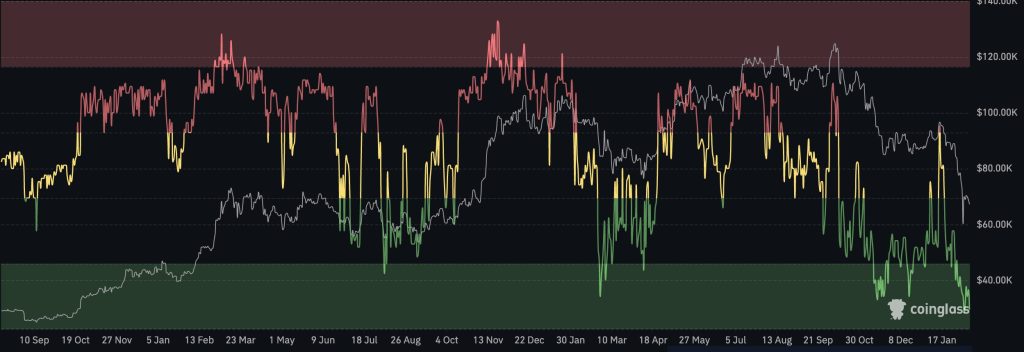
The cryptocurrency market is bleeding out before our eyes, with retail traders abandoning ship in a full-blown panic that’s painting the digital asset landscape blood red. The Fear and Greed Index has plummeted to an almost unthinkable 12—a reading so extreme it hasn’t been witnessed since the darkest days of crypto winter.
But here’s where it gets interesting, and potentially terrifying for those who understand market dynamics: while retail investors are frantically dumping their holdings, perpetual futures volume is surging to levels that suggest something far more sophisticated is happening beneath the surface chaos.
The Numbers Don’t Lie: A Market in Freefall
In just 30 days, the cryptocurrency market has vaporized nearly $800 billion in value. That’s not a correction—that’s a market massacre. Bitcoin has been knocked down to approximately $67,610, while Ethereum struggles to maintain relevance above $1,950. These aren’t just numbers on a screen; they represent life savings, retirement funds, and the shattered dreams of countless investors who believed they were getting in on the ground floor of the future of finance.
Yet, the perpetual futures market tells a completely different story. While spot markets show pure terror, futures volume is spiking—and that divergence doesn’t happen by accident. Something is brewing beneath the surface, and it’s not the kind of thing retail traders typically catch until it’s too late.
The Smart Money Question: Who’s Actually Buying?
Let’s cut through the noise for a moment. When markets are this terrified, who has the stomach—and the capital—to actually buy? The answer might surprise you.
Bitcoin’s current price of $67,610 sits well below JPMorgan’s estimated production cost of $77,000 per coin. This isn’t just a technical breakdown; it’s an economic impossibility that can’t last forever. Miners are operating at a loss, and in the brutal world of Bitcoin mining, losses don’t persist for long. Either the price rebounds, or the hash rate collapses—and historically, when price drops below production cost, the market finds a way to correct.
But here’s the kicker: this isn’t showing up as retail FOMO. When retail traders pile in, funding rates for perpetual futures go positive and stay there. Instead, Bitcoin funding rates are nearly flat, while Ethereum’s are actually negative. That’s not greed—that’s sophisticated positioning.
Two Possibilities: Hedging or Accumulation?
The divergence between spot panic and futures activity suggests only two real scenarios playing out:
First scenario: Institutional players are hedging their exposure. They’re using the futures market to protect against further downside while potentially accumulating spot positions on the cheap. This is classic “buying the dip” behavior, but executed with the kind of capital and sophistication that moves markets.
Second scenario: We’re witnessing strategic positioning for a major move. When smart money senses a bottom forming—or anticipates a catalyst that could reverse the trend—they position quietly in derivatives before the spot market catches on.
Neither scenario suggests the kind of capitulation that typically marks a true market bottom. This feels more like a shakeout—a painful but necessary process of separating the true believers from the weak hands.
The Technical Picture: Support Levels Under Siege
The charts look absolutely brutal right now. Support levels are crumbling like sandcastles against an incoming tide. The psychological $60,000 level for Bitcoin is under intense pressure, and if that breaks, the $50,000 floor becomes the next critical support.
But here’s where it gets really interesting: JPMorgan’s analysts maintain a bullish outlook for 2026 despite the current carnage. They see the current weakness as a buying opportunity rather than a death knell. Their thesis? The fundamentals that drove crypto’s explosive growth haven’t disappeared—they’ve just been temporarily overshadowed by macroeconomic headwinds and regulatory uncertainty.
The Miner’s Dilemma: Production Costs vs. Market Reality
Bitcoin mining economics provide a fascinating lens through which to view the current situation. With global average electricity costs around $0.17 per kWh, many miners are operating at a significant loss at current prices. This creates a natural feedback loop: as unprofitable miners shut down, the network’s hash rate drops, making the remaining miners more profitable and potentially triggering a supply squeeze.
Historically, when Bitcoin’s price falls below its production cost, the market doesn’t stay there for long. Either miners capitulate en masse (creating a true bottom), or the price rebounds to restore profitability. The fact that we’re seeing neither extreme yet suggests we might be in a transitional phase.
The Bear Case: Could We See $40,000?
Before we get too bullish, let’s acknowledge the bear case. Chief equity strategist John Blank has warned that Bitcoin could slide to $40,000 within 6 to 8 months. That would represent a nearly 50% decline from current levels and would likely trigger the kind of capitulation that truly marks a bottom.
A drop to $40,000 would wipe out the majority of late-cycle buyers and force even the most die-hard HODLers to reconsider their positions. It would be ugly, painful, and potentially necessary for the market to reset and build a foundation for the next bull run.
The Institutional Edge: Why Smart Money Isn’t Panicking
What separates institutional players from retail traders in moments like these? It’s not just about having more money—it’s about having a longer time horizon and a deeper understanding of market cycles.
Institutional investors think in quarters and years, not days and weeks. They understand that markets move in cycles, and that the best opportunities often emerge when fear is at its peak. They also have access to tools and strategies—like basis trading, options spreads, and delta-neutral positions—that allow them to profit from volatility regardless of direction.
Most importantly, they understand that markets are forward-looking. By the time the news is universally terrible and everyone is panicking, the worst is often already priced in. The real question isn’t whether we’ve seen the bottom—it’s whether we’re close enough that the risk-reward ratio favors establishing positions now.
The Bottom Line: Extreme Fear, Extreme Opportunity?
The current market environment presents a paradox: extreme fear on the surface, but potentially significant opportunity beneath. The Fear and Greed Index at 12 suggests we’re either at or near a major bottom—levels this extreme have historically preceded significant rallies.
However, the path from here to recovery is unlikely to be smooth. We could see further downside, potentially testing the $50,000 or even $40,000 levels. But for investors with a long-term perspective and the stomach for volatility, the current environment might represent one of the best buying opportunities in years.
The key is distinguishing between capitulation (which we haven’t truly seen yet) and a healthy shakeout of weak hands. The former creates lasting bottoms; the latter often precedes powerful recoveries.
Tags & Viral Phrases
- Bitcoin panic selling intensifies as crypto market loses $800 billion
- Fear and Greed Index hits extreme 12—is this the ultimate buying opportunity?
- Institutional whales quietly accumulating while retail investors flee
- Bitcoin trading below production cost—mathematical impossibility or market inefficiency?
- $50,000 support level under siege: Will Bitcoin hold or collapse to $40,000?
- Perpetual futures volume spikes while spot markets panic—smart money positioning?
- JPMorgan maintains 2026 bullish outlook despite crypto bloodbath
- Crypto miners operating at a loss—supply squeeze incoming?
- Extreme fear in crypto markets historically precedes massive rallies
- Retail capitulation vs. institutional accumulation: Who’s right?
- Bitcoin production cost at $77,000 while price sits at $67,610
- The $800 billion question: Is this the bottom or just the beginning?
- Crypto winter deepens—but smart money sees spring on the horizon
- Why perpetual futures volume matters more than spot price action
- The great crypto wealth transfer: From retail panic to institutional accumulation
- Bitcoin’s hash rate dilemma: Can miners survive at current prices?
- Fear index at 12: When everyone’s terrified, should you be greedy?
- The $40,000 scenario: How low could Bitcoin go before recovering?
- Crypto market bloodbath: Opportunity or trap for unsuspecting investors?
- Institutional hedging strategies revealed in crypto futures markets
- The production cost paradox: Why Bitcoin below $77,000 can’t last
- Extreme fear, maximum opportunity: Crypto’s contrarian playbook
- Who’s buying Bitcoin at $67,000 while everyone else is selling?
- The smart money playbook: Accumulating during maximum fear
- Crypto capitulation watch: Are we there yet or is more pain coming?
- Bitcoin’s $60,000 line in the sand: Support or illusion?
- The futures divergence: What rising perpetual volume really means
- Mining economics 101: Why Bitcoin’s price can’t stay below production cost
- The $800 billion reset: Is crypto cleansing itself for the next bull run?
- Fear index extreme: The contrarian’s guide to crypto investing
,


Leave a Reply
Want to join the discussion?Feel free to contribute!