
Saturn’s Rings Came From a Two-Moon Collision About 100 Million Years Ago, Study Says
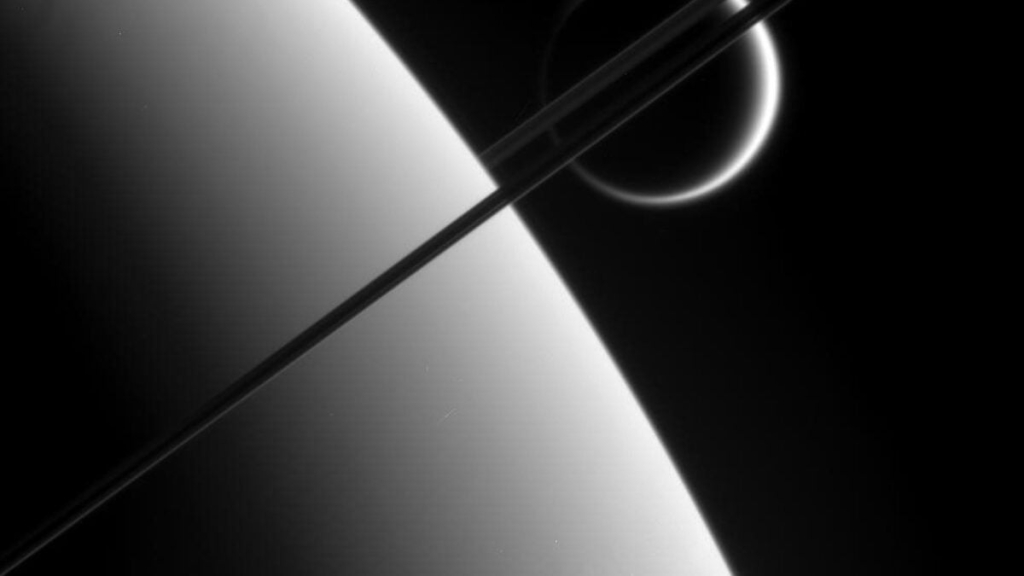
Saturn’s Rings and Titan’s Origin: A Cosmic Collision Theory Reshapes Our Understanding of the Gas Giant
Saturn has long captivated human imagination with its breathtaking rings and an impressive family of 274 moons. But groundbreaking new research is reigniting a bold theory about how this iconic planet came to be the way we see it today—especially its largest moon, Titan.
A study recently accepted for publication in The Planetary Science Journal delves into one of astronomy’s most intriguing puzzles: Why are Saturn’s rings surprisingly young, and what explains the unusual orbit of Titan? Led by researchers at the SETI Institute, the study proposes a dramatic possibility—that Titan itself may have formed from the violent merger of two ancient moons, and that the debris from this colossal collision eventually coalesced into Saturn’s famous rings.
The paper, currently available as a preprint on arXiv, builds on observations from NASA’s Cassini mission, which spent 13 years orbiting Saturn and transforming our understanding of the gas giant and its moons. Yet, Cassini also uncovered mysteries that defied conventional theories—such as the oddly young age of Saturn’s rings and the peculiar, lopsided orbits of several moons.
Cassini’s Legacy and Lingering Mysteries
Humanity’s first close-up glimpse of Saturn came in 1979 with NASA’s Pioneer 11, followed by flybys from Voyager 1 and 2. But it was Cassini that truly revolutionized our view, capturing stunning images and collecting invaluable data. However, some of Cassini’s findings challenged long-standing beliefs.
For example, several of Saturn’s moons displayed orbits that didn’t match existing models. Saturn’s rings also appeared much younger than previously thought. Additionally, the planet’s internal mass distribution was more centrally concentrated than expected, hinting at gaps in our understanding of Saturn’s orbital dynamics.
A Daring “What If”
In 2022, a team of astronomers proposed that these anomalies could be explained if Saturn had lost a moon around 100 million years ago—roughly the same time its rings are believed to have formed. The new study tests this hypothesis using sophisticated computer simulations to determine whether an extra moon could have spiraled close enough to Saturn to create the rings we see today.
The researchers had to ensure that such a collision would be consistent with the current arrangement and characteristics of Saturn’s moons. Intriguingly, their simulations revealed a consistent anomaly that pointed to a surprising clue.
“Hyperion, the smallest among Saturn’s major moons, provided us the most important clue about the history of the system,” said Matija Ćuk, the study’s lead author and a researcher at the SETI Institute.
Specifically, when the team added an unstable extra moon to their models, it repeatedly drove Hyperion—a real, known moon—out of existence. This clue suggested that something was amiss with the single-moon scenario. The researchers also noted that Hyperion’s orbit was locked with Titan’s, but this orbital relationship appeared to be only a few hundred years old, hinting at a more recent and dramatic past.
Not One, But Two
The team eventually converged on a compelling scenario: What if there were two earlier moons, not just one? If a “Proto-Titan” merged with a smaller “Proto-Hyperion,” it could explain why Titan has so few impact craters—its surface was essentially reset by the merger. Additionally, if a smaller object had influenced Titan’s orbit before the merger, it would account for Titan’s eccentric path around Saturn.
The debris from this titanic collision could have then come together to form Hyperion—a moon with a lumpy, irregular shape that seems to bear the scars of its tumultuous origin.
As for Saturn’s rings, the researchers were surprised to find that Titan’s eccentric orbit often destabilizes the planet’s inner moons. This instability could send smaller moons into extreme trajectories, resulting in massive collisions that produce the icy rings encircling Saturn.
The Next Chapter: Dragonfly’s Mission
While the new research is based on simulations, the team is eager for fresh data from NASA’s upcoming Dragonfly mission, which is set to reach Titan in 2034. Dragonfly’s close-up observations will provide crucial evidence to test these hypotheses and potentially confirm or refine our understanding of Saturn’s dynamic history.
This new perspective on Saturn’s past not only reshapes our view of the gas giant but also highlights the ever-evolving nature of planetary science. As we continue to explore our cosmic neighborhood, each discovery brings us closer to unraveling the mysteries of how our solar system—and perhaps others—came to be.
Tags: Saturn, Titan, Hyperion, planetary science, SETI Institute, Cassini mission, Dragonfly mission, moon collision, Saturn’s rings, solar system, astronomy, space exploration, cosmic collisions, planetary formation
Viral phrases: “Saturn’s rings younger than we thought,” “Titan’s wild origin story,” “Two moons merged to form Titan,” “Cassini’s lingering mysteries,” “Hyperion’s strange orbit,” “Dragonfly mission to Titan,” “Cosmic collision theory,” “Saturn’s dynamic past,” “Planetary science breakthrough,” “Space mysteries solved?”
,


Leave a Reply
Want to join the discussion?Feel free to contribute!