
Crypto Use in Trafficking Surges, but May Help in Crackdowns
Cryptocurrency’s Double-Edged Sword: How Blockchain Transparency Is Both Enabling and Exposing Human Trafficking Networks
The cryptocurrency landscape faces a disturbing paradox in 2025: while blockchain technology offers unprecedented transparency that could help law enforcement dismantle criminal operations, it has simultaneously become a preferred payment method for human trafficking networks, with transaction flows increasing by a staggering 85% over the past year.
According to a comprehensive report released Thursday by blockchain analytics firm Chainalysis, the total cryptocurrency transaction volume flowing to suspected human trafficking networks—predominantly concentrated in Southeast Asia—has reached “hundreds of millions of dollars across identified services.” This alarming surge represents not just an increase in volume, but a sophisticated evolution in how criminal enterprises leverage digital assets to facilitate their operations.
The Criminal Ecosystem: Beyond Simple Transactions
Chainalysis’s investigation reveals that these trafficking services are “closely aligned” with other illicit operations, creating a complex web of criminal activity. The report identifies connections between human trafficking networks and scam compounds, online casinos, and Chinese-language money-laundering operations that have seen significant growth in popularity over recent months.
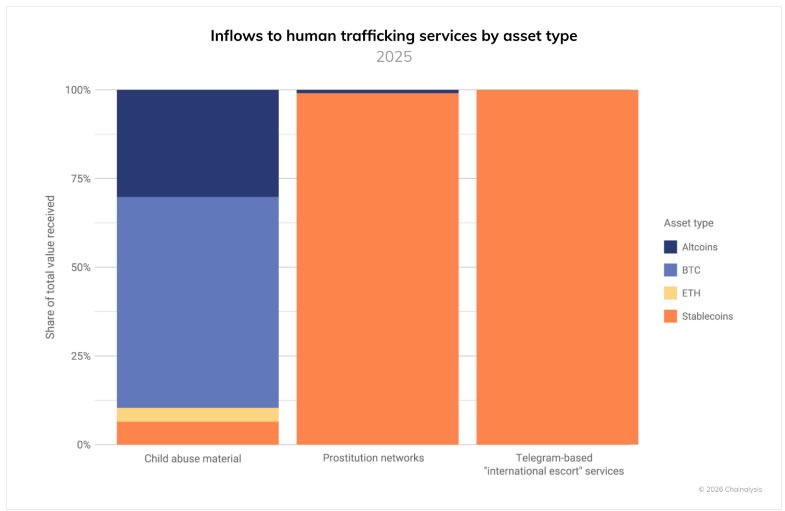
The crypto-facilitated human trafficking tracked by Chainalysis encompasses a range of disturbing activities. Telegram-based services facilitating international escort arrangements represent one facet, while labor placement agents who engage in kidnapping and forced labor at scam compounds form another disturbing component. Prostitution networks and vendors of child sexual abuse material round out the spectrum of criminal activity being funded through cryptocurrency transactions.
What makes this particularly concerning is the sophistication and diversity of crypto payment methods employed. International escort services and prostitution networks operate almost exclusively using stablecoins, which offer the advantages of cryptocurrency—speed, borderless transactions, and reduced traceability—while maintaining relative price stability compared to more volatile cryptocurrencies.

Source: Chainalysis
Blockchain’s Transparency: A Double-Edged Sword
While the statistics paint a grim picture, Chainalysis emphasizes that blockchain’s inherent transparency could become law enforcement’s most powerful tool in combating these networks. Unlike traditional cash transactions that leave virtually no trace, blockchain technology creates an immutable, public ledger of all transactions.
“This transparency provides unprecedented visibility into these operations, creating unique opportunities for detection and disruption that would be impossible with traditional payment methods,” Chainalysis stated in their report. The firm argues that this fundamental characteristic of blockchain technology—often cited by cryptocurrency advocates as a feature—could become its most significant contribution to fighting human trafficking.
The blockchain’s transparency allows investigators to identify transaction patterns, monitor compliance across exchanges, and target strategic chokepoints where criminal operations interface with legitimate financial infrastructure. Every transaction, regardless of how many times it’s mixed or tumbled, leaves a digital footprint that skilled investigators can follow.
Compliance and Detection Strategies
Chainalysis outlines several key indicators that compliance teams and law enforcement should monitor to identify potential trafficking operations. Large, regular payments to labor placement services raise immediate red flags, as do wallet clusters showing activity across multiple categories of illicit services. Regular stablecoin conversion patterns, particularly those involving round-number transactions or those occurring at specific times, may indicate organized criminal activity.
The report emphasizes that successful disruption requires a multi-faceted approach. Law enforcement must combine blockchain analysis with traditional investigative techniques, while cryptocurrency exchanges need robust compliance programs that can identify suspicious patterns without impeding legitimate transactions.
Recent Success Stories: Blockchain Analysis in Action
Despite the concerning growth in crypto-facilitated trafficking, Chainalysis points to several notable victories in 2025 where blockchain analysis played a crucial role. German authorities, for instance, successfully dismantled a major child sexual exploitation platform, with blockchain analysis providing critical evidence that helped identify the operators and their financial flows.
These successes demonstrate that while criminals may be adopting cryptocurrency, the technology itself contains the seeds of its own regulation. The same transparency that allows traffickers to move money across borders also creates a permanent record that investigators can use to build cases and identify networks.
The Broader Context: Cryptocurrency and Illicit Finance
The human trafficking findings come amid broader trends in cryptocurrency’s use for illicit purposes. Chainalysis’s separate research indicates that crypto launderers are increasingly turning away from centralized exchanges, suggesting a cat-and-mouse game between criminals seeking anonymity and investigators developing more sophisticated tracking methods.
The report also notes the growth of illicit online marketplaces like Huione, which has seen accelerated growth following the launch of its stablecoin. These platforms create ecosystems where various forms of criminal activity can flourish, with cryptocurrency serving as the connective tissue between different operations.
Looking Forward: Technology as Both Problem and Solution
The cryptocurrency industry faces a critical juncture. While blockchain technology offers genuine benefits in terms of financial inclusion and efficiency, its adoption by criminal networks presents significant challenges. The industry must balance the legitimate uses of cryptocurrency with the need to prevent its exploitation by traffickers and other criminals.
Chainalysis’s report serves as both a warning and a roadmap. The 85% increase in crypto flows to trafficking networks demands immediate attention and action from the cryptocurrency industry, law enforcement, and policymakers. However, the same technology that enables these transactions also provides the tools necessary to combat them.
As blockchain technology continues to evolve, the battle between those who would use it for criminal purposes and those working to maintain its integrity will likely intensify. The outcome of this struggle will determine whether cryptocurrency fulfills its promise as a revolutionary financial technology or becomes synonymous with the worst forms of criminal activity.
Tags: Cryptocurrency, Human Trafficking, Blockchain Analytics, Chainalysis, Stablecoins, Southeast Asia, Criminal Networks, Financial Crime, Digital Assets, Law Enforcement, Illicit Finance, Crypto Compliance, Telegram, Online Casinos, Money Laundering, Child Exploitation, Scam Compounds, Labor Trafficking, Financial Transparency, Blockchain Technology
Viral Sentences:
- Cryptocurrency flows to human trafficking networks surged 85% in 2025
- Blockchain’s transparency could be the key to dismantling trafficking operations
- Hundreds of millions in crypto transactions linked to suspected trafficking services
- Southeast Asian criminal networks increasingly rely on digital assets
- Stablecoins become preferred currency for international escort services
- Blockchain creates permanent digital footprints that investigators can follow
- Crypto’s double-edged sword: enabling crime while exposing criminals
- Law enforcement scores major wins using blockchain analysis against traffickers
- The cryptocurrency industry faces a critical juncture in fighting criminal exploitation
- Every crypto transaction leaves an immutable record that can’t be erased
- Criminal networks create sophisticated ecosystems using multiple illicit services
- German authorities dismantle child exploitation platform with blockchain evidence
- Crypto launderers increasingly avoid centralized exchanges
- Online marketplaces like Huione accelerate growth with stablecoin integration
- The battle between crypto innovation and criminal exploitation intensifies
- Blockchain transparency provides unprecedented visibility into criminal operations
- Cryptocurrency compliance teams must balance security with legitimate use
- The future of crypto depends on its ability to prevent criminal exploitation
- Digital assets create both opportunities and challenges for law enforcement
- The cryptocurrency revolution faces its greatest test against human trafficking
,

Leave a Reply
Want to join the discussion?Feel free to contribute!