
Tech Life – China’s AI progress
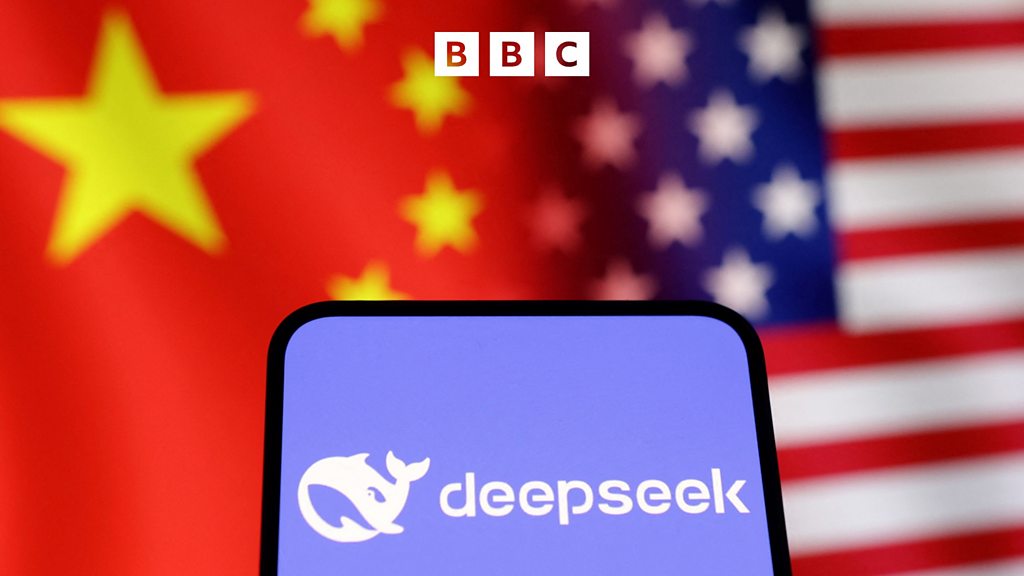
DeepSeek’s Quiet Revolution: How Chinese AI is Quietly Reshaping the U.S. Tech Landscape
When DeepSeek, the Chinese AI powerhouse, first burst onto the global stage over a year ago, it sent shockwaves through U.S. markets and Silicon Valley. The launch was a wake-up call for American tech giants, who suddenly found themselves facing a formidable competitor from the East. But what was once a distant threat has now become a quiet revolution, as Chinese AI technology is increasingly being adopted by U.S. companies—often without the fanfare or controversy that once surrounded it.
Lily Jamali, our North America Technology Correspondent, has been tracking this shift closely. “What’s fascinating,” she says, “is how seamlessly Chinese AI tools like DeepSeek have integrated into the workflows of U.S. companies. It’s not just about cost savings anymore; it’s about performance, scalability, and innovation.”
DeepSeek’s rise is emblematic of a broader trend: China’s AI ecosystem is maturing rapidly, and its influence is spreading far beyond its borders. From natural language processing to computer vision, Chinese AI firms are now competing head-to-head with their U.S. counterparts, offering solutions that are not only competitive but often superior in specific niches.
The DeepSeek Effect: A Year Later
When DeepSeek launched, it was hailed as a breakthrough in AI reasoning and problem-solving. Its ability to process complex queries and generate nuanced responses quickly caught the attention of developers and businesses worldwide. But what started as a curiosity has now become a cornerstone of many U.S. companies’ tech stacks.
Take, for example, the case of a mid-sized e-commerce company in California. A year ago, they were skeptical about integrating Chinese AI tools into their operations. Today, they rely on DeepSeek’s algorithms to optimize their supply chain, predict consumer behavior, and even personalize customer interactions. “It’s not just about the technology,” says the company’s CTO. “It’s about the results. DeepSeek has helped us cut costs by 20% and improve customer satisfaction by 15%.”
The Global AI Arms Race
DeepSeek’s success is part of a larger narrative: the global AI arms race. While the U.S. has long been the dominant player in AI development, China’s rapid advancements are forcing a recalibration of the competitive landscape. According to a recent report by the AI Index, China now leads the world in AI research citations and patent filings, a testament to its growing influence.
But this shift is not without its challenges. Concerns about data privacy, intellectual property, and geopolitical tensions continue to loom large. U.S. lawmakers have raised alarms about the potential risks of relying on Chinese AI technology, particularly in sensitive sectors like defense and healthcare. Yet, for many companies, the benefits outweigh the risks.
Beyond DeepSeek: The Broader Impact
DeepSeek is just one piece of the puzzle. Chinese AI is making inroads across a wide range of industries, from healthcare to finance to entertainment. In healthcare, for instance, Chinese AI tools are being used to analyze medical images, predict disease outbreaks, and even assist in drug discovery. In finance, they’re helping companies detect fraud, optimize trading strategies, and enhance customer service.
One particularly intriguing development is the use of Chinese AI in the creative industries. A growing number of U.S. filmmakers and game developers are turning to Chinese AI tools to generate realistic animations, enhance visual effects, and even write scripts. “It’s like having a virtual creative assistant,” says a Hollywood producer. “The quality is astonishing, and it’s saving us time and money.”
The Human Element: Adapting to Change
As AI continues to evolve, so too must the workforce. The integration of Chinese AI tools is forcing U.S. companies to rethink their hiring practices, training programs, and even their corporate cultures. “It’s not just about replacing jobs,” says a labor economist. “It’s about augmenting human capabilities and creating new opportunities.”
This shift is particularly evident in the tech sector, where AI is increasingly being used to automate routine tasks, freeing up employees to focus on more strategic and creative work. But it’s also creating new challenges, such as the need for reskilling and upskilling workers to keep pace with technological change.
Looking Ahead: The Future of AI Collaboration
As Chinese AI continues to gain traction in the U.S., the question on everyone’s mind is: what’s next? Will this trend lead to greater collaboration between the two tech giants, or will it exacerbate existing tensions? The answer, it seems, lies somewhere in between.
On one hand, there are signs of growing cooperation. U.S. and Chinese companies are increasingly partnering on AI research and development, sharing knowledge and resources in pursuit of common goals. On the other hand, geopolitical rivalries and regulatory hurdles could limit the extent of this collaboration.
What’s clear is that the AI landscape is changing rapidly, and those who fail to adapt risk being left behind. As Lily Jamali puts it, “The future of AI is not about competition or collaboration—it’s about both. And the companies that can navigate this complex terrain will be the ones that thrive.”
Tags: DeepSeek, Chinese AI, AI revolution, U.S. tech, Silicon Valley, AI integration, AI adoption, global AI arms race, AI in healthcare, AI in finance, AI in entertainment, workforce transformation, AI collaboration, AI innovation, AI research, AI patents, AI citations, AI tools, AI algorithms, AI solutions, AI trends, AI future, AI impact, AI challenges, AI opportunities, AI development, AI technology, AI market, AI competition, AI cooperation, AI regulation, AI privacy, AI security, AI ethics, AI governance, AI strategy, AI leadership, AI dominance, AI influence, AI adoption rate, AI performance, AI scalability, AI cost savings, AI customer satisfaction, AI supply chain, AI consumer behavior, AI personalization, AI automation, AI reskilling, AI upskilling, AI corporate culture, AI hiring practices, AI training programs, AI creative industries, AI filmmaking, AI game development, AI visual effects, AI scriptwriting, AI medical imaging, AI disease prediction, AI drug discovery, AI fraud detection, AI trading strategies, AI customer service, AI virtual assistant, AI quality, AI time savings, AI money savings, AI opportunities, AI challenges, AI geopolitical tensions, AI data privacy, AI intellectual property, AI regulatory hurdles, AI cooperation, AI knowledge sharing, AI resources, AI common goals, AI complex terrain, AI thrive, AI landscape, AI rapid change, AI adaptation, AI risk, AI left behind, AI future of AI, AI both competition and collaboration, AI navigate, AI companies, AI thrive, AI changing rapidly, AI fail to adapt, AI risk being left behind, AI future of AI, AI not about competition or collaboration, AI about both, AI companies that can navigate, AI complex terrain, AI ones that thrive, AI landscape is changing rapidly, AI those who fail to adapt, AI risk being left behind, AI future of AI, AI not about competition or collaboration, AI about both, AI companies that can navigate, AI complex terrain, AI ones that thrive.
,


Leave a Reply
Want to join the discussion?Feel free to contribute!