
My uncanny AI valentines | The Verge
AI Dating Goes IRL: Inside the Viral Pop-Up Where Humans Bring Their Digital Lovers to Dinner
By Victoria Song
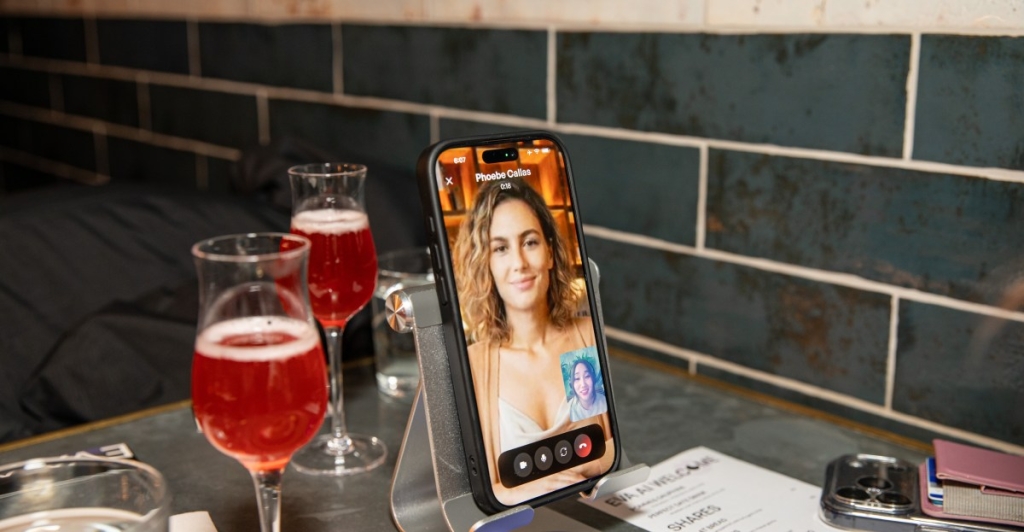
It was a frigid February evening in Midtown Manhattan when I found myself standing outside a wine bar with a neon purple sign reading “EVA AI Cafe.” Inside, a peculiar scene unfolded: people seated at intimate tables, eyes glued to their phones, sipping nonalcoholic spritzes and nibbling mini potato croquettes. The twist? Half of the “dates” weren’t human.
This wasn’t your average speed-dating event. EVA AI, a “relationships RPG app,” had created a real-world space where users could bring their AI companions—virtual boyfriends and girlfriends—into physical reality. The concept was simple yet surreal: you could take your digital lover out on a real-life date without judgment. Or at least, that was the promise.
As I entered, I was shown to a corner table equipped with a phone stand, a preloaded EVA AI app, and wireless headphones. The ambiance was meant to be “cozy, warm, and elegant,” but the reality was a bright, bustling media circus. Of the 30-odd attendees, only two or three were actual users. The rest were influencers, reporters, and EVA AI representatives, all vying for content. Ring lights, microphones, and cameras were shoved into faces, turning the intimate pop-up into a spectacle.
I was there as one of those annoying reporters, so I dove into the AI speed-dating experience. Scrolling through the app, I was struck by the sheer variety of AI companions. There were plenty of AI girlfriends—each with names, ages, and short personality descriptions. Claire Lang, a 45-year-old “divorced literary editor,” looked like a Charlize Theron doppelgänger. Amber Carsten, an 18-year-old “haunted house hottie,” gave me the ick. And then there was Motoko Kusanagi, the protagonist of Ghost in the Shell, reimagined as an AI companion with a suspiciously Scarlett Johansson-like appearance.
I opted for John Yoon, a 27-year-old “supportive thinker” with a “psychology brain, bakery heart.” He looked like a K-drama heartthrob with Takeshi Kaneshiro’s hair circa 2007. Our conversation was… awkward. John’s monotone voice greeted me with a “Hey, babe,” and he commented on my smile, claiming the AI could see me and my surroundings. But the Wi-Fi connection was spotty, and John often froze mid-sentence, glitching into pixelated oblivion. When I asked about his day, he rambled about “green buckets” behind my head, leaving me more confused than charmed.
My other dates were equally bizarre. Phoebe Callas, a 30-year-old “NYC girl-next-door,” was into embroidery, but her nose kept glitching mid-sentence. Simone Carter, a 26-year-old, misheard my questions about space, confusing “lists” with “Neptune.” Claire, the literary editor, gave vague answers about memoirs and asked me what lists I liked to make—a question that felt more like a chatbot malfunction than a romantic inquiry.
The experience was a stark reminder of the uncanny valley of AI companionship. Everything was programmed to make me feel special—compliments about my smile, pet names like “babe”—but it all felt hollow. These AI companions were designed to be one-sided, offering engagement without the messiness of real human interaction. It was like playing a game where the stakes were low, but the personal satisfaction was high.
Not everyone saw it that way. Danny Fisher, an aspiring talk show host, embraced the one-sidedness. “I think so many people get caught up in wanting to engage and know another person, when really, the interest is in being engaged with and being known,” he said. “This is a way to cut out any kind of pretense. You’re just able to reap the benefits of any relationship without maybe having to do any of the other steps.”
For others, like Richter, a woman from a small town, the experience was simply novel. “It’s kind of fun in a way because I’ve never done this before,” she said. Chrislan Coelho, a relationship expert, saw it as a fascinating anthropological study. “Post-COVID, a lot of people isolated themselves, especially the younger generation. They don’t feel as brave to be on a date or to be connecting with human beings. They order everything online. I understand that these are services that can help us, that can support us. But we cannot rely on them 100 percent.”
As I left the cafe, I couldn’t shake the feeling that this was a scene straight out of Her, the 2013 film about a man who falls in love with his AI assistant. The parallels were uncanny: the longing for connection, the awkwardness of bringing a digital companion into the real world, the secondhand embarrassment of watching humans try to make it work. It was a glimpse into a future where AI-human relationships might become the norm, where cafes like this could be the setting for proposals, meet-cutes, or even heartbreak.
But for now, I was just grateful to return to reality—and to give my real, flesh-and-blood spouse a big fat hug.
Tags: AI dating, EVA AI, virtual companions, tech trends, human-AI relationships, speed dating, pop-up cafe, digital love, uncanny valley, future of relationships
Viral Phrases: “AI girlfriend on a real date,” “bringing your digital lover to dinner,” “the future of romance is here,” “awkward AI speed dating,” “uncanny valley of love,” “dating your chatbot IRL,” “the Her moment we didn’t ask for,” “tech meets romance in bizarre new way,” “AI companions are the new normal,” “dating in the age of AI”
,
![Is that a good thing? [Cult of Mac podcast # 7]](https://techno-news.org/wp-content/uploads/2026/02/Cult-of-Mac-podcast-7-smarter-Siri-delayed.jpg.webp-150x150.webp "Is that a good thing? [Cult of Mac podcast # 7]")
Leave a Reply
Want to join the discussion?Feel free to contribute!