
Sideways on the ice, in a supercar: Stability control is getting very good
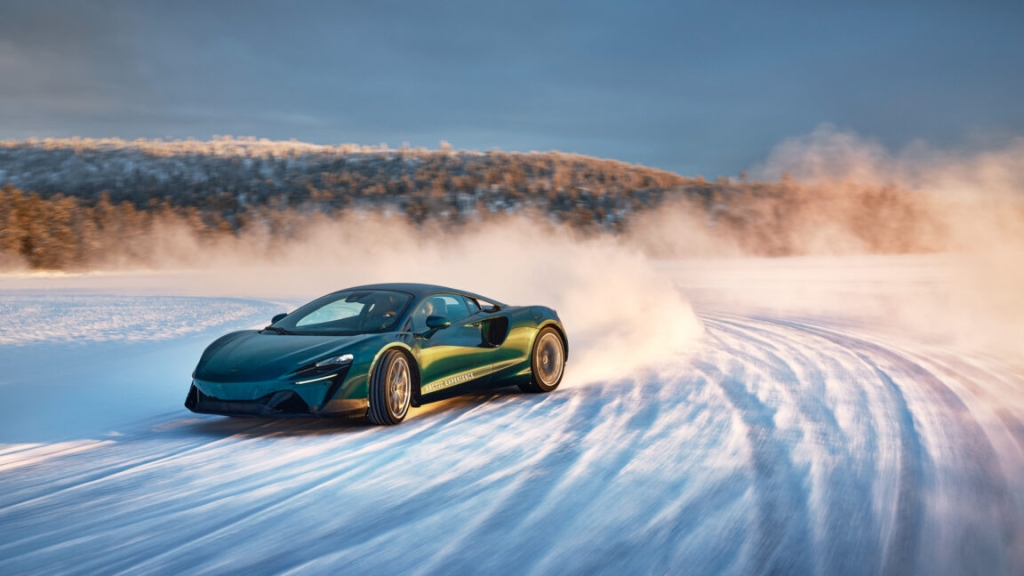
McLaren’s Arctic Adventure: Testing Stability Control on Frozen Lakes
SAARISELKÄ, FINLAND—The moment the rear tires break loose beneath you, a visceral thrill courses through your body. It’s that same rush you get on a roller coaster, except this time you’re holding the reins. When you know it’s coming, the sideways drift transforms from terrifying to exhilarating—a dance between man and machine on a slippery stage.
But when that slide catches you off guard? That’s when the fun evaporates, replaced by a cold sweat and the sinking realization that physics has other plans for your day.
This is precisely why modern electronic stability control systems have become automotive lifelines. For over three decades, these silicon guardians have evolved from rudimentary traction aids into sophisticated choreographers of controlled chaos, preventing countless accidents since becoming mandatory in the early 2010s.
Here’s how the magic works: A network of sensors constantly monitors lateral acceleration, wheel speeds, steering input, and yaw rates. When the computer detects that your intended path doesn’t match reality—say, you’re turning left but the car wants to go straight—it springs into action. The system can individually brake any wheel while simultaneously cutting engine power, effectively telling Newton to take a coffee break while you regain control.
The most direct way to test these systems? Turn them off and drive like you’ve just stolen the car. But even at professional track events, manufacturers typically insist on keeping some electronic safety net active. Why? Because modern performance tires are so grippy that when cars do break loose at speed—especially on dry pavement—the resulting slides happen with alarming velocity. Hitting barriers at those speeds doesn’t end well for anyone involved.
This is where Finland’s frozen lakes become the ultimate proving grounds. Imagine thousands of acres of perfectly smooth, low-friction surface, completely devoid of obstacles, wildlife, or anything that might interrupt your automotive experimentation. It’s like having the world’s largest, most expensive skid pad delivered by Mother Nature herself.
The McLaren Artura—a mid-engine hybrid supercar that balances performance with surprising everyday usability—becomes the perfect laboratory specimen for this kind of testing. Smaller and more approachable than its more powerful siblings in McLaren’s lineup, the Artura offers the ideal platform for exploring the boundaries of electronic chassis control without requiring a racing background.
On these frozen expanses, engineers can push the Artura to its limits repeatedly, gathering data on how the stability control algorithms respond to various inputs and conditions. They can fine-tune the system’s intervention points, adjust the threshold for power reduction, and calibrate the brake application strategy. Each iteration brings the car closer to that sweet spot where safety and driver engagement coexist harmoniously.
The conditions here are brutally honest. There’s no hiding poor calibration or overly aggressive intervention when every input is magnified by the lack of traction. A slight steering correction that might go unnoticed on dry pavement becomes immediately apparent when your rear tires are skating across ice. This feedback loop allows engineers to dial in the perfect balance between electronic assistance and driver control.
What makes this testing particularly valuable is the repeatability factor. Unlike real-world conditions where ice patches appear randomly and unpredictably, these frozen lakes offer consistent, controlled environments. Engineers can reproduce the exact same scenario hundreds of times, making minute adjustments and immediately observing the results.
The data gathered here doesn’t just benefit Arctic drivers. The lessons learned on ice translate directly to improved stability control performance in rain, gravel, or any low-traction situation. That gentle intervention when you hit a patch of black ice on your morning commute? It might have been perfected on a Finnish lake months earlier.
As we look toward an automotive future increasingly dominated by automation and driver assistance systems, the fundamental principles being refined on these frozen test beds remain crucial. The ability to maintain control when conditions turn against you—whether through electronic intervention or driver skill—represents one of the most important safety advances in automotive history.
And for those fortunate enough to experience it firsthand, there’s something profoundly satisfying about mastering vehicle control on a surface that seems to defy physics itself. It’s a reminder that even in our age of advanced technology, there’s still room for the pure, visceral joy of driving—just with a sophisticated electronic safety net ready to catch you when things go sideways.
Tags: McLaren Artura, electronic stability control, frozen lake testing, Arctic driving, hybrid supercar, traction control systems, automotive engineering, winter testing, stability control algorithms, Finnish winter, vehicle dynamics, driver assistance systems
Viral Sentences:
- “The Artura is probably my favorite McLaren, as it’s smaller and more versatile than the more expensive, more powerful machines in the range.”
- “When you’re not expecting it, there’s anxiety instead of excitement and, should the slide end with a crunch, a lot more negative emotions, too.”
- “There are few environments that are more conducive to exploring the limits and capabilities of electronic chassis control.”
- “The most direct way to test these systems? Turn them off and drive like you’ve just stolen the car.”
- “It’s like having the world’s largest, most expensive skid pad delivered by Mother Nature herself.”
- “A giant sand dune would work. Or a frozen lake.”
- “The data gathered here doesn’t just benefit Arctic drivers. The lessons learned on ice translate directly to improved stability control performance in rain, gravel, or any low-traction situation.”
- “That gentle intervention when you hit a patch of black ice on your morning commute? It might have been perfected on a Finnish lake months earlier.”
- “There’s something profoundly satisfying about mastering vehicle control on a surface that seems to defy physics itself.”
- “It’s a reminder that even in our age of advanced technology, there’s still room for the pure, visceral joy of driving.”
,


Leave a Reply
Want to join the discussion?Feel free to contribute!