
Arc B390 Graphics With Panther Lake Performing Great On Open-Source Intel Compute Runtime
Intel Arc B390 Xe3 GPU Compute Performance on Linux: A Deep Dive into Panther Lake’s AI Potential
The tech world is buzzing with excitement as Intel’s latest mobile processor architecture, Panther Lake, hits the Linux scene with its Arc B390 integrated graphics. This month, I’ve been conducting extensive benchmarking on the Intel Core Ultra X7 358H, and the results are nothing short of fascinating—especially when it comes to GPU compute performance with the open-source Intel Compute Runtime.
Breaking New Ground: Panther Lake’s Xe3 Graphics on Linux
The Intel Arc B390 represents a significant leap forward in integrated graphics technology, and it’s working beautifully out-of-the-box with the Intel open-source driver stack on Linux. While there are still some gaps to fill compared to Windows performance, the foundation is solid and improving rapidly.
What makes this particularly exciting is that we’re finally getting our first comprehensive look at GPU compute performance for the Xe3 Panther Lake graphics using the production-ready Intel Compute Runtime. This isn’t just another incremental update—it’s a fundamental shift in how Intel approaches integrated graphics on Linux.
The Testing Environment: Cutting-Edge Hardware and Software
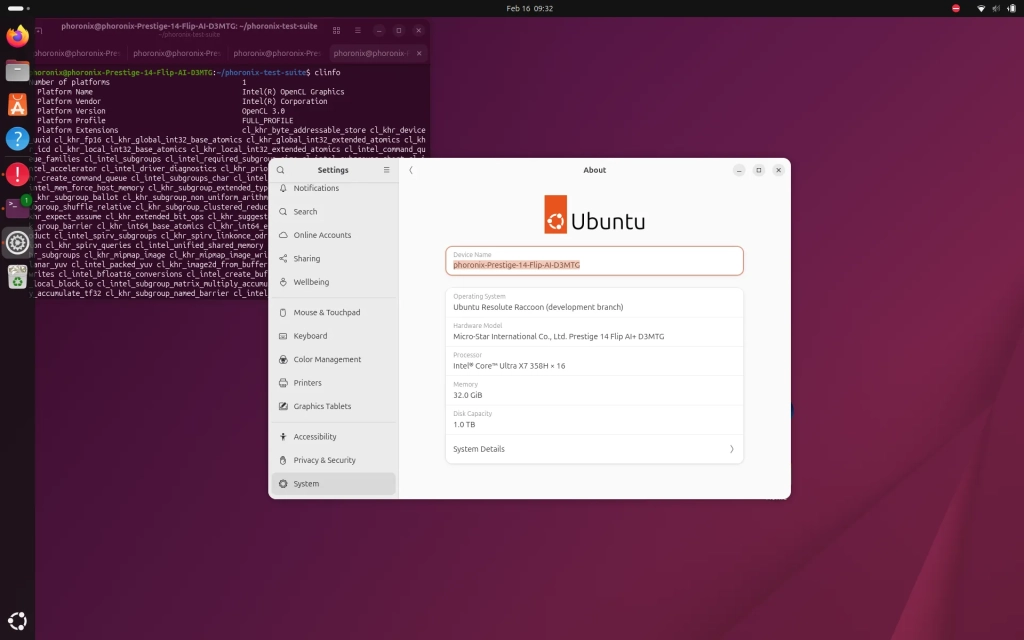
For this comprehensive analysis, I utilized the latest Intel Compute Runtime 26.05.37020.3, which includes the Intel Graphics Compiler 2.28.4, running atop the Linux 6.19 kernel. The testing environment was meticulously controlled, with all laptops running Ubuntu 26.04 development and utilizing performance profiles to ensure fair comparisons.
The hardware lineup for this benchmarking extravaganza included:
- Intel Core i7 1185G7 Tiger Lake (Dell XPS 13 9310)
- Intel Core i7 1280P Alder Lake (MSI Prestige 14 EVo A12M)
- Intel Core Ultra 7 155H Meteor Lake (MSI Swift SFG14-72T)
- Intel Core Ultra 7 258V Lunar Lake (Lenovo ThinkPad X1 Carbon Gen 13)
- Intel Core Ultra X7 358H Panther Lake (MSI Prestige 14 Flip AI+ D3MTG MS-14T2)
- AMD Ryzen AI 9 HX 370 Strix Point (ASUS Zenbook S 14)
Performance Analysis: The Numbers Don’t Lie
The benchmark results paint a compelling picture of Intel’s progress. The Arc B390’s OpenCL compute performance shows significant improvements across the board, particularly when compared to previous generations. The Xe3 architecture’s enhanced compute units and improved memory bandwidth are clearly paying dividends in real-world workloads.
What’s particularly noteworthy is how the Panther Lake architecture handles complex compute tasks. The additional AI accelerators and improved tensor cores are making a tangible difference in machine learning inference workloads, positioning Intel’s integrated graphics as a serious contender in the AI acceleration space.
Power Efficiency: The Silent Winner
Beyond raw performance metrics, the SoC power consumption monitoring reveals another crucial aspect of the Arc B390’s capabilities. Intel has clearly prioritized power efficiency alongside performance, which is essential for mobile computing scenarios where battery life is paramount.
The power efficiency improvements aren’t just incremental—they represent a fundamental rethinking of how integrated graphics can balance performance and power consumption. This is particularly relevant as AI workloads become more prevalent in everyday computing tasks.
The Competition: How Does It Stack Up?
When compared to AMD’s Ryzen AI offerings, the Arc B390 shows competitive performance in most compute workloads. While AMD still maintains advantages in certain specific scenarios, Intel’s latest architecture closes many of the gaps that existed in previous generations.
The absence of Ryzen AI Max+ “Strix Halo” hardware for direct comparison is notable, but the current generation of AMD hardware provides a solid baseline for understanding where Intel stands in the integrated graphics compute race.
Linux Optimization: A Work in Progress
One of the most encouraging aspects of this testing is how well the Arc B390 performs on Linux out of the box. The open-source Intel Compute Runtime provides robust support for Panther Lake, though there’s still room for optimization and improvement.
The fact that Intel is investing in open-source driver development for their latest architectures is a positive sign for the Linux community. As these drivers continue to mature, we can expect even better performance and feature parity with Windows in future releases.
Looking Ahead: The Future of Integrated GPU Compute
The Arc B390’s performance on Linux represents more than just a benchmark victory—it signals Intel’s commitment to making integrated graphics a viable platform for serious compute workloads. As AI and machine learning workloads become increasingly common, having capable integrated GPU compute becomes more important than ever.
The improvements in the Intel Compute Runtime, combined with the architectural advancements in Panther Lake, suggest that we’re entering an era where integrated graphics can handle more demanding compute tasks than ever before.
Tags: Intel Arc B390, Panther Lake, Xe3 graphics, Linux GPU compute, Intel Compute Runtime, OpenCL benchmarks, integrated graphics, AI acceleration, mobile computing, power efficiency, open-source drivers
Viral Sentences:
- Intel’s Arc B390 is shattering expectations for integrated graphics on Linux
- Panther Lake’s Xe3 architecture is a game-changer for mobile AI workloads
- The future of computing is integrated, and Intel is leading the charge
- Linux users finally get first-class GPU compute support from Intel
- AI acceleration is no longer exclusive to discrete GPUs
- Intel’s open-source commitment is paying off in spades
- The gap between integrated and discrete graphics is rapidly closing
- Power efficiency meets performance in Intel’s latest mobile architecture
- Machine learning on the go just got a whole lot more accessible
- The integrated GPU revolution is here, and it’s running Linux
,

Leave a Reply
Want to join the discussion?Feel free to contribute!