
NASA’s Curiosity Rover Finds Organic Molecules on Mars That Meteorites Can’t Explain
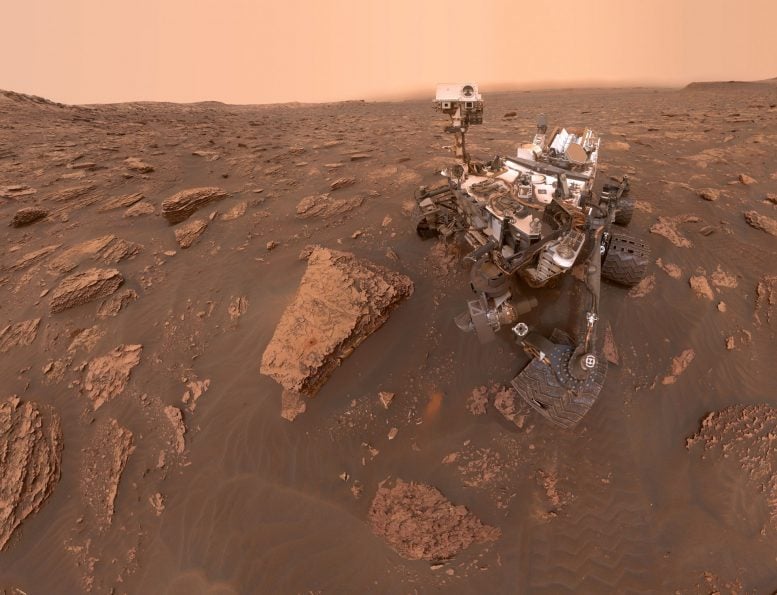
NASA’s Curiosity Rover Stumbles Upon Martian Organic Mystery That Meteorites Can’t Solve
In a revelation that has the scientific community buzzing, NASA’s Curiosity rover has uncovered organic molecules on Mars that defy conventional explanation. A recent study published in the Proceedings of the National Academy of Sciences suggests that the abundance of these carbon-based compounds found in Martian rock samples is too great to be explained by known non-biological processes alone.
The discovery was made in the Sheepbed mudstone, a sedimentary layer in Mars’ Gale Crater that Curiosity drilled into in 2013. The rover’s Sample Analysis at Mars (SAM) instrument heated the sample and analyzed the gases released, revealing a surprising richness in organic molecules such as thiophenes, benzene, toluene, and small carbon chains. These molecules, built around carbon atoms, are the building blocks of life on Earth—though they can also form through non-biological chemical reactions.
What makes this finding so tantalizing is the sheer quantity of organics detected. Scientists have long known that meteorites and interplanetary dust can deliver organic material to Mars. However, the amount Curiosity found far exceeds what these sources could plausibly contribute. Even accounting for the possibility that these molecules formed through radiation-driven reactions in the Martian soil or ancient hydrothermal processes, the numbers don’t quite add up.
“This is a puzzle,” said Dr. Jennifer Stern, a planetary scientist at NASA’s Goddard Space Flight Center and co-author of the study. “The levels of organic material we’re seeing are higher than what we’d expect from just meteoritic input or known surface processes. There’s something else going on here.”
The implications are profound. On Earth, organic molecules are synonymous with life, forming the chemical basis for DNA, proteins, and other essential biological structures. While their presence on Mars doesn’t necessarily mean life exists or ever existed there, it does suggest that the Red Planet once had the right conditions to support complex chemistry—and possibly life.
Curiosity’s findings also raise new questions about Mars’ past environment. The Sheepbed mudstone is believed to have formed in an ancient lakebed, a setting that could have been habitable billions of years ago when Mars had a thicker atmosphere and liquid water on its surface. The presence of organic molecules in such a location hints at the possibility that Mars’ early chemistry was more dynamic and life-friendly than previously thought.
Yet, the mystery deepens. If these organics aren’t from meteorites or known surface processes, where did they come from? One possibility is that they were produced by now-extinct Martian microbes. Another is that they formed through exotic chemical reactions unique to Mars’ ancient environment. Or, perhaps, they were preserved in a way that has yet to be fully understood.
NASA’s Perseverance rover, which landed in Jezero Crater in 2021, is now tasked with building on Curiosity’s discoveries. Perseverance is equipped to collect and cache rock samples for future return to Earth, where scientists can analyze them with far more advanced instruments than those on the rover. The hope is that these samples will provide the definitive answers to the organic molecule mystery.
For now, Curiosity’s discovery stands as a testament to the rover’s enduring legacy and the tantalizing potential of Mars to surprise us. As Dr. Paul Mahaffy, the principal investigator for SAM, put it: “We’re only scratching the surface of what Mars has to tell us. Every new finding brings us closer to understanding whether we’re alone in the universe.”
Tags & Viral Phrases:
Mars organic molecules, Curiosity rover discovery, NASA Mars mystery, Martian life clues, carbon-based chemistry, Gale Crater secrets, ancient Martian lake, Perseverance rover mission, SAM instrument findings, extraterrestrial organic compounds, Mars habitability, space exploration breakthrough, interplanetary dust mystery, Martian geology, astrobiology news, Red Planet revelations, NASA science update, Martian meteorites, organic molecule abundance, space chemistry puzzle, Mars sample return, alien life possibilities, Martian surface processes, cosmic organic origins, NASA Curiosity legacy, Jezero Crater exploration, Martian microbial life, space science viral, Mars geology mystery, NASA Mars mission, organic molecule enigma, Martian environmental history, space exploration excitement, Mars astrobiology, cosmic chemistry, Martian ancient environment, NASA scientific discovery, space exploration news, Mars rover updates, interplanetary organic chemistry, Mars life search, NASA Mars program, Martian surface analysis, space science headlines, Mars organic mystery, Curiosity rover legacy, NASA Mars breakthroughs, Martian sample analysis, space exploration future, Mars organic compounds, NASA Mars updates.
,

Leave a Reply
Want to join the discussion?Feel free to contribute!