
A Massive Star Suddenly Vanished and Left a Black Hole Behind
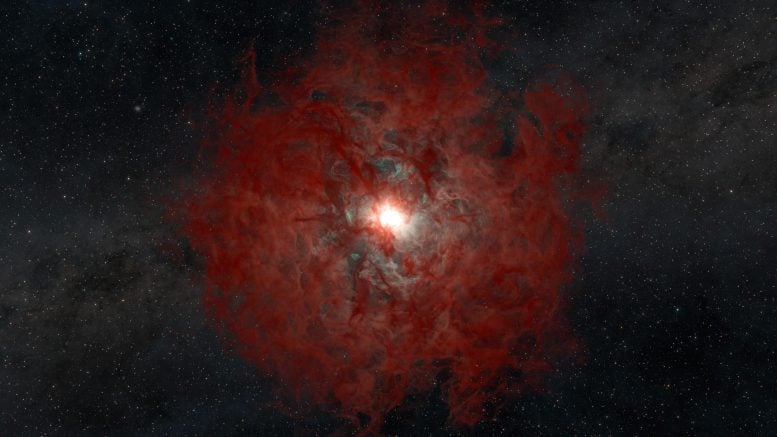
Astronomers Witness Rare Cosmic Event: Massive Star Vanishes Without Supernova, Collapses Directly Into Black Hole
In a discovery that has sent shockwaves through the global astronomy community, scientists have observed a massive star in a distant galaxy that mysteriously vanished without the dramatic supernova explosion that typically marks the death of such stellar giants. Instead of the expected brilliant cosmic fireworks, the star simply disappeared, leaving behind a black hole in what researchers are calling one of the most significant astronomical observations in recent memory.
The unprecedented event occurred in a galaxy approximately 120 million light-years from Earth, where astronomers using the Hubble Space Telescope and ground-based observatories detected the sudden disappearance of a star estimated to be about 25 times more massive than our Sun. This observation marks the first time scientists have directly witnessed what’s known as “failed supernova” or “direct collapse” in action.
Dr. Christopher Kochanek, an astronomer at Ohio State University and lead researcher on the project, described the discovery as “both thrilling and perplexing.” “We’ve long theorized that some of the most massive stars might collapse directly into black holes without the characteristic supernova explosion,” Kochanek explained. “But seeing it happen in real-time is something else entirely. It’s like watching a magician make a star disappear, except this trick is playing out across millions of light-years of space.”
The star in question, located in the galaxy NGC 6946 (also known as the “Fireworks Galaxy” due to its unusually high supernova rate), had been under observation for years. Scientists had been monitoring it as part of a broader survey of massive stars in their death throes. When the star suddenly vanished from view in 2009, researchers initially suspected equipment malfunction or data errors. However, subsequent observations confirmed that the star had indeed disappeared without a trace.
What makes this discovery particularly fascinating is what it tells us about stellar evolution and the formation of black holes. Traditional models of stellar death suggest that when massive stars exhaust their nuclear fuel, they undergo catastrophic core collapse, triggering a shockwave that tears the star apart in a brilliant supernova explosion. The remnant core then either forms a neutron star or, if massive enough, collapses further into a black hole.
However, this new observation suggests an alternative pathway. In cases where the star is sufficiently massive and perhaps has lost much of its outer envelope through previous episodes of mass loss, the core collapse might proceed so rapidly and quietly that no supernova occurs. Instead, the entire star simply collapses inward, forming a black hole that swallows the remaining stellar material before any explosion can occur.
“This changes our understanding of how black holes form,” said Dr. Scott Adams, a co-author of the study published in the Monthly Notices of the Royal Astronomical Society. “We’ve essentially caught the universe in the act of making a black hole the quiet way, without the usual fanfare of a supernova. It’s like the star decided to go out with a whisper rather than a bang.”
The implications of this discovery extend far beyond this single star. If direct collapse into black holes is more common than previously thought, it could help explain several astronomical mysteries. For instance, it might account for why astronomers detect fewer supernovae than theoretical models predict, and it could provide new insights into the population of massive black holes observed throughout the universe.
The research team utilized data from multiple observatories, including the Large Binocular Telescope in Arizona, the Hubble Space Telescope, and the Spitzer Space Telescope. By combining observations across different wavelengths and time periods, they were able to confirm that the star’s disappearance wasn’t due to obscuration by dust or other intervening material, but rather represented a genuine change in the star itself.
Interestingly, the star’s behavior prior to its disappearance showed some unusual characteristics that now make sense in hindsight. In the years leading up to 2009, the star exhibited erratic brightness variations and significant mass loss, suggesting it was undergoing dramatic internal changes. These precursor events, which might have seemed like anomalies at the time, now appear to be telltale signs of an impending direct collapse.
The discovery also raises new questions about the frequency of such events. While this is the first direct observation of a failed supernova, astronomers estimate that such events might occur in about 10-30% of all massive star deaths. This means that throughout the universe, thousands of stars might be quietly collapsing into black holes every year without the spectacular displays we’ve come to associate with stellar death.
For the broader field of astronomy, this finding has significant implications. It suggests that our census of supernovae and black hole formation rates may need revision, and it provides a new window into understanding the life cycles of the most massive stars in the universe. Additionally, it offers a potential explanation for the existence of certain types of black holes that have puzzled astronomers for years.
The research team is continuing to monitor the region where the star disappeared, using increasingly sophisticated instruments to search for any signs of the black hole that now lurks there. While the black hole itself is invisible, its presence might be detectable through its gravitational effects on nearby stars or through the emission of radiation as it occasionally consumes nearby material.
As astronomers worldwide digest this groundbreaking discovery, one thing is clear: the universe continues to surprise us with its complexity and variety. What we once thought we understood about how stars die has just become more nuanced, reminding us that even in well-studied areas of astrophysics, nature still has secrets to reveal.
This observation represents not just a scientific milestone, but a philosophical one as well. It challenges our assumptions about cosmic violence and spectacle, showing us that some of the universe’s most dramatic transformations can occur in complete silence, hidden from view until we develop the tools and patience to witness them.
Tags: black hole formation, failed supernova, direct stellar collapse, massive star death, NGC 6946, cosmic mysteries, stellar evolution, astronomical discovery, universe secrets, quiet cosmic events, black hole census, stellar astrophysics, space observation, cosmic phenomena, astronomical breakthrough
Viral phrases: massive star vanishes, black hole without explosion, star disappears quietly, cosmic magic trick, universe’s silent transformation, stellar death mystery, astronomical game-changer, space’s best-kept secret, cosmic event of the decade, stellar evolution rewritten, black hole formation mystery, universe surprises scientists, space observation breakthrough, cosmic phenomenon, stellar collapse mystery
,


Leave a Reply
Want to join the discussion?Feel free to contribute!