
The Small English Town Swept Up in the Global AI Arms Race
AI’s Hunger for Data Centers Sparks Rural Uproar in the UK
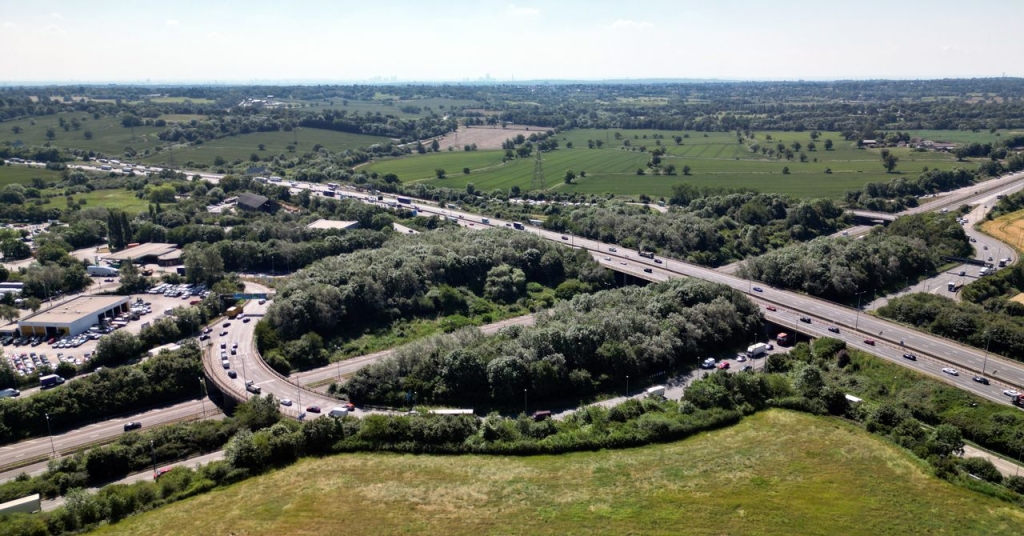
Just a short drive north of London, the sleepy Hertfordshire town of Potters Bar shares a bucolic border with the village of South Mimms—an 85-acre patchwork of farmland stitched together by hedgerows and interrupted only by the occasional wandering footpath. In one corner of this pastoral quilt stands a lone oak, its branches outstretched like a welcoming arm for hikers. Recently, though, the tree has become an unlikely protest symbol: a hand-scrawled sign nailed to its trunk reads simply, “NO TO DATA CENTRE.”
The controversy erupted last September when a property developer quietly submitted plans to build one of Europe’s largest industrial-scale data centers on this very farmland. When word leaked out, locals quickly mobilized, launching a Facebook group that ballooned to over 1,000 members united in opposition. Their concerns ran deep: the loss of precious green space, the disruption to wildlife corridors, and the looming shadow of massive server warehouses on their countryside vistas.
Despite the grassroots resistance, the local government moved swiftly. In January 2025, Hertsmere Borough Council granted planning permission for the project. Just months later, in October, multinational data center operator Equinix swooped in, acquiring the land for what it claims will be a £3.9 billion investment in the UK’s “critical national infrastructure.” The company plans to break ground this year.
On a damp January afternoon, I stood with Ros Naylor—one of the Facebook group’s administrators—and six other residents at the field’s edge. They spoke of more than just NIMBYism. For them, this land represents an irreplaceable buffer between town and country, a mental health sanctuary, and a physical barrier against the roar of the nearby highway and service station. “The beauty of walking in this area is coming through this space,” Naylor told me, her breath visible in the cold air. “It’s incredibly important for mental health and wellbeing.”
Their fight is far from isolated. As the UK government races to meet the exploding demand for data centers needed to train AI models and run AI applications, similar battles are erupting nationwide. Massive facilities are being approved from Northumberland to Lincolnshire, each promising economic benefits while threatening to reshape the countryside forever.
The political winds shifted dramatically after the current government took power in 2024. In a move that critics call a “bonfire of red tape,” officials introduced a new land classification—grey belt—designed to fast-track construction on previously protected green belt areas deemed “underperforming.” Simultaneously, data centers were elevated to “critical national infrastructure” status, placing them in the same category as power plants and hospitals.
This dual policy shift has created a perfect storm for data center developers. Across the UK, planning applications have skyrocketed by more than 60 percent in 2025 alone. The government’s AI Opportunities Action Plan explicitly calls for rapid expansion of data center capacity, positioning the UK as a global AI hub.
Meanwhile, the world’s largest AI labs are planning to spend trillions of dollars collectively on infrastructure as they chase increasingly ambitious—some say fantastical—goals of artificial general intelligence. OpenAI CEO Sam Altman has spoken openly about needing data centers that could eventually cost hundreds of billions, even trillions, of dollars.
But for communities like Potters Bar, these grand technological ambitions offer cold comfort. When the planning authority approved the data center, its officers acknowledged that the farmland met the technical definition of grey belt and that government support for the data center industry influenced their decision. They concluded that the economic benefits outweighed the loss of green space.
Jeremy Newmark, leader of Hertsmere Borough Council, argues that the opposition rests on a misunderstanding. “People have this slightly romantic idea that all green belt land comprises pristine, rolling green fields,” he says. “The reality is that this site, along with many others, is anything but that. It’s a patch of very low-performing green belt land.”
Yet for residents who walk these fields daily, the distinction between “high-performing” and “low-performing” green space feels academic. They see a living landscape that supports biodiversity, provides recreation, and maintains the character of their community. To them, the arrival of server farms represents not progress but a fundamental alteration of their environment.
The tension reflects a broader global pattern. From Northern Virginia to Singapore, communities are organizing against data center developments, concerned about everything from water usage and energy consumption to noise pollution and visual blight. In many cases, these facilities—despite their sleek, futuristic branding—look and function much like the warehouses and factories communities have fought against for decades.
As Equinix prepares to break ground in Potters Bar, the oak tree protest sign remains, weathered but defiant. The battle over this 85-acre field has become a microcosm of a much larger struggle: how to balance the insatiable appetite of AI development with the preservation of local communities and landscapes. For now, at least, the data center developers appear to have the upper hand. But in the rolling fields of Hertfordshire, the resistance is just beginning.
Tags & Viral Phrases:
- AI data center controversy
- UK green belt protection
- Rural communities vs. tech giants
- Data center environmental impact
- Equinix UK expansion
- AI infrastructure boom
- Local resistance to tech development
- Grey belt reclassification
- Critical national infrastructure designation
- Countryside preservation vs. AI progress
- Hertfordshire data center protest
- Potters Bar environmental battle
- NIMBYism in the AI age
- Trillions in AI infrastructure spending
- Local government caught between developers and residents
- The hidden cost of AI advancement
- When your backyard becomes a server farm
- The great British countryside data center land grab
- Communities fight back against tech colonization
,


Leave a Reply
Want to join the discussion?Feel free to contribute!