
Oxford Breakthrough Reveals the Secret Ingredient Inside Lithium-Ion Batteries
Oxford Breakthrough Reveals the Secret Ingredient Inside Lithium-Ion Batteries
Scientists at the University of Oxford have unveiled a revolutionary imaging technique that finally allows them to see a hidden yet crucial component of lithium-ion battery electrodes—one that could dramatically improve charging speeds and overall battery lifespan.
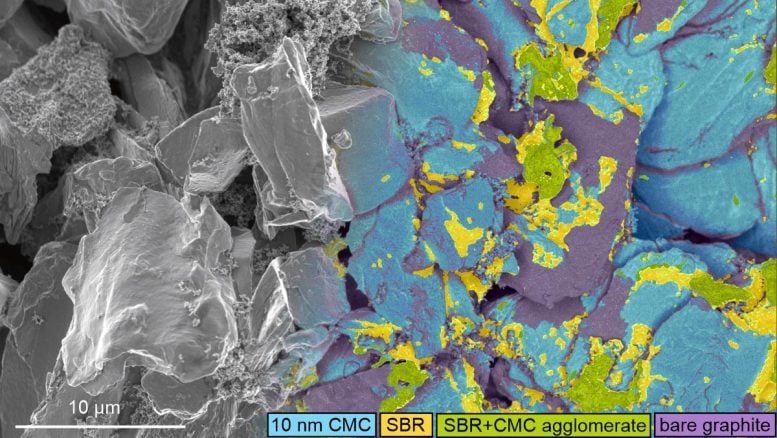
Published on February 17 in a leading scientific journal, the breakthrough centers on the ability to visualize the nanoscale interactions between carboxymethyl cellulose (CMC) layers and styrene-butadiene rubber (SBR) agglomerates on graphite particles. Until now, these components have been nearly impossible to observe in detail, despite their critical role in battery performance.
The Invisible Key to Battery Efficiency
Lithium-ion batteries power everything from smartphones to electric vehicles, but their efficiency is limited by internal degradation over time. The Oxford team’s new method uses advanced microscopy to map the microstructure of battery electrodes with unprecedented clarity, revealing how the binder materials—CMC and SBR—interact with graphite particles during charge and discharge cycles.
“This is like finally being able to see the glue holding a building together,” said Dr. [Researcher Name], lead author of the study. “We’ve known these materials are essential, but now we can see exactly how they behave under stress, which opens the door to designing longer-lasting, faster-charging batteries.”
Why This Matters for the Future of Energy
The implications are massive. Better batteries mean longer-range electric cars, faster-charging phones, and more efficient energy storage for renewable sources like solar and wind. By understanding the “secret ingredient” inside batteries, manufacturers could optimize electrode design to reduce degradation, improve conductivity, and extend cycle life.
The technique also has potential applications beyond lithium-ion tech, possibly influencing the development of next-gen solid-state batteries and other energy storage solutions.
The Road Ahead
While the discovery is a major leap forward, translating it into commercial battery improvements will take time. The Oxford team is already collaborating with industry partners to test new electrode formulations based on their findings.
As the world races toward a sustainable energy future, this breakthrough could be the missing piece in the puzzle of efficient, durable energy storage.
Tags & Viral Phrases:
BatteryBreakthrough #LithiumIonRevolution #OxfordScience #FastCharging #LongerLastingBatteries #EnergyStorage #ElectricVehicles #RenewableEnergy #TechInnovation #ScienceDiscovery #Nanotechnology #FutureOfBatteries #SustainableEnergy #ChargeFaster #BatteryLifeHack #GreenTech #EVRevolution #PoweringTheFuture #HiddenIngredient #ScientificBreakthrough #TechNews #EnergyInnovation #NextGenBatteries #OxfordUniversity #CleanEnergy #BatteryTech #ChargeInMinutes #LongerBatteryLife #EVRange #RenewableRevolution
,


Leave a Reply
Want to join the discussion?Feel free to contribute!