
Tiny Supernova Error Could Make The Dark Energy ‘Crisis’ Vanish, New Paper Suggests : ScienceAlert
Is Dark Energy Evolving? New Research Challenges Our Understanding of Cosmic Expansion
Dark energy, the mysterious force driving the accelerating expansion of the universe, has long been one of cosmology’s greatest enigmas. But what if everything we thought we knew about this invisible cosmic component is wrong? A provocative new paper by Dr. Slava Turyshev suggests that the apparent evolution of dark energy might be nothing more than measurement error—or perhaps something even stranger is at work.
The Cosmic Tension: When Data Doesn’t Add Up
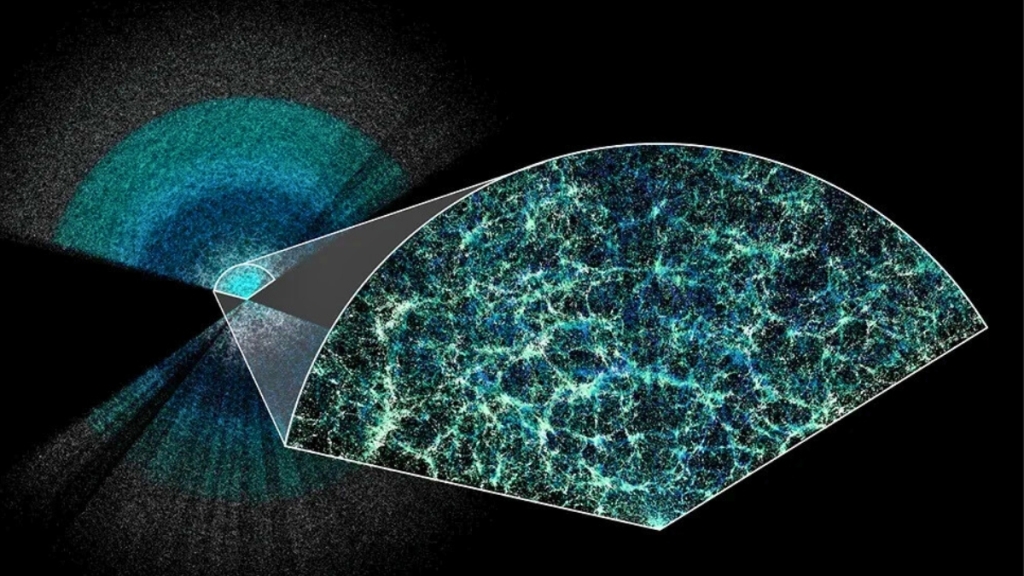
The debate ignited with the release of the Dark Energy Spectroscopic Instrument’s (DESI) second data release, DR2. When cosmologists compared DESI’s detailed galaxy maps with measurements of the Cosmic Microwave Background (CMB)—the afterglow of the Big Bang—they found something unexpected: a discrepancy.
Previous research had suggested this mismatch could mean dark energy isn’t constant after all. Instead, it might be “evolving”—either strengthening or weakening over billions of years. This would revolutionize our understanding of cosmology and potentially require rewriting the fundamental physics governing our universe.
The Measurement Problem: Are We Seeing Clearly?
Dr. Turyshev, renowned not only for his cosmological research but also as the leading advocate for the Solar Gravitational Lens mission, urges caution. “Extraordinary claims require extraordinary evidence,” he notes, and he’s identified a critical potential source of error in our cosmic measurements.
The crux of the issue lies with supernovae—the brilliant explosions of dying stars that serve as our cosmic distance markers. These stellar beacons are crucial for measuring vast cosmological distances, but even tiny inaccuracies in measuring their brightness could cascade into significant errors in our understanding of cosmic expansion.
Dr. Turyshev points out that if our measurements of supernovae brightness are off by just 0.02 magnitudes—a minuscule amount in astronomical terms—it could entirely explain the apparent disconnect between DESI’s observations and CMB measurements.
The Sound Horizon: Our Cosmic Ruler
Another potential source of error involves what astrophysicists call the “sound horizon”—essentially the universe’s built-in measuring stick. This cosmic ruler represents the maximum distance sound waves could travel through the hot plasma of the early universe before atoms formed and froze these oscillations in place, about 380,000 years after the Big Bang.
We use this frozen distance as a reference to measure everything else in the cosmos. But like any measurement, slight inaccuracies in determining this fundamental scale can introduce errors that propagate through all our cosmological calculations.
A New Approach: The Alcock-Paczynski Diagnostic
To address these potential measurement issues, Dr. Turyshev proposes using the Alcock-Paczynski (AP) diagnostic—a mathematical technique that examines the shape of the universe without relying on the potentially problematic sound horizon measurement.
This approach could help determine whether dark energy truly appears to be evolving or if we’re simply seeing artifacts of our measurement techniques.
If Dark Energy Is Evolving: What Then?
If, after accounting for measurement uncertainties, dark energy still appears to be changing, Dr. Turyshev offers two fascinating possibilities.
First is the Late-Transition Interacting Thawer (LTIT) model. This theory suggests that dark energy might have remained dormant for most of cosmic history before “thawing” at a specific point, gradually becoming more interactive with other forms of energy and matter—manifesting as the accelerating expansion we observe today.
The second possibility is even more dramatic: the “Phantom Crossing.” In this scenario, dark energy could become extremely powerful at some point, transitioning to what physicists call “phantom” energy. This would represent such a fundamental departure from our current understanding that it would require entirely new physics beyond the Standard Model.
The Quest Continues: New Data on the Horizon
The search for answers continues with multiple missions contributing fresh data. Euclid, another cosmological probe, has recently released its first dataset, with astrophysicists worldwide analyzing it for clues about dark energy’s true nature.
Meanwhile, DESI continues its observations, with the third data release expected later this year. This upcoming release will include three years of survey data, potentially providing the definitive evidence needed to resolve the current tensions in our cosmological models.
The Bigger Picture: Why This Matters
Understanding whether dark energy is constant or evolving isn’t just an academic exercise. It has profound implications for the ultimate fate of our universe. A changing dark energy could mean the difference between a universe that expands forever at an accelerating rate, one that eventually collapses, or something even more exotic.
As Dr. Turyshev’s research demonstrates, the path to understanding dark energy requires both bold theoretical proposals and meticulous attention to the details of our measurements. In the end, it may be this combination of grand vision and careful analysis that finally illuminates one of the universe’s darkest mysteries.
This research is available as a preprint on arXiv: https://doi.org/10.48550/arXiv.2602.05368
This article was originally published by Universe Today. Read the original article.
Tags & Viral Phrases:
- Dark energy mystery solved?
- Universe expansion accelerating
- Cosmic Microwave Background
- Big Bang afterglow
- Supernova distance measurements
- Sound horizon cosmic ruler
- Baryon Acoustic Oscillations
- Alcock-Paczynski diagnostic
- Late-Transition Interacting Thawer model
- Phantom energy crossing
- Euclid space telescope data
- DESI instrument findings
- Standard Model physics challenged
- Cosmology revolution incoming
- Measurement error in space
- 0.02 magnitude difference
- Universe fate determined
- Dark energy evolution debate
- Solar Gravitational Lens mission
- Dr. Slava Turyshev research
- Cosmic tension explained
- New physics needed?
- Universe cooling timeline
- Hot plasma early universe
- First atoms formation
- Cosmic distance markers
- Galaxy maps comparison
- DR2 data release
- Third data release coming
- Measurement accuracy crucial
- Extraordinary claims evidence
- Cosmological feature measurements
- Universe shape calculations
- Dark force universe
- Scientific discovery trending
- Space research breakthrough
- Astronomy news viral
- Physics mystery solved?
,


Leave a Reply
Want to join the discussion?Feel free to contribute!