
SpaceX vets raise $50M Series A for data center links
Three SpaceX Veterans Raise $50 Million to Revolutionize Optical Transceivers and AI Data Centers
In a bold move that signals the next frontier of AI infrastructure, three former SpaceX engineers have emerged from the shadows of satellite communications to tackle one of the most overlooked bottlenecks in modern computing: optical transceivers. Travis Brashears, Cameron Ramos, and Serena Grown-Haeberli—who once engineered the optical links that keep thousands of Starlink satellites in constant communication—have now launched Mesh Optical Technologies, a Los Angeles-based startup that just secured a $50 million Series A funding round led by Thrive Capital.
The trio’s journey from designing interplanetary communication systems to building the backbone of AI data centers is a testament to the growing convergence of space tech and artificial intelligence. At SpaceX, they were responsible for ensuring that Starlink satellites could communicate seamlessly using advanced optical links. But as they began working on the next generation of compute-hungry satellites, they stumbled upon a critical insight: the optical transceiver market—the unsung heroes that convert optical signals from fiber or laser into electrical signals for computers—was ripe for disruption.
The Hidden Backbone of AI
Optical transceivers are the silent workhorses of modern AI infrastructure. They enable multiple GPUs to work in concert, a necessity for training and operating large deep learning models. As AI models grow exponentially in size and complexity, the demand for high-performance, scalable, and energy-efficient transceivers has skyrocketed. One established U.S. supplier, AOI, recently secured a staggering $4 billion contract to provide components for AWS data centers, underscoring the market’s explosive growth.
“Someone will brag about a million GPU cluster; you have to multiply by four to five for the number of transceivers in that cluster,” Brashears explained, highlighting the sheer scale of the opportunity. With data centers projected to consume an ever-larger share of global energy, even a 3% to 5% reduction in power usage—something Mesh’s current design promises—could translate into massive cost savings and environmental benefits.
A National Security Imperative
But Mesh’s ambitions go beyond just building better transceivers. The company is positioning itself as a critical player in the U.S. tech ecosystem, particularly in light of the dominance of Chinese firms in the optical transceiver market. While trade restrictions haven’t yet impacted the market, Mesh’s founders and their backers are acutely aware of the potential risks. “If AI is the most important technology in several generations (which we believe to be true), to have critical parts of AI data center capex run through misaligned/competitive countries is a problem,” wrote Thrive Partner Philip Clark in a statement to TechCrunch.
By building its supply chain outside of China, Mesh is not only addressing a market need but also contributing to a broader national security strategy. The company’s goal is to manufacture a thousand units per day within the year, with plans to begin qualifying for bulk orders in 2027 and 2028. This rapid scaling is essential to meet the insatiable demand from hyperscalers like AWS, Google, and Microsoft, who are racing to build ever-larger AI clusters.
The Manufacturing Challenge
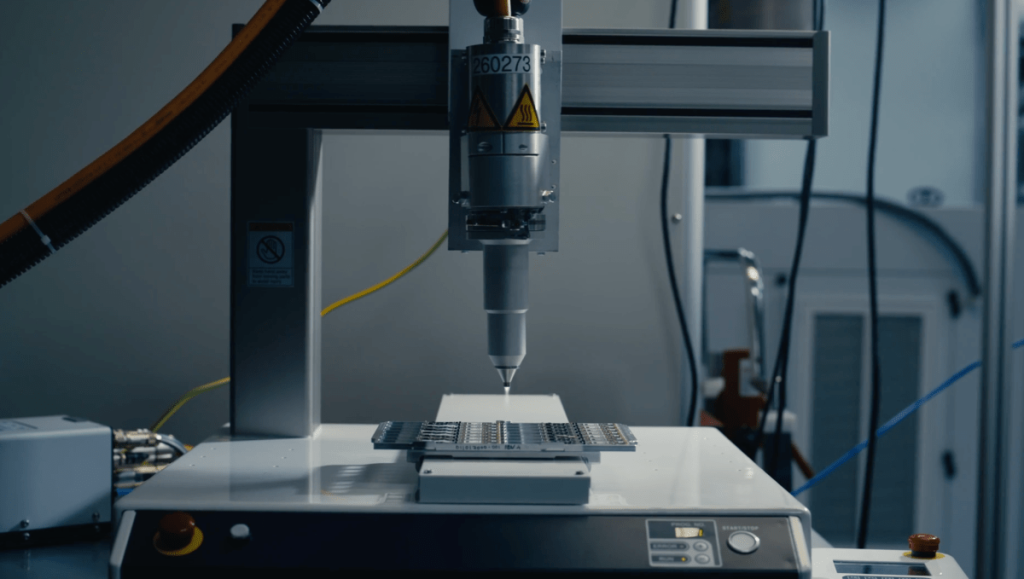
One of the biggest hurdles Mesh faces is executing lights-out, automated manufacturing techniques—a feat that is far from common in U.S. industry. Much of the expertise in this area is concentrated in China, to the point where even European equipment suppliers expect Chinese customers. One German firm’s standard intake form, for instance, asks for a Chinese company registration number.
By co-locating design and production, Mesh aims to overcome these challenges and deliver more efficient, lower-cost components. Their current design removes a commonly used but power-hungry component, a move that could significantly reduce the energy consumption of GPU clusters. This innovation is particularly timely as hyperscalers seek to wring every ounce of efficiency out of their systems in the face of rising energy costs and environmental concerns.
Beyond Data Centers: The Future of Communication
While data centers are Mesh’s initial focus, the company’s vision extends far beyond. The founders see optical wavelength communications as the next paradigm in communications, potentially replacing traditional radio frequencies (RF) in many applications. “The world has primarily focused on [radio frequencies] for a long time,” Brashears told TechCrunch. “We want to be at the precipice of transition from RF to photonics…we want to interconnect everything, and not just computers, but that’s where we’re starting.”
This ambitious vision could have far-reaching implications, from enabling faster, more reliable internet connections to powering the next generation of autonomous vehicles and smart cities. By pioneering the shift from RF to photonics, Mesh is positioning itself at the forefront of a technological revolution that could reshape how we communicate and compute.
The Road Ahead
Mesh Optical Technologies is more than just a startup; it’s a symbol of the growing intersection between space technology, AI, and national security. With $50 million in fresh funding and a team of engineers who have already proven their mettle at SpaceX, the company is well-positioned to tackle the challenges ahead. As AI continues to evolve and data centers become even more critical to our digital infrastructure, the demand for innovative solutions like Mesh’s will only grow.
The road ahead is not without its challenges, from scaling manufacturing to navigating geopolitical complexities. But if the founders’ track record is any indication, Mesh is more than up to the task. As they work to interconnect everything—from GPUs to satellites—they are not just building a company; they are laying the groundwork for the future of communication and computation.
Tags:
SpaceX, Mesh Optical Technologies, optical transceivers, AI data centers, Thrive Capital, national security, photonics, GPU clusters, automated manufacturing, Starlink, deep learning, hyperscalers, energy efficiency, RF to photonics transition.
Viral Sentences:
- “From Starlink to AI: How SpaceX alumni are rewiring the future of computing.”
- “The $50 million bet on optical transceivers that could redefine AI infrastructure.”
- “Why the next tech war might be fought over photons, not chips.”
- “Mesh Optical: The startup that’s turning space tech into AI gold.”
- “From satellites to data centers: The engineers rewriting the rules of connectivity.”
- “The hidden bottleneck in AI? These founders are solving it with light.”
- “How a 3% power reduction could save hyperscalers millions—and the planet.”
- “The U.S. is betting big on optical tech to outpace China in the AI race.”
- “From RF to photonics: The communication revolution you didn’t see coming.”
- “Mesh Optical: The startup that’s making photons the new silicon.”
,

Leave a Reply
Want to join the discussion?Feel free to contribute!