
What’s Causing Antarctica’s Strange “Gravity Hole”? Scientists Finally Solve the Mystery
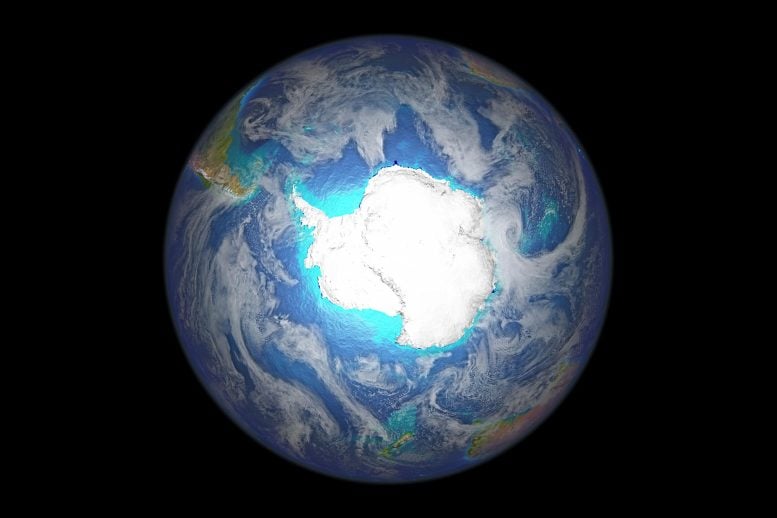
Scientists Finally Crack the Mystery of Antarctica’s “Gravity Hole” — And It’s All About Slow-Moving Rocks Deep Underground
For decades, a strange gravitational anomaly has puzzled scientists and geophysicists alike — a region beneath Antarctica where Earth’s gravitational pull is noticeably weaker than anywhere else on the planet. Dubbed the “gravity hole,” this bizarre phenomenon has long defied explanation, leaving researchers to speculate about everything from hidden caverns to shifts in the planet’s core.
Now, a groundbreaking new study has finally solved the mystery, and the answer lies deep beneath the Earth’s surface, in the slow, relentless movement of rocks over millions of years. The discovery not only sheds light on this peculiar anomaly but also offers new insights into the dynamic processes shaping our planet.
What Is the “Gravity Hole”?
To understand the gravity hole, we first need to grasp how gravity works on Earth. Contrary to popular belief, gravity is not uniform across the planet’s surface. Variations in Earth’s density, topography, and internal structure cause slight differences in gravitational pull from one location to another. These differences are measured using satellites like NASA’s GRACE (Gravity Recovery and Climate Experiment) and are mapped as gravity anomalies.
The gravity hole in question is located in the Indian Ocean, just south of the Indian subcontinent, but its effects extend to Antarctica. In this region, gravity is approximately 0.001% weaker than the global average — a seemingly tiny difference, but significant enough to catch the attention of scientists.
The Long-Standing Mystery
For years, the cause of this anomaly remained elusive. Some theories suggested it could be linked to ancient tectonic activity, while others proposed that it might be the result of a massive underground cavity or a dense concentration of material deep within the Earth. However, none of these explanations fully accounted for the observed data.
The breakthrough came when a team of researchers from the Indian Institute of Science in Bangalore used advanced computer simulations to model the Earth’s interior. By analyzing seismic data and running complex calculations, they were able to trace the gravity hole back to its source: a massive, slow-moving blob of hot, less dense rock deep within the Earth’s mantle.
The Role of Mantle Plumes
The key to understanding the gravity hole lies in the behavior of mantle plumes — columns of hot, buoyant rock that rise from the Earth’s core-mantle boundary. These plumes are responsible for many of the planet’s geological features, including volcanic hotspots like Hawaii and Iceland.
In this case, the researchers discovered that a particularly large and sluggish mantle plume has been slowly rising beneath the Indian Ocean for millions of years. As this plume ascends, it displaces denser material in the mantle, creating a region of lower density and, consequently, weaker gravity.
The process is incredibly slow — we’re talking about movements measured in centimeters per year — but over geological timescales, these tiny shifts can have profound effects on the planet’s surface and gravitational field.
Implications for Earth Science
This discovery is more than just a fascinating piece of trivia; it has significant implications for our understanding of Earth’s interior and its dynamic processes. By studying the gravity hole, scientists can gain insights into the behavior of mantle plumes, the movement of tectonic plates, and the long-term evolution of the planet’s surface.
Moreover, the research highlights the importance of interdisciplinary collaboration in solving complex scientific mysteries. The team combined expertise in geophysics, seismology, and computational modeling to piece together the puzzle, demonstrating how different fields of science can work together to uncover the secrets of our planet.
What’s Next?
While the mystery of the gravity hole has been solved, many questions remain. For instance, how do mantle plumes interact with other geological processes, such as plate tectonics and volcanic activity? And what other hidden anomalies might be lurking beneath the Earth’s surface, waiting to be discovered?
As technology continues to advance, scientists will undoubtedly uncover more surprises about our planet’s inner workings. For now, though, the gravity hole serves as a reminder of just how dynamic and complex Earth truly is — and how much we still have to learn about the world beneath our feet.
Tags and Viral Phrases
gravity hole, Antarctica, Earth’s gravity, mantle plumes, Indian Ocean, geophysics, seismic data, tectonic activity, Earth’s interior, mantle plumes, gravitational anomalies, NASA GRACE, Indian Institute of Science, Bangalore, geological processes, Earth’s mantle, core-mantle boundary, volcanic hotspots, Hawaii, Iceland, computational modeling, interdisciplinary collaboration, Earth science, planetary evolution, hidden anomalies, Earth’s surface, geological timescales, tectonic plates, volcanic activity, Earth’s dynamic processes, scientific mysteries, mantle behavior, Earth’s core, gravitational field, geological features, buoyant rock, Earth’s density, topography, gravitational pull, gravity variations, Earth’s structure, geological features, mantle plumes, Earth’s interior, gravitational anomalies, Earth’s gravity, mantle plumes, Indian Ocean, Antarctica, geophysics, seismic data, tectonic activity, Earth’s interior, mantle plumes, gravitational anomalies, NASA GRACE, Indian Institute of Science, Bangalore, geological processes, Earth’s mantle, core-mantle boundary, volcanic hotspots, Hawaii, Iceland, computational modeling, interdisciplinary collaboration, Earth science, planetary evolution, hidden anomalies, Earth’s surface, geological timescales, tectonic plates, volcanic activity, Earth’s dynamic processes, scientific mysteries, mantle behavior, Earth’s core, gravitational field, geological features, buoyant rock, Earth’s density, topography, gravitational pull, gravity variations, Earth’s structure.
,


Leave a Reply
Want to join the discussion?Feel free to contribute!