
Surprise Shark Caught on Camera in an Unexpected Place : ScienceAlert
Giant Sleeper Shark Spotted in Antarctic Waters in Groundbreaking Discovery
In a stunning revelation that’s sending shockwaves through the marine biology community, researchers have captured unprecedented footage of a massive sleeper shark navigating the icy depths of the Antarctic Ocean—a discovery that challenges long-held assumptions about the distribution of these elusive predators.
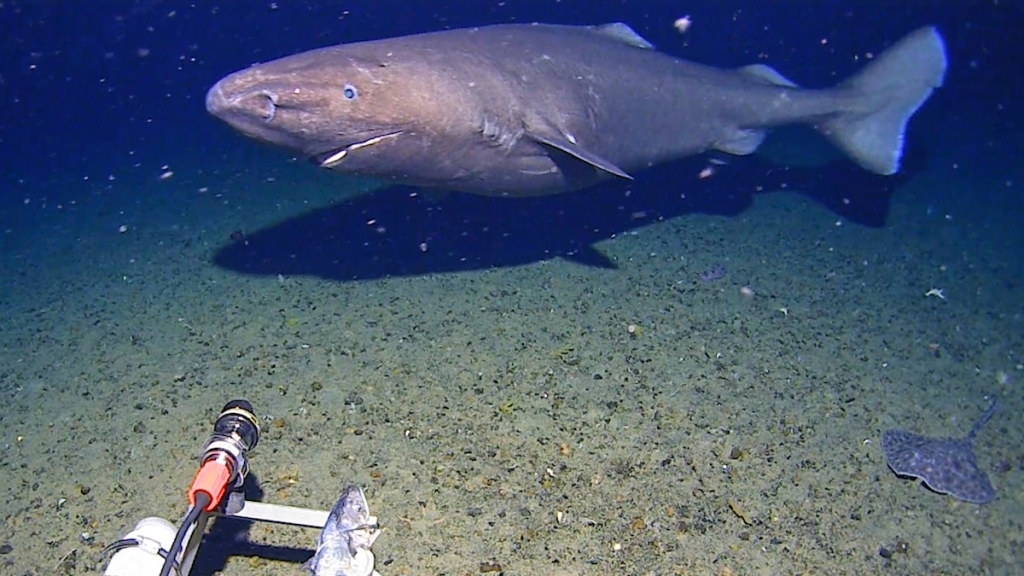
The remarkable encounter occurred in January 2025 when scientists from the Minderoo-UWA Deep-Sea Research Centre deployed specialized underwater cameras near the South Shetland Islands, close to the Antarctic Peninsula. What they captured was nothing short of extraordinary: a formidable sleeper shark, measuring an estimated 3 to 4 meters (10 to 13 feet) in length, gliding through near-freezing waters at a depth of 490 meters (1,608 feet).
“We went down there not expecting to see sharks because there’s a general rule of thumb that you don’t get sharks in Antarctica,” explained Alan Jamieson, founding director of the research center. “And it’s not even a little one either. It’s a hunk of a shark. These things are tanks.”
The discovery is particularly significant because it represents the first confirmed sighting of a shark within the boundaries of the Antarctic Ocean, also known as the Southern Ocean, which lies below the 60-degree south latitude line. The footage, which the research center has now shared with the public, shows the massive predator moving slowly over what appears to be a barren seabed, accompanied by a skate that seems completely unperturbed by the shark’s presence.
What makes this finding even more remarkable is the extreme environment in which it occurred. The water temperature at the depth where the shark was filmed was a bone-chilling 1.27 degrees Celsius (34.29 degrees Fahrenheit)—conditions that many marine biologists previously believed were too harsh to support shark populations.
The sleeper shark belongs to the Somniosidae family, known for their slow movements and deep-water habitats. These sharks are typically found in Arctic and sub-Arctic waters, but this discovery suggests their range may extend much farther south than previously documented. The species is known for its remarkable adaptations to cold environments, including specialized proteins that prevent their blood from freezing and a metabolism that allows them to survive on minimal food resources.
Peter Kyne, a conservation biologist at Charles Darwin University who was not involved in the research, emphasized the significance of the finding. “This is great. The shark was in the right place, the camera was in the right place and they got this great footage. It’s quite significant.”
The discovery raises intriguing questions about how these sharks survive in such extreme conditions. Jamieson speculates that the Antarctic sleeper shark population likely feeds on the carcasses of whales, giant squids, and other marine creatures that die and sink to the ocean floor. The stratified nature of the Antarctic Ocean, with its layered water columns, may also play a crucial role in the sharks’ survival strategy.
“The shark maintained that depth because that was the warmest layer of several water layers stacked upon each other to the surface,” Jamieson explained. This thermal stratification, created by the mixing of colder, denser water from below with fresh water running off melting ice from above, creates distinct temperature zones that the sharks appear to exploit.
Climate change implications cannot be ignored in this context. While it’s too early to draw definitive conclusions, warming ocean temperatures could potentially be driving sharks to seek out colder waters in the Southern Hemisphere. However, Kyne notes that limited data on range changes near Antarctica makes it difficult to determine whether this sighting represents a recent shift or simply the first documentation of a previously undetected population.
The timing of this discovery is particularly interesting. Jamieson points out that research cameras capable of operating in Antarctic waters can only function during the Southern Hemisphere summer months, from December through February. “The other 75% of the year, no one’s looking at all. And so this is why, I think, we occasionally come across these surprises,” he said.
This finding underscores the vast amount we still have to learn about Earth’s most remote and extreme environments. The Antarctic Ocean, despite being one of the most important regions for global climate regulation, remains one of the least explored marine ecosystems on the planet. The discovery of a previously undocumented shark population highlights the potential for many more surprises lurking in these icy depths.
The sleeper shark’s presence in Antarctic waters also has implications for our understanding of deep-sea ecosystems and the adaptability of marine life. These sharks are known to have exceptionally long lifespans, with some estimates suggesting they can live for several centuries. Their ability to thrive in such extreme conditions could provide valuable insights into evolutionary adaptations and the resilience of marine species in the face of environmental change.
As research continues, scientists are eager to learn more about the behavior, population size, and ecological role of these Antarctic sleeper sharks. Future expeditions may focus on deploying more extensive camera networks and potentially using environmental DNA sampling to detect the presence of these elusive predators in other parts of the Southern Ocean.
This groundbreaking discovery serves as a powerful reminder of the ocean’s capacity to surprise us and the importance of continued exploration and research in understanding our planet’s most mysterious ecosystems. As climate change continues to alter marine environments worldwide, documenting and understanding these changes becomes increasingly crucial for conservation efforts and our broader understanding of global ocean health.
Tags and Viral Phrases:
sleeper shark, Antarctic Ocean, Antarctic Peninsula, South Shetland Islands, deep-sea research, marine biology, climate change, ocean exploration, rare shark discovery, underwater footage, extreme environments, marine conservation, Southern Ocean, cold-water species, deep-sea ecosystem, scientific breakthrough, unexpected discovery, marine adaptation, ocean stratification, environmental research, scientific surprise, marine wildlife, Antarctic research, deep-sea camera, shark population, ocean warming, marine species range, scientific expedition, underwater technology, marine predator, polar research, ocean biodiversity, scientific documentation, marine ecosystem, climate impact, deep-sea life, scientific community, marine science, unexpected findings, ocean mysteries, research breakthrough, scientific significance, marine discovery, Antarctic wildlife, deep-sea exploration, scientific research, marine biology news, ocean conservation, scientific advancement, marine environment, research technology, ocean depths, scientific surprise, marine adaptation, environmental change, deep-sea species, scientific documentation, marine research, ocean exploration, scientific breakthrough, marine conservation, unexpected discovery, scientific expedition, underwater technology, marine predator, polar research, ocean biodiversity, scientific documentation, marine ecosystem, climate impact, deep-sea life, scientific community, marine science, unexpected findings, ocean mysteries, research breakthrough, scientific significance, marine discovery, Antarctic wildlife, deep-sea exploration, scientific research, marine biology news, ocean conservation, scientific advancement, marine environment, research technology, ocean depths, scientific surprise, marine adaptation, environmental change, deep-sea species, scientific documentation, marine research
,

Leave a Reply
Want to join the discussion?Feel free to contribute!