
How uncrewed narco subs could transform the Colombian drug trade
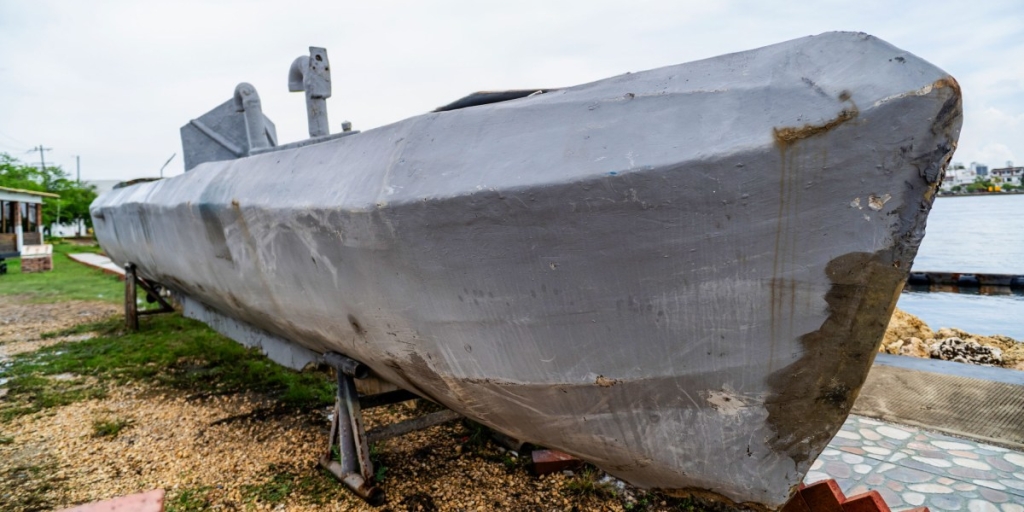
The Tayrona: Inside the World’s First Fully Autonomous Narco Submarine
Colombia’s Navy has captured a revolutionary new drug trafficking vessel that could transform the cocaine trade forever.
Today, the Tayrona semisubmersible sits exposed on a grassy strip at the ARC Bolívar naval base in Cartagena, its once-secretive hull now vulnerable to the tropical elements. Rain streaks have marred its paint job, and nearby sits an older, bulkier narco sub seized a decade ago—a blue cylinder with an unmistakably crude profile. The Tayrona, by contrast, presents a lower, leaner, and more refined silhouette that hints at the technological leap it represents.
Up close, the vessel reveals its handmade origins. The hull, painted in a dull gray-blue, shows rough fiberglass patches in several places, bearing the scrapes and dents from its tow into port. No identifying marks mar its exterior—no country codes, no company logos, no port registration numbers that might tie it to any legitimate entity. Most tellingly, two Starlink satellite internet antennas sit prominently on the upper surface, painted over in matching gray-blue to camouflage them against the ocean’s surface.
I climbed up a ladder and dropped through the small hatch near the stern, immediately feeling the vessel’s claustrophobic reality. The air inside was damp and close, walls beaded with condensation, small puddles of fuel collecting in the bilge. The space offered no seating, no helm or steering wheel, and barely enough room to stand upright or lie down fully. This wasn’t designed for human comfort—it was designed for one purpose only.
A technical analysis by CMCON, Colombia’s maritime research center, revealed the vessel’s operational parameters: enough fuel for approximately 800 nautical miles of autonomous travel, with a central cargo bay capable of holding between one and 1.5 tons of cocaine worth millions on international markets.
At the aft end, the machinery compartment resembled a tangle of hardware store purchases rather than sophisticated military technology: a diesel engine, batteries, pumps, and a chaotic bundle of cables feeding into an electronics rack. Every core component remained intact, providing investigators with crucial insights into the vessel’s capabilities.
Inside that electronics rack, investigators identified a NAC-3 autopilot processor—a commercial unit designed to steer mid-size boats by interfacing with standard hydraulic pumps, heading sensors, and rudder-feedback systems. These units retail for approximately $2,200 on Amazon, representing the democratization of sophisticated maritime technology.
“These are plug-and-play technologies,” explains Wilmar Martínez, a mechatronics professor at the University of America in Bogotá, when shown photographs of the sub’s interior. “Mid-career mechatronics students could install them. The barrier to entry has dropped dramatically.”
The implications are staggering. Where building a crewed semisubmersible once required extensive maritime knowledge, welding expertise, and a crew willing to risk their lives, this autonomous version requires only the ability to follow assembly instructions and basic electrical skills. The human risk—traditionally the weak link in drug trafficking operations—has been virtually eliminated.
For all its technological advantages, the autonomous drug-smuggling submarine isn’t invincible. The satellite internet terminals, whether Starlink or other providers, create digital footprints that law enforcement is beginning to exploit. Every terminal comes with a billing address, a payment method, and logs documenting where and when it connects to its constellation.
Colombian authorities have started discussions about negotiating formal agreements with satellite internet providers, requesting alerts when a transceiver’s movements match known smuggling patterns. Brazil has already taken decisive action, cutting a deal with Starlink to curb criminal use of its service in the Amazon region.
The fundamental approach to detecting these vessels will mirror current methods used for crewed semisubmersibles. Aircraft and ships will employ radar to identify small anomalies and infrared cameras to detect the heat signatures of diesel engines or the turbulence created by wakes. However, experts warn these methods may prove insufficient.
“If they wind up being smaller, they’re going to be darn near impossible to detect,” cautions Michael Knickerbocker, a former US Navy officer who now advises defense technology firms. The smaller profile, combined with the absence of human heat signatures and the ability to travel at depths that minimize surface disturbance, creates a detection nightmare for maritime security forces.
The challenge is compounded by resource constraints. Naval forces already struggle to act on the fraction of intelligence leads they receive due to insufficient ships and aircraft. Knickerbocker advocates for “robot on robot” warfare—deploying swarms of small, relatively inexpensive unmanned systems including surface vessels, underwater gliders, and long-endurance aerial vehicles that can loiter, sense, and relay data back to human operators.
These technological counter-measures are already in development. The US 4th Fleet, responsible for Latin America and the Caribbean, is actively experimenting with unmanned platforms in counternarcotics patrols. Across the Atlantic, the European Union’s European Maritime Safety Agency operates drones for maritime surveillance operations.
The Tayrona represents more than just a new smuggling vessel—it embodies the relentless innovation of criminal organizations and the democratization of technology that makes sophisticated autonomous systems accessible to non-state actors. As one researcher studying maritime drug trafficking put it, “Autonomous drug subs are a great example of how resilient cocaine traffickers are, and how they’re continuously one step ahead of authorities.”
The arms race between law enforcement and drug traffickers has entered a new phase, where the battlefield is increasingly autonomous, the technology increasingly accessible, and the stakes—measured in tons of cocaine and billions in profits—remain as high as ever.
autonomous narco submarine
Starlink drug trafficking
Colombia naval base Cartagena
CMCON technical analysis
NAC-3 autopilot processor
Amazon maritime technology
Wilmar Martínez mechatronics
Michael Knickerbocker Navy
US 4th Fleet unmanned
European Maritime Safety Agency
cocaine smuggling innovation
maritime surveillance drones
criminal autonomous systems
drug trafficking technology
narco sub detection
satellite internet terminals
maritime security challenges
unmanned surface vessels
underwater gliders surveillance
criminal organization innovation
technology democratization crime
autonomous vessel detection
maritime law enforcement
cocaine trade transformation
handmade submarine construction
gray-blue fiberglass hull
diesel engine smuggling
bilge fuel collection
cargo bay cocaine
nautical mile range
plug-and-play maritime tech
mechatronics student capabilities
human risk elimination
digital footprint tracking
billing address monitoring
constellation connection logs
Brazil Starlink agreement
Amazon criminal use
radar anomaly detection
infrared camera surveillance
heat signature elimination
wake turbulence minimization
resource constraint challenges
robot on robot warfare
unmanned system swarms
surface vessel drones
aerial vehicle endurance
data relay operations
counternarcotics patrol technology
maritime research center
autonomous navigation systems
commercial maritime hardware
$2,200 autopilot processor
Amazon maritime purchases
University of America Bogotá
ARC Bolívar naval base
Cartagena drug seizures
semisubmersible evolution
crude cylinder design
low profile vessel
tropical elements exposure
rain streak weathering
scrape and dent damage
no identifying marks
camouflage paint techniques
claustrophobic interior design
no seating arrangement
no helm steering wheel
standing space limitations
lying down restrictions
single purpose construction
technical report findings
machinery compartment tangle
hardware store purchases
chaotic cable bundles
electronics rack assembly
intact component analysis
maritime knowledge requirements
welding expertise elimination
crew risk removal
digital footprint exploitation
formal provider agreements
transceiver movement tracking
smuggling pattern matching
decisive law enforcement action
fundamental detection approach
aircraft surveillance methods
ship-based radar systems
infrared heat detection
wake turbulence monitoring
small profile advantages
human signature elimination
depth-based disturbance reduction
detection nightmare creation
intelligence lead processing
insufficient maritime assets
technological counter-measures
active experimentation programs
unmanned platform testing
maritime surveillance operations
relentless criminal innovation
technology accessibility expansion
non-state actor capabilities
high-stakes maritime warfare
arms race escalation
autonomous battlefield emergence
criminal organization resilience
authorities constantly behind
new phase warfare
increasingly autonomous operations
accessible sophisticated technology
**billions in criminal profits
,


Leave a Reply
Want to join the discussion?Feel free to contribute!