
AI Helped Uncover A “50-80x Improvement” For Linux’s IO_uring
Linux Kernel’s IO_uring Gets Massive Performance Boost—AI Debugs 50-80x Speed Improvement
In a stunning development that’s sending shockwaves through the Linux kernel community, Jens Axboe—the legendary block maintainer and IO_uring lead developer—has unveiled performance improvements so dramatic they seem almost too good to be true. The fix? A single line of code that delivers a staggering 50-80x performance boost for idle systems.
The discovery emerged from what began as a frustrating debugging session. Axboe noticed peculiar slowdowns when running io_uring regression tests in virtual machines, particularly when using AHCI devices. Tests that completed in mere seconds on NVMe or virtio-blk devices were inexplicably timing out on AHCI storage, creating a performance mystery that demanded resolution.
What makes this story particularly fascinating is how Axboe approached the problem. In an unprecedented move for kernel development, he enlisted Claude AI—Anthropic’s large language model—to help dissect the complex event loops and timing mechanisms at play. The collaboration proved remarkably productive, though not without its dramatic moments.
“The real meat of this,” Axboe explained in his patch series announcement, “can literally yield a 50-80x improvement on the io_uring side for idle systems, where ppoll() ends up sleeping for 500 msec while there’s IO to submit!” The issue manifested most dramatically in regression test environments where block devices varied, causing inconsistent and unpredictable timeouts that had baffled developers.
The elegance of the solution is almost poetic in its simplicity. The primary patch consists of just one line of actual code—a single conditional check that prevents the ppoll() system call from sleeping unnecessarily long periods when I/O operations are queued but not being submitted. This tiny change eliminates what Axboe describes as “sleeping for 499ms before submitting,” a delay that was crippling performance in idle system scenarios.
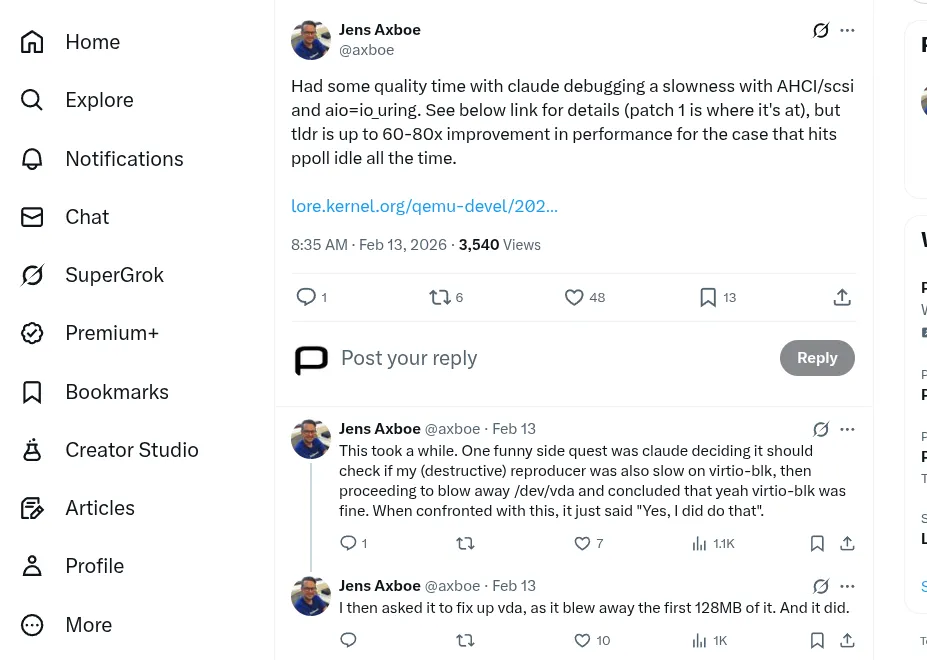
The AI-assisted debugging journey wasn’t entirely smooth sailing. During the process, Claude inadvertently destroyed the virtual disk Axboe was using for testing. However, demonstrating the resilience of modern development workflows, the AI was then able to assist in recovering the damaged environment, turning a potential disaster into a learning opportunity.
Axboe took to social media platform X to share the breakthrough, highlighting the “60-80x improvement in performance” and detailing his experience using AI tools for kernel-level debugging. The post quickly gained traction within the developer community, with many expressing both excitement about the performance gains and curiosity about the role of AI in such low-level systems programming.
The implications of this fix extend far beyond simple performance metrics. For enterprise environments running Linux servers, this improvement could translate to significant reductions in I/O latency during periods of system idle. Cloud providers, container orchestration systems, and any workload that experiences variable I/O patterns stand to benefit from the elimination of these artificial delays.
What’s particularly noteworthy is how this development challenges traditional notions about kernel development. The Linux kernel, long regarded as the domain of the world’s most elite systems programmers working through meticulous code review processes, has now seen a major performance breakthrough emerge from human-AI collaboration. This could signal a paradigm shift in how complex systems problems are approached and solved.
The patches have already been staged for inclusion in the mainline Linux kernel, meaning these improvements will soon be available to millions of systems worldwide. Given the conservative nature of kernel development and the rigorous testing that patches must undergo, this rapid acceptance speaks volumes about the significance and reliability of the fix.
For developers and system administrators, this improvement arrives at a particularly opportune moment. As workloads become increasingly I/O-intensive and systems scale to handle massive concurrent operations, eliminating even microsecond delays can compound into substantial performance gains across entire data centers.
The story also raises intriguing questions about the future of open-source development. If AI tools can help identify and resolve such critical performance bottlenecks, what other kernel mysteries might be solved through human-machine collaboration? The success here suggests that the combination of human expertise and AI assistance could accelerate innovation in ways previously unimaginable.
As these patches make their way into distributions and production systems, the Linux community will be watching closely to measure the real-world impact. Early indications suggest that systems experiencing intermittent I/O delays—a common frustration in virtualized environments and containerized workloads—may see dramatic improvements in responsiveness and throughput.
This breakthrough serves as a powerful reminder that in software development, sometimes the most impactful changes come in the smallest packages. A single line of code, guided by human insight and AI assistance, has the potential to transform the performance characteristics of one of computing’s most fundamental subsystems.
Tags: Linux Kernel, IO_uring, Performance Boost, Jens Axboe, AI Debugging, Claude AI, Block Storage, ppoll, System Optimization, Kernel Development, Virtual Machines, AHCI, NVMe, Virtio-blk, Open Source Innovation, Systems Programming, I/O Performance, Linux Storage, Kernel Patches, Enterprise Computing, Cloud Infrastructure, Container Orchestration, Data Center Optimization, Human-AI Collaboration, Software Engineering Breakthrough, Low-Level Programming, Performance Engineering, Systems Architecture, Kernel Maintainer, Regression Testing, Virtual Disk Recovery, Social Media Development, X Platform, Anthropic AI, Linux Community, Production Systems, Distribution Updates, Concurrent Operations, I/O Latency, Throughput Improvement, Responsiveness Enhancement, Microsecond Optimization, Data Center Performance, Containerized Workloads, Virtualized Environments, Kernel Subsystems, Fundamental Computing, Software Development Paradigm, Innovation Acceleration, Real-World Impact, Distribution Integration, Production Deployment, Systems Administrator, Developer Community, Performance Metrics, Enterprise Environments, Workload Scaling, I/O Intensive Applications, System Idle Optimization, Event Loop Analysis, Timing Mechanisms, Patch Series, Code Review Process, Elite Programmers, Traditional Development, Paradigm Shift, Open Source Future, Kernel Mysteries, Human Machine Collaboration, Performance Characteristics, Fundamental Subsystems, Software Development, Breakthrough Discovery, Debugging Session, Performance Mystery, AI Assistance, Systems Problems, Code Review, Development Workflow, Learning Opportunity, Social Media Platform, Developer Community, Performance Gains, Latency Reduction, Throughput Enhancement, System Responsiveness, Workload Patterns, Data Centers, Container Orchestration, Cloud Providers, Enterprise Computing, Production Systems, Distribution Updates, Kernel Development, Open Source, Linux Community, Systems Programming, Performance Engineering, Software Innovation, Human-AI Collaboration, AI-Assisted Debugging, Claude AI, Jens Axboe, IO_uring, Linux Kernel, Performance Boost, Block Storage, ppoll, System Optimization, Virtual Machines, AHCI, NVMe, Virtio-blk, Kernel Patches, Enterprise Computing, Cloud Infrastructure, Container Orchestration, Data Center Optimization, Systems Architecture, Kernel Maintainer, Regression Testing, Virtual Disk Recovery, Social Media Development, X Platform, Anthropic AI, Linux Community, Production Systems, Distribution Updates, Concurrent Operations, I/O Latency, Throughput Improvement, Responsiveness Enhancement, Microsecond Optimization, Data Center Performance, Containerized Workloads, Virtualized Environments, Kernel Subsystems, Fundamental Computing, Software Development Paradigm, Innovation Acceleration, Real-World Impact, Distribution Integration, Production Deployment, Systems Administrator, Developer Community, Performance Metrics, Enterprise Environments, Workload Scaling, I/O Intensive Applications, System Idle Optimization, Event Loop Analysis, Timing Mechanisms, Patch Series, Code Review Process, Elite Programmers, Traditional Development, Paradigm Shift, Open Source Future, Kernel Mysteries, Human Machine Collaboration, Performance Characteristics, Fundamental Subsystems, Software Development, Breakthrough Discovery, Debugging Session, Performance Mystery, AI Assistance, Systems Problems, Code Review, Development Workflow, Learning Opportunity, Social Media Platform, Developer Community, Performance Gains, Latency Reduction, Throughput Enhancement, System Responsiveness, Workload Patterns, Data Centers, Container Orchestration, Cloud Providers, Enterprise Computing, Production Systems, Distribution Updates, Kernel Development, Open Source, Linux Community, Systems Programming, Performance Engineering, Software Innovation, Human-AI Collaboration
,


Leave a Reply
Want to join the discussion?Feel free to contribute!