
This Comet Mysteriously Reversed Its Spin After Passing The Sun, But Why? : ScienceAlert
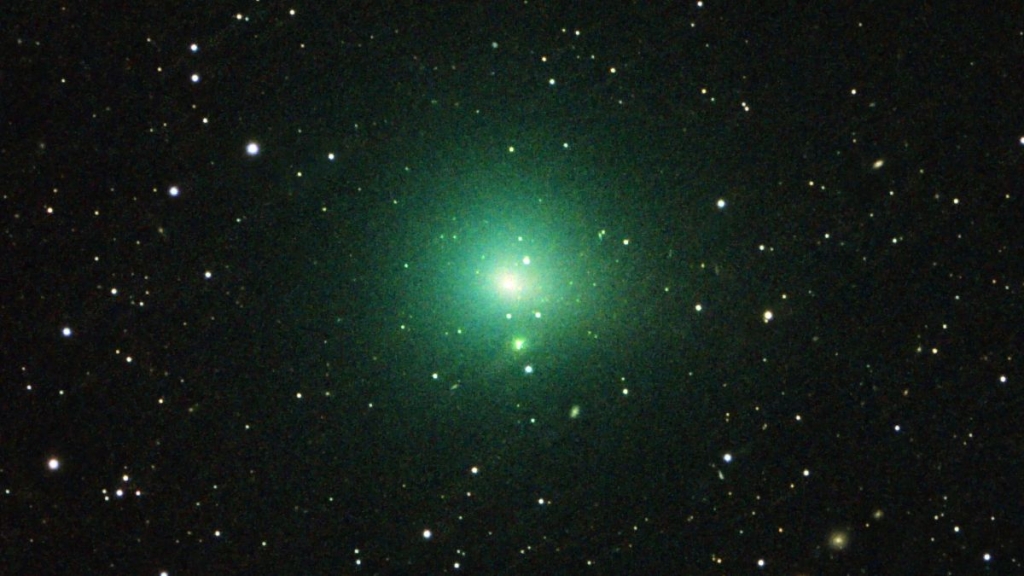
Comet 41P’s Unbelievable Spin Reversal: A Cosmic First That Has Scientists Stunned
In a discovery that’s sending shockwaves through the astronomical community, a small comet has pulled off a cosmic stunt never before witnessed by human eyes. Comet 41P/Tuttle-Giacobini-Kresák, a relatively modest space traveler measuring just about one kilometer across, has stunned scientists by appearing to completely stop its rotation and then reverse direction during its 2017 journey around the Sun.
This isn’t just any ordinary comet story. What makes 41P’s behavior so extraordinary is the sheer speed and magnitude of the change. While comets are known to occasionally alter their spin as they heat up during close approaches to the Sun, nothing in recorded astronomical history has shown such a dramatic reversal happening so rapidly.
The Incredible Timeline of a Cosmic Flip
The story begins in March 2017, when astronomers first measured 41P’s rotation period at approximately 20 hours. By May of that same year, something remarkable had already occurred—the comet’s spin had slowed dramatically to over 53 hours per rotation. But the real jaw-dropper came in December 2017, when observations revealed the rotation period had actually decreased to just 14.4 hours.
This dramatic shortening can only be explained by one mind-bending possibility: sometime around June 2017, 41P’s rotation must have slowed to a complete stop before starting up again in the opposite direction. Imagine a spinning top gradually winding down, hovering motionless for a moment, and then suddenly spinning backward—that’s essentially what this comet appears to have done.
Why This Matters: The Science Behind the Spin
To understand why this is so significant, we need to look at what makes comets tick. These celestial objects are essentially dirty snowballs—conglomerations of rock and ice that have remained largely unchanged since the early days of our Solar System. As they approach the Sun, the heat causes their icy components to sublimate, transitioning directly from solid to gas without becoming liquid first.
This sublimation process creates spectacular jets and geysers that spray material into space. Each of these jets acts like a tiny rocket engine, applying torque to the comet’s nucleus and potentially altering its rotation. For most comets, these changes happen gradually over months or even years.
The previous record-holder for rapid spin change was comet 103P/Hartley 2, which took 90 days to slow its rotation from 17 to 19 hours. In stark contrast, 41P accomplished a change more than ten times greater in just 60 days. This unprecedented rate of change has left astronomers scrambling to understand the underlying mechanics.
The Perfect Storm of Cosmic Conditions
Several factors aligned to make 41P’s dramatic behavior possible. First, its small size—roughly the length of ten football fields laid end to end—means that even relatively small forces can have outsized effects on its rotation. Think of trying to spin a basketball versus a beach ball; the smaller object responds more dramatically to the same amount of force.
Second, the distribution of ice and other materials within 41P may have been highly irregular. If the Sun heated different parts of the comet unevenly, or if the ice content was concentrated in certain areas rather than distributed uniformly, this could create unbalanced forces that dramatically affect rotation.
Third, the timing and intensity of the outgassing events during 41P’s 2017 perihelion passage appear to have been particularly favorable for creating the observed effects. The comet was essentially in the right place at the right time with the right internal structure to produce this once-in-a-lifetime observation.
The Detective Work Behind the Discovery
Determining that 41P had reversed its spin wasn’t straightforward. Astronomers use light-curve measurements—tracking how the comet’s brightness changes over time—to infer rotation rates. However, these measurements can tell us how fast something is spinning, not necessarily which direction it’s spinning.
David Jewitt, the University of California, Los Angeles astronomer who led this research, had to employ some clever detective work. By combining the light-curve data with new estimates of the comet’s size derived from archival Hubble Space Telescope observations, he found that the only way to make all the measurements align smoothly was to conclude that the comet had indeed reversed its spin direction.
“This isn’t just a minor tweak to our understanding,” Jewitt explains in his preprint paper. “The observed, rapid changes are natural consequences of torques from outgassed volatiles acting on the very small nucleus.” In other words, this dramatic behavior, while shocking to witness, actually makes perfect sense when you consider the physics involved.
What Comes Next for 41P?
The story doesn’t end with this single observation. If 41P’s spin continues evolving at the rate seen in 2017, it could potentially spin itself apart within just a few decades. This wouldn’t be unprecedented—some comets have been observed breaking apart when their rotation speeds become too extreme.
Currently, there’s a gap in our observational data. No published spin rates exist from 41P’s September 2022 perihelion passage, leaving astronomers uncertain about its current state. The next opportunity to measure its spin will come during its 2028 perihelion, and scientists around the world will undoubtedly be watching closely.
A Window Into Solar System History
Beyond the immediate excitement of witnessing such a rare phenomenon, 41P offers valuable insights into the history and evolution of our Solar System. Comets like this one are among the most primitive objects we can study—they’ve remained largely unchanged for 4.5 billion years, preserving materials and conditions from the Solar System’s formation.
The dramatic changes observed in 41P suggest that it may be the remnant of a much larger comet that has been gradually whittled away by repeated close encounters with the Sun. Each pass around our star strips away some of its material, slowly transforming it over millions of years.
This process of gradual destruction and transformation is ongoing throughout the Solar System. By studying comets like 41P, scientists gain insights not only into current processes but also into how our cosmic neighborhood has evolved over billions of years.
The Broader Implications
41P’s behavior raises fascinating questions about other small bodies in our Solar System. If such dramatic spin reversals can occur in comets, might similar processes affect asteroids or other minor planets? Understanding these mechanisms helps astronomers better predict the behavior of near-Earth objects and assess potential hazards.
Moreover, this discovery highlights the importance of continued observation and monitoring of comets and other small bodies. Just when we think we understand these ancient travelers, they surprise us with behaviors we’ve never seen before, reminding us that there’s still much to learn about our cosmic neighborhood.
The findings from this research are available on the arXiv preprint server, where they await peer review. Regardless of the final published conclusions, one thing is certain: Comet 41P has earned its place in astronomical history as the first comet observed to undergo such a dramatic spin reversal, and its story will continue to captivate scientists and space enthusiasts for years to come.
#CosmicFirst #CometReversal #SpaceDiscovery #AstronomyBreakthrough #SolarSystemSecrets #41P #CometSpin #AstronomicalPhenomenon #SpaceScience #CosmicDance #ScientificDiscovery #SpaceNews #Astronomy #CometBehavior #SolarSystemEvolution #SpaceResearch #CosmicEvents #AstronomicalRecords #SpaceExploration #ScientificBreakthrough,


Leave a Reply
Want to join the discussion?Feel free to contribute!