
This Tiny Glass Square Could Store 2 Million Books of Data For 10,000 Years : ScienceAlert
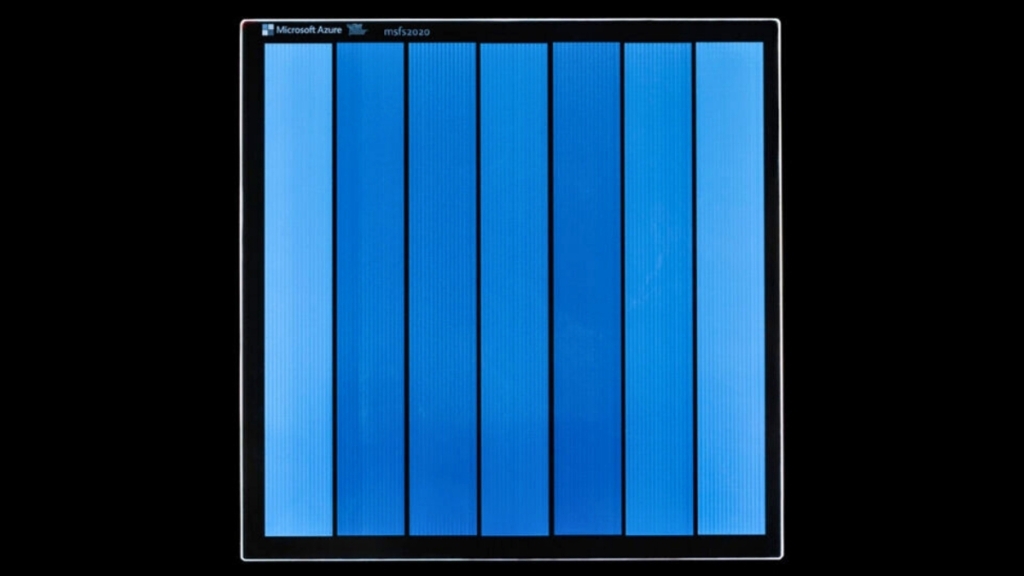
Microsoft’s Silica: A Glass Revolution in Data Storage That Could Last 10,000 Years
In a breakthrough that sounds like science fiction, Microsoft Research scientists have unveiled Silica, a revolutionary data storage system that writes information into ordinary glass using nothing but pulses of laser light. This isn’t just another incremental improvement—it’s a complete reimagining of how humanity might preserve its most precious digital assets for millennia to come.
The Femtosecond Revolution
The magic happens in unimaginably brief moments. Silica employs ultrashort laser pulses lasting mere femtoseconds—that’s quadrillionths of a second (10^-15 seconds). To grasp this scale, consider that ten femtoseconds compared to one minute is like comparing one minute to the entire age of the universe. These aren’t just fast pulses; they’re the same technology that earned the 2023 Nobel Prize in Physics for allowing scientists to observe electron motion inside atoms.
When these femtosecond pulses are focused inside transparent materials like glass, they create intense electric fields that permanently alter the molecular structure in a tiny three-dimensional volume called a voxel. Each voxel is less than a millionth of a meter across—smaller than a human cell.
From Lab Curiosity to Real-World Solution
While the concept of laser-written glass storage isn’t new—Harvard researchers explored volumetric optical storage in the 1990s and Southampton scientists demonstrated “seemingly unlimited lifetime” data storage in 2014—Microsoft’s Silica represents something fundamentally different: a complete, practical system.
The Microsoft team has engineered every component needed for real-world deployment: encoding algorithms, writing protocols, reading mechanisms, decoding processes, and sophisticated error correction. They’ve systematically evaluated trade-offs between reliability, writing speed, energy efficiency, and data density.
Two Paths to Glass Immortality
Silica explores two distinct approaches to writing data in glass. The first creates tiny elongated void-like structures through laser-driven micro-explosions, achieving an astonishing storage density of 1.59 gigabits per cubic millimeter. The second method makes subtler changes to the glass’s refractive index—slower to write but more energy-efficient, capable of writing about 65.9 megabits per second.
The implications are staggering: a thin, palm-sized square of glass could store the equivalent of two million books. More remarkably, accelerated aging tests suggest this data could remain readable for over 10,000 years—outlasting magnetic tape, hard drives, and even most civilizations.
The Mission Impossible Connection
The technology’s potential captured Hollywood’s imagination before it even reached the mainstream. In the latest Mission Impossible film, “The Final Reckoning,” a similar glass storage device appears as a secure vault capable of containing powerful AI. While fictional, the portrayal isn’t far from reality—glass-based storage offers unprecedented security against electromagnetic pulses, radiation, and physical degradation.
Why This Matters Now
When ultrafast laser technology emerged in the late 1990s, it existed only in a handful of specialized laboratories. Today, reliable industrial femtosecond lasers are commercially available off-the-shelf. This maturation means Silica isn’t a distant dream but a technology ready for deployment.
The applications extend far beyond archival storage. Consider the Library of Alexandria’s destruction, the loss of countless historical documents to fire and decay, or the fragility of our current digital infrastructure. Silica offers humanity its first truly permanent digital memory—a way to preserve knowledge across civilizational timescales.
The Future Written in Glass
Microsoft’s Silica represents more than a technological achievement; it’s a philosophical statement about how we value information. In an age of ephemeral cloud storage and rapidly obsolescing formats, glass offers permanence. It’s immune to bit rot, electromagnetic interference, and technological obsolescence.
As ultrafast photonics continues to mature, we’re witnessing the dawn of an era where our digital legacy can outlast the pyramids. The question isn’t whether this technology will transform data storage—it’s how quickly we’ll embrace it and what we’ll choose to preserve for the distant future.
The glass is no longer just half-full or half-empty. With Silica, it’s forever full of our collective memory, written in light and preserved for millennia.
Tags: Microsoft Silica, femtosecond lasers, glass data storage, archival storage, 10000 year data, laser-written glass, volumetric storage, Microsoft Research, permanent data storage, glass memory, future of storage, data preservation, Mission Impossible tech, Nobel Prize physics, glass voxels, refractive index storage, micro-explosions, data immortality, Library of Alexandria, digital legacy
Viral Sentences:
- “Microsoft just stored 2 million books in a piece of glass—and it could last 10,000 years”
- “This isn’t science fiction anymore: data written in glass by lasers that blink faster than the universe has existed”
- “The same technology that won the Nobel Prize is now preserving humanity’s digital legacy in glass”
- “Forget the cloud—the future of data storage is transparent, indestructible, and fits in your palm”
- “Microsoft’s glass storage could outlast every hard drive, every cloud server, and possibly every civilization”
- “The Library of Alexandria could have survived if they’d had Microsoft’s glass storage technology”
- “Data written by lasers so fast they make the universe look slow”
- “This palm-sized glass square could hold all of Wikipedia… and every edit it’s ever had”
- “The Mission Impossible tech is real, and it’s coming to a data center near you”
- “Glass storage: because your grandchildren’s grandchildren deserve to read your tweets”
,

Leave a Reply
Want to join the discussion?Feel free to contribute!