
Vulkan 1.4.344 Released With New Extension From Valve
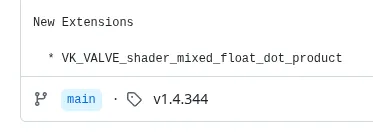
Vulkan 1.4.344 Released with Groundbreaking Valve Extension for Mixed-Precision Shader Operations
In a significant development for the graphics and compute API landscape, the Khronos Group has officially released Vulkan 1.4.344, bringing a host of improvements and a particularly noteworthy addition from Valve Corporation that promises to revolutionize shader performance optimization.
A New Era of Shader Precision
The headline feature of this update is the introduction of VK_VALVE_shader_mixed_float_dot_product, an innovative extension developed by Valve engineers Mike Blumenkrantz and Georg Lehmann. This extension represents a paradigm shift in how developers can approach shader precision management, offering unprecedented control over mixed-precision dot product operations.
Technical Deep Dive: How It Works
The extension leverages a new SPIR-V extension called SPV_VALVE_mixed_float_dot_product, which fundamentally changes how dot product operations can be handled in shaders. Traditionally, shader developers had to choose between precision and performance, often sacrificing one for the other. This new extension elegantly solves this dilemma by allowing different precision levels for inputs and accumulation operations.
Supported Precision Combinations
The SPV_VALVE_mixed_float_dot_product extension currently supports four distinct precision configurations:
-
2-component vector of 16-bit float inputs with 32-bit accumulation: This configuration allows developers to use lower-precision inputs while maintaining higher precision during accumulation, effectively balancing memory bandwidth savings with numerical accuracy.
-
2-component vector of 16-bit float inputs with 16-bit accumulation: For scenarios where both input and accumulation precision can be reduced without significant quality loss, this option provides maximum performance benefits.
-
2-component vector of bfloat16 inputs with 32-bit or bfloat16 accumulation: Brain floating-point (bfloat16) support opens up new possibilities for machine learning and AI workloads, where this format has proven particularly effective.
-
4-component vector of 8-bit float inputs with 32-bit accumulation: This configuration is particularly interesting for color processing and other operations where high dynamic range isn’t critical but accumulation precision remains important.
Performance Implications
The introduction of mixed-precision dot products has far-reaching implications for performance optimization. By allowing developers to tailor precision levels to specific use cases, applications can achieve significant performance gains without compromising visual quality where it matters most.
For instance, in graphics rendering pipelines, many operations don’t require full 32-bit precision throughout the entire computation chain. The ability to use 16-bit or even 8-bit precision for certain operations while maintaining 32-bit precision for critical accumulation steps can result in substantial memory bandwidth savings and improved cache utilization.
Industry Impact and Adoption
This extension is particularly timely given the current trends in hardware development. Modern GPUs from NVIDIA, AMD, and Intel have increasingly focused on supporting lower-precision operations to accelerate AI and machine learning workloads. Valve’s extension bridges the gap between traditional graphics programming and these emerging hardware capabilities.
The gaming industry, in particular, stands to benefit significantly. With the ongoing push for higher frame rates and more complex visual effects, the ability to optimize shader precision without sacrificing quality could be a game-changer for developers working on performance-critical applications.
Broader Ecosystem Benefits
Beyond gaming, this extension has potential applications in scientific computing, data visualization, and any field that relies heavily on GPU acceleration. The flexibility offered by mixed-precision operations could enable more efficient simulations, faster data processing, and improved real-time analytics.
Technical Implementation Details
For developers interested in implementing this extension, the specification details how the mixed-precision operations integrate seamlessly with existing Vulkan workflows. The extension maintains backward compatibility while providing new capabilities that can be selectively enabled based on hardware support and application requirements.
The implementation follows Vulkan’s established patterns for extension development, ensuring that developers familiar with the API can quickly adopt these new features without a steep learning curve.
Future Developments
While the current version of the extension supports a specific set of precision combinations, the underlying architecture suggests potential for future expansion. As hardware continues to evolve and new precision formats emerge, this extension framework could be extended to support additional configurations.
Community Response
The graphics development community has responded positively to this release, with many developers expressing excitement about the potential performance optimizations enabled by mixed-precision operations. The extension has already sparked discussions about best practices for precision management in shader development.
Accessing the Update
The Vulkan 1.4.344 specification and all related documentation are available through the Khronos Group’s official channels. Developers can access the complete specification, along with implementation guides and example code, to begin integrating these new capabilities into their projects.
Conclusion
Vulkan 1.4.344 represents a significant step forward in graphics API evolution, with Valve’s mixed-precision extension serving as a prime example of how industry collaboration can drive innovation. As developers begin to explore and implement these new capabilities, we can expect to see tangible improvements in application performance across a wide range of use cases.
The release underscores Vulkan’s continued relevance in an increasingly competitive graphics API landscape and demonstrates the Khronos Group’s commitment to evolving the standard in response to industry needs and technological advancements.
tags
Vulkan #GraphicsAPI #Valve #ShaderProgramming #MixedPrecision #GamingTechnology #GPUComputing #KhronosGroup #SPIRV #PerformanceOptimization #GameDevelopment #GraphicsProgramming #TechNews #APIUpdate #ComputerGraphics
viral_sentences
Valve drops game-changing Vulkan extension that will supercharge shader performance
Mixed-precision operations coming to Vulkan thanks to Valve engineers
Graphics developers rejoice: Vulkan 1.4.344 brings revolutionary precision control
The future of shader programming just got a major upgrade
Valve’s latest contribution to Vulkan could change how we think about precision in graphics
Gaming performance is about to get a serious boost
This Vulkan update is what graphics developers have been waiting for
Mixed-precision dot products: the optimization technique you didn’t know you needed
Valve continues to push the boundaries of graphics technology
The Khronos Group delivers another powerful update to the Vulkan ecosystem
Shader programming enters a new era of flexibility and performance
Graphics cards are about to get even more efficient
This extension could be the key to unlocking next-gen gaming performance
Vulkan keeps proving why it’s the API of choice for cutting-edge graphics
Valve’s engineering team strikes again with another brilliant graphics innovation
The precision-performance balance just got a whole lot more interesting
Graphics developers now have unprecedented control over shader operations
This update proves Vulkan is still the most innovative graphics API
Mixed-precision operations are coming to a GPU near you
The future of real-time graphics just got brighter
,


Leave a Reply
Want to join the discussion?Feel free to contribute!