
Simdjson Shows More Speed-Ups Possible For SIMD In JSON Parsing: Another 30% Boost
simdjson 4.3 Unleashes Massive Performance Gains in JSON Parsing with SIMD Optimizations
In the fast-paced world of software development, JSON parsing is a critical operation that can significantly impact application performance. The open-source simdjson project has long been a leader in high-performance JSON parsing, leveraging Single Instruction, Multiple Data (SIMD) instructions to achieve speeds of parsing gigabytes of JSON per second. With the release of simdjson 4.3, the project continues to push the boundaries of what’s possible, delivering yet another round of groundbreaking optimizations that promise to revolutionize JSON processing.
A Brief History of simdjson’s Performance Breakthroughs
Years ago, simdjson made headlines when it demonstrated the massive performance advantages of using AVX-512 instructions in JSON parsing. The results were nothing short of astonishing, with speed improvements that developers had only dreamed of. Since then, the simdjson team has been relentless in their pursuit of optimization, continuously refining and enhancing the library to squeeze every last bit of performance out of modern hardware.
What’s New in simdjson 4.3?
The latest release, simdjson 4.3, is packed with a host of improvements and optimizations that further cement its position as the go-to library for high-performance JSON parsing. Let’s dive into the key highlights:
1. Runtime Dispatching on LoongArch
One of the most significant additions in simdjson 4.3 is the introduction of runtime dispatching on LoongArch, a new instruction set architecture. This enhancement allows simdjson to take full advantage of the LSX (Loongson SIMD eXtensions) and LASX (Loongson Advanced SIMD eXtensions) instructions, ensuring optimal performance on Loongson processors. This move underscores simdjson’s commitment to supporting a wide range of hardware platforms and maximizing performance across diverse environments.
2. Microsoft Visual C++ Group’s Build Optimizations
In a collaborative effort, Microsoft’s Visual C++ Group has contributed optimizations that have significantly improved the build throughput of simdjson by an impressive 30%. This enhancement not only speeds up the development process but also makes it easier for developers to integrate simdjson into their projects, reducing the time from code to execution.
3. SIMD String Escaping and Batch Integer Formatting
Perhaps the most exciting feature of simdjson 4.3 is the introduction of SIMD optimizations for string escaping and batch integer formatting. This optimization, detailed in this pull request, is a game-changer for applications that handle large amounts of string-heavy JSON data. By leveraging SIMD instructions, simdjson can now process string escaping and integer formatting in parallel, resulting in massive performance gains.
4. Benchmark Results: The Proof is in the Pudding
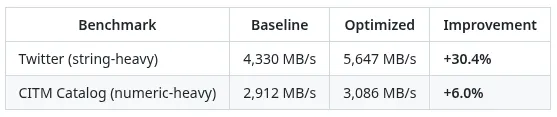
To quantify the impact of these optimizations, the simdjson team conducted rigorous benchmarks using the Twitter and CITM Catalog datasets. The results are nothing short of spectacular:
- Twitter Benchmark: A staggering 30% improvement in parsing speed, making it even faster to process the massive amounts of JSON data generated by social media platforms.
- CITM Catalog Benchmark: A 6% improvement, particularly notable given that this dataset is more numeric-heavy than string-heavy. This demonstrates the versatility of the optimizations, benefiting a wide range of JSON data types.
These optimizations are implemented using ARM64 NEON and SSE2 instructions, ensuring compatibility with a broad spectrum of modern processors.
Why This Matters: The Impact on Developers and Applications
The release of simdjson 4.3 is more than just a technical milestone; it has real-world implications for developers and the applications they build. Here’s why this matters:
-
Faster Applications: With the ability to parse JSON data faster than ever before, applications can deliver a smoother, more responsive user experience. Whether it’s a real-time analytics dashboard or a high-frequency trading platform, every millisecond counts.
-
Reduced Infrastructure Costs: Faster JSON parsing means less computational overhead, which can translate to lower infrastructure costs. Companies can handle more data with fewer resources, optimizing their operations and reducing their carbon footprint.
-
Enhanced Developer Productivity: The 30% improvement in build throughput, thanks to Microsoft’s contributions, means developers can iterate faster, test more efficiently, and bring their products to market sooner.
-
Broader Hardware Support: The inclusion of LoongArch support ensures that simdjson remains relevant in an increasingly diverse hardware landscape, catering to developers working with Loongson processors.
How to Get Started with simdjson 4.3
For developers eager to harness the power of simdjson 4.3, getting started is straightforward. The library is available for download on GitHub, where you can find detailed documentation, installation instructions, and examples to help you integrate simdjson into your projects.
If you’re interested in seeing how simdjson performs on different CPUs, you can explore the benchmark results on OpenBenchmarking.org. These benchmarks provide valuable insights into the performance characteristics of simdjson across various hardware configurations.
Looking Ahead: The Future of JSON Parsing
As the volume of JSON data continues to grow exponentially, the need for high-performance parsing solutions will only become more critical. simdjson has consistently demonstrated its ability to rise to the challenge, and with the release of version 4.3, it has once again set a new standard for what’s possible.
The simdjson team’s relentless focus on optimization, coupled with their commitment to supporting diverse hardware platforms, ensures that simdjson will remain at the forefront of JSON parsing technology for years to come. Whether you’re a developer working on a small-scale application or a large enterprise managing petabytes of data, simdjson 4.3 offers the performance, flexibility, and reliability you need to succeed.
Conclusion
In conclusion, simdjson 4.3 is a testament to the power of open-source collaboration and the relentless pursuit of performance optimization. With its groundbreaking SIMD optimizations, support for new hardware architectures, and impressive benchmark results, simdjson 4.3 is poised to transform the way developers handle JSON data. If you haven’t already, now is the perfect time to explore what simdjson can do for your projects.
Tags:
JSON parsing, SIMD instructions, high-performance computing, simdjson 4.3, AVX-512, LoongArch, LSX, LASX, ARM64 NEON, SSE2, Microsoft Visual C++, build optimizations, string escaping, batch integer formatting, Twitter benchmark, CITM Catalog benchmark, open-source, GitHub, OpenBenchmarking.org, JSON data processing, software development, hardware acceleration, performance optimization.
Viral Sentences:
- “simdjson 4.3 parses gigabytes of JSON per second—yes, you read that right!”
- “30% faster build throughput? Microsoft just made simdjson even more unstoppable.”
- “String-heavy JSON? No problem. simdjson 4.3’s SIMD optimizations crush it.”
- “LoongArch support in simdjson 4.3? The future of JSON parsing is here.”
- “From Twitter to CITM Catalog, simdjson 4.3 delivers mind-blowing performance gains.”
- “Why settle for slow JSON parsing when simdjson 4.3 can do it in a blink?”
- “simdjson 4.3: Where cutting-edge SIMD meets real-world performance.”
- “Developers, rejoice! simdjson 4.3 is here to make your life easier and your apps faster.”
- “The benchmarks don’t lie: simdjson 4.3 is a game-changer for JSON parsing.”
- “Open-source brilliance: simdjson 4.3 proves that collaboration drives innovation.”
,

Leave a Reply
Want to join the discussion?Feel free to contribute!