
We’ve spotted the strongest microwave laser in the known universe
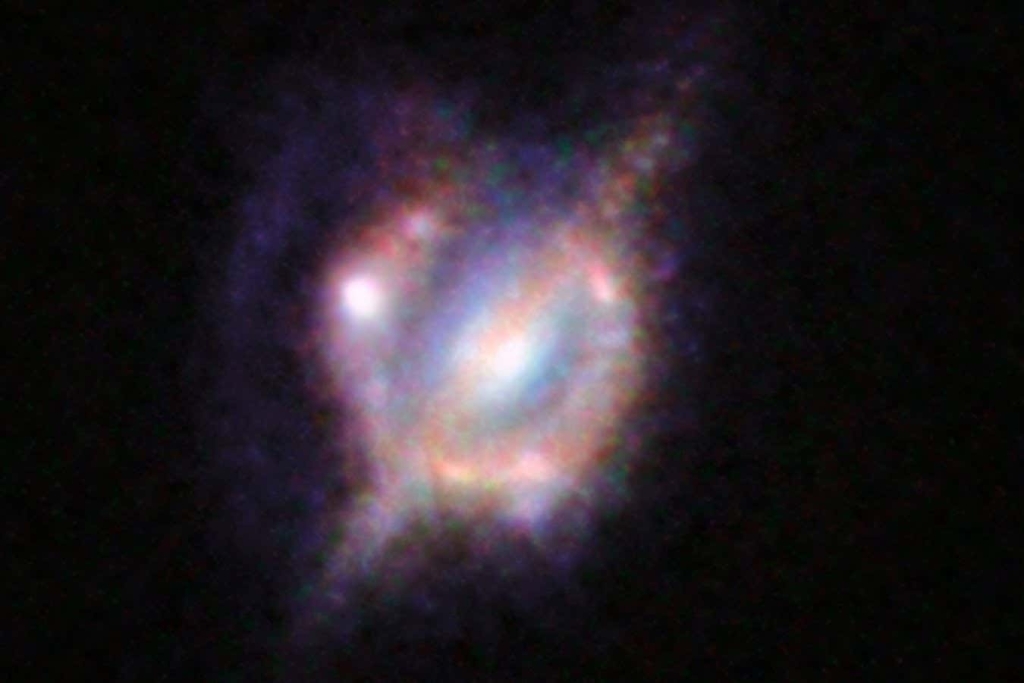
Breaking: Astronomers Detect Record-Breaking Cosmic Laser Beam 8 Billion Light-Years Away—A Galactic Collision Like No Other
In a discovery that’s sending shockwaves through the astrophysics community, scientists have detected the brightest and most distant cosmic maser ever observed—a laser-like beam of microwaves produced by two galaxies violently colliding 8 billion light-years from Earth. This isn’t just another space headline; this is a game-changer for how we understand the early universe, galactic evolution, and the extreme physics of cosmic collisions.
The Discovery: A Maser 100,000 Times Brighter Than a Star
The team, led by Dr. Roger Deane at the University of Pretoria, South Africa, was using the MeerKAT radio telescope array—64 linked dishes working as one giant cosmic ear—when they stumbled upon something extraordinary. While scanning for molecular hydrogen emissions, they detected an intense signal at 1667 megahertz, a frequency only produced by powerful masers.
“We had a quick look at the 1667 megahertz, just to see whether it was even detectable, and there was this booming, huge signal,” Deane said. “It was immediately the record. It was serendipitous.”
This maser is so bright—approximately 100,000 times the luminosity of a star—that it may deserve its own classification: a “gigamaser,” far more powerful than the megamasers previously observed in nearby galaxies.
How Cosmic Masers Work: The Universe’s Natural Lasers
Think of a maser as the microwave version of a laser. In a laser, atoms are excited to higher energy states, then stimulated by photons to emit identical, coherent light. In space, when galaxies collide, the compression of gas triggers intense star formation. The light from these newborn stars travels through dust clouds, exciting hydroxyl molecules (OH)—combinations of hydrogen and oxygen atoms. When these excited molecules are hit with radio waves from sources like supermassive black holes, they relax and emit a focused beam of microwave radiation: a maser.
Gravitational Lensing: Nature’s Cosmic Magnifying Glass
What makes this discovery even more remarkable is that the light from galaxy H1429-0028 was magnified by a massive galaxy between it and Earth, acting as a gravitational lens. This cosmic magnification effect allowed astronomers to detect a signal that would otherwise be far too faint, revealing details of a galaxy merger from when the universe was less than half its current age.
Why This Matters: Peering Into the Early Universe
Dr. Matt Jarvis of the University of Oxford emphasizes the significance: “Such distant galaxy masers will be from some of the first galaxies formed in the universe and could give us precise information about how galaxies were merging far back in time.”
These masers require very specific conditions: intense infrared emission from dust heated by forming stars, and radio continuum emission—both of which are only found in merging galaxies. By studying these cosmic beacons, astronomers can map the timeline of galactic collisions and star formation in the early cosmos with unprecedented precision.
The Future: Square Kilometre Array and Beyond
The MeerKAT telescope’s discovery is just the beginning. When the Square Kilometre Array (SKA) in South Africa comes online in the coming years, it will be far more sensitive and capable of detecting similar masers at even greater distances. This will open a new window into the universe’s formative years, allowing scientists to witness galactic mergers as they happened billions of years ago.
Tags & Viral Phrases:
- Record-breaking cosmic maser detected 8 billion light-years away
- Universe’s most powerful natural laser beam discovered
- Galaxies colliding to create brightest microwave beam ever seen
- Gigamaser: 100,000 times brighter than a star
- Gravitational lensing magnifies ancient galactic collision
- MeerKAT telescope makes serendipitous discovery
- Square Kilometre Array to reveal even more cosmic secrets
- Early universe galactic mergers mapped with cosmic masers
- Astronomers detect laser-like microwaves from colliding galaxies
- Breakthrough in understanding how galaxies formed and evolved
This discovery isn’t just a scientific milestone—it’s a cosmic spectacle that reminds us how much of the universe remains hidden, waiting for the right telescope and the right moment to reveal its secrets. Stay tuned: the SKA era is about to rewrite the story of the cosmos.
,

Leave a Reply
Want to join the discussion?Feel free to contribute!