
AI hit: India hungry to harness US tech giants’ technology at Delhi summit | India
India’s AI Gamble: Independence, Innovation, and the Shadow of Digital Colonialism
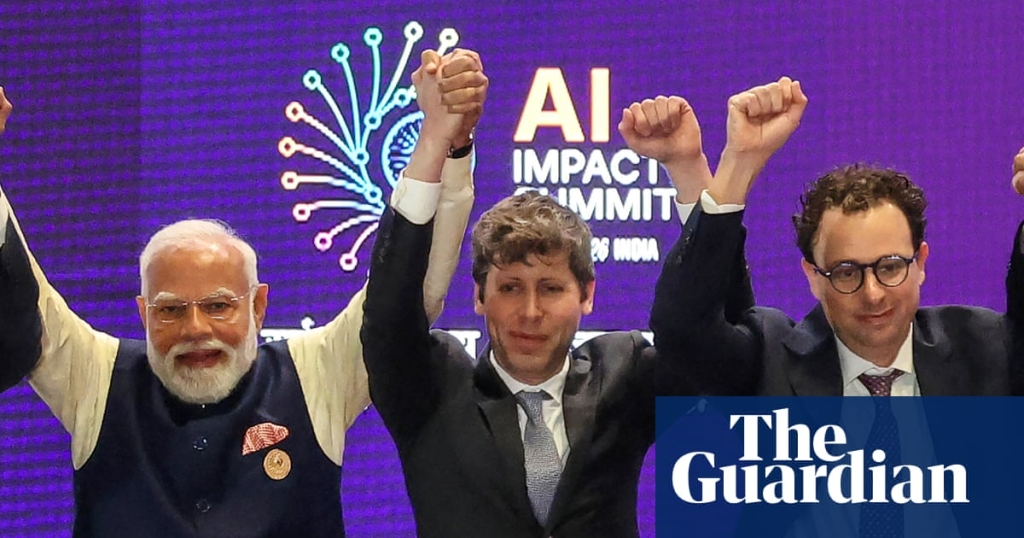
As India marks 80 years of independence from British rule in August 2027, the nation finds itself at another pivotal crossroads—this time in the realm of artificial intelligence. At the AI Impact Summit in Delhi, hosted by Prime Minister Narendra Modi, the question loomed large: Can India harness the power of AI to propel its 1.4 billion people into a new era of prosperity without falling back into the trap of dependence on foreign powers?
Modi, ever the visionary, likened AI to a civilization-altering force, comparing it to the discovery of fire or the dawn of electricity. His ambition is clear: to use AI to supercharge India’s economic growth and secure its place as a global leader. But as Silicon Valley giants like OpenAI, Google, and Anthropic flood the market with their AI models, India faces a stark choice—align with the US or risk being left behind in the global AI race.
The stakes couldn’t be higher. At the summit, the US government signed the Pax Silica agreement, a pact that binds India closer to American tech and further from Beijing. Jacob Helberg, the US under secretary of state for economic affairs, warned of the dangers of looking elsewhere, citing a suspected Chinese cyber-attack on Mumbai in 2020 as a cautionary tale. “We have seen the lights of a great Indian city extinguished by a keystroke,” he said, underscoring the geopolitical tensions at play.
But India’s path forward is fraught with challenges. The country lacks the semiconductors, power plants, and vast data centers needed to build its own AI infrastructure. Like most nations, it must choose between US and Chinese AI models—a decision that could determine who controls India’s future. As Stuart Russell, a professor of artificial intelligence at Berkeley, put it, “If we get to AGI, AI is going to be producing 80% of the global economy, all manufacturing, most agriculture, all services will be just done, managed by AI, produced by AI.”
Imagine a rural Indian village that can’t afford a health center. In the future, AI could design the hospital, and a fleet of giant quadcopters could deliver the materials, while robots assemble everything in weeks. But in this scenario, technology becomes the backbone of a nation’s well-being, and the controller of AI gains enormous leverage. As Anthropic’s CEO Dario Amodei suggested, AI could even help India achieve a staggering 25% economic growth, catapulting it to a per-capita GDP equivalent to Greece in a decade. How could any leader resist?
Modi’s tech secretary, Shri Krishnan, emphasized the need for India to ally with like-minded countries to avoid “enslavement.” But the US, too, has its own agenda. Chris Lehane, OpenAI’s head of global policy, framed the partnership as one of equals: “We don’t see India as a customer, we see it as a strategic partner.” Yet, as Michael Kratsios, Donald Trump’s science and technology adviser, argued, “Any country that builds on top of the American AI stack will have the most open, independently controlled, secured stack the world has to offer.”
Still, skepticism abounds. Russell warned that Silicon Valley’s ultimate goal is to create “AI addicts” who can’t function without their help. “Silicon Valley has always been about eyeballs,” he said. “You monetise later and it works. Google and Facebook generate vast amounts of money.” And when asked how Indian entrepreneurs could build their own AI, OpenAI’s Sam Altman was blunt: “It’s totally hopeless to compete with us on training foundation models, and you shouldn’t even try.”
India is investing billions in data centers and semiconductor capacity, but it will take years for these efforts to bear fruit. In the meantime, the country must navigate a delicate balance between leveraging American AI and preserving its cultural and economic sovereignty. As Joanna Shields, a former Facebook and Google executive, warned, “If we have a world where we are accepting models from just the global north, we will lose so much of our cultural diversity, our uniqueness as people.”
As India stands on the brink of this new era, the question remains: Will it thrive with American AI, or will it find a way to chart its own course? The answer could shape not just India’s future, but the future of the entire world.
Tags: #AI #India #Technology #ArtificialIntelligence #DigitalSovereignty #GlobalTech #Innovation #EconomicGrowth #Geopolitics #SiliconValley #OpenAI #Google #Anthropic #NarendraModi #USIndiaRelations #China #CyberSecurity #CulturalDiversity #FutureOfWork #AGI #DataCenters #Semiconductors #DigitalColonialism
Viral Phrases: “AI could help India achieve 25% economic growth,” “The lights of a great Indian city extinguished by a keystroke,” “AI addicts who can’t tie their shoelaces without AI,” “The most open, independently controlled, secured stack,” “Losing cultural diversity to a handful of global models,” “It’s totally hopeless to compete with us on training foundation models.”
,

Leave a Reply
Want to join the discussion?Feel free to contribute!