
Linux Begins Seeing Early Preparations For PCIe 7.0
Linux Kernel Begins Early PCI Express 7.0 Support as Next-Gen Standard Takes Shape
The world of high-speed computing is once again preparing for a leap forward, and this time it’s not just about faster processors or bigger GPUs—it’s about how those components talk to each other. PCI Express, the backbone interconnect standard that powers nearly every modern computer, is on the verge of its next major evolution. While PCI Express 6.0 devices are still making their way into the market, engineers are already laying the groundwork for PCI Express 7.0, the next generation that promises to double data throughput and redefine the limits of system performance.
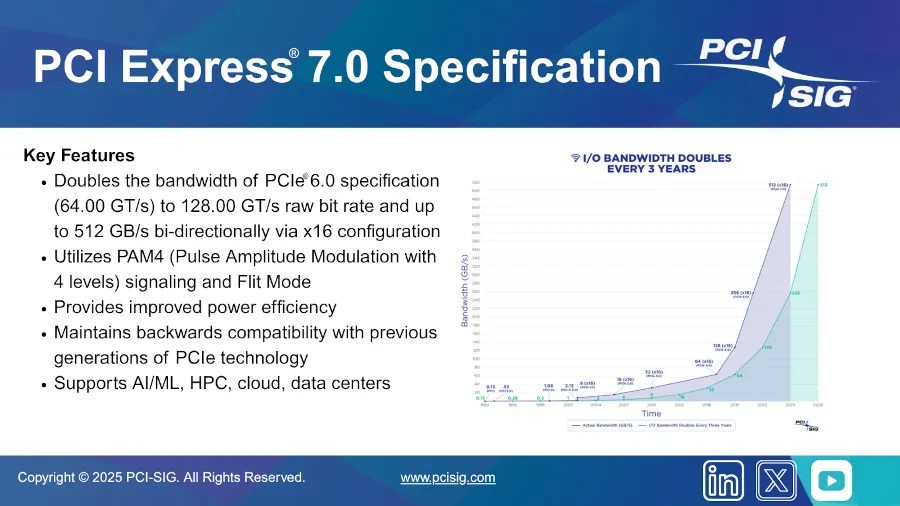
In mid-2025, the PCI-SIG (PCI Special Interest Group) officially released the PCI Express 7.0 specification. This new standard pushes the raw data rate to an astounding 128 gigatransfers per second (GT/s), effectively doubling the speed of PCIe 6.0. For context, that means a single PCIe 7.0 x16 slot can now support up to 512 gigabytes per second of bi-directional communication. To put that into perspective, that’s enough bandwidth to transfer the entire contents of a modern solid-state drive in just a few seconds.
But raw speed isn’t the only headline here. PCIe 7.0 maintains full backward compatibility with all previous generations, ensuring that new hardware can slot seamlessly into existing systems. It also brings significant improvements in power efficiency and thermal management, crucial for the increasingly power-hungry components in today’s data centers and high-performance computing environments.
Despite the impressive specifications, PCIe 7.0 hardware is still a ways off. Industry analysts predict that the first PCIe 7.0 devices won’t appear until late 2027 or even 2028. However, the open-source community isn’t waiting around. In a sign of just how forward-thinking the Linux kernel development community is, early patches supporting PCIe 7.0 have already begun to surface.
This week, Ionut Nechita, an engineer at Amazon Web Services (AWS), submitted a set of patches to the Linux kernel mailing list. These patches lay the foundational groundwork for PCIe 7.0 support, including register definitions, speed detection routines, and basic bandwidth and thermal management tweaks. While the code is still in its infancy—only compile-tested and not yet run on actual hardware—it represents a crucial first step in ensuring that Linux will be ready to support the next generation of PCIe devices from day one.
The patches themselves are mostly boilerplate at this stage, setting up the necessary infrastructure so that when PCIe 7.0 hardware finally arrives, the Linux kernel will be able to recognize and utilize it without requiring major overhauls. This proactive approach is typical of the Linux community, which has a long history of preparing for future technologies well in advance.
For those interested in following the development, the patch series is available on the Linux kernel mailing list. While it may be some time before these changes make their way into a mainline kernel release, the fact that work is already underway is a testament to the collaborative and forward-looking nature of open-source development.
As we look to the future, the arrival of PCI Express 7.0 signals more than just another speed bump. It represents a fundamental shift in what’s possible for computing at every level—from consumer PCs to the largest cloud data centers. With support for unprecedented data rates, improved efficiency, and seamless backward compatibility, PCIe 7.0 is poised to power the next generation of technological innovation.
And while we may have to wait a few more years before we can slot a PCIe 7.0 device into our machines, the fact that the Linux kernel is already preparing for it is a clear sign that the future of computing is being built today—one patch at a time.
Tags / Viral Phrases:
PCI Express 7.0, PCIe 7.0, 128 GT/s, 512GB/s, PCI-SIG, Linux kernel, Ionut Nechita, AWS, next-gen hardware, data center, high-speed computing, bi-directional communication, backward compatibility, power efficiency, thermal management, open-source development, kernel patches, RFC patches, compile-tested, future-proof, technological innovation, gigatransfers per second, system performance, interconnect standard, hardware driver, mainline kernel, collaborative development, forward-looking, cutting-edge technology, computing evolution.
,

Leave a Reply
Want to join the discussion?Feel free to contribute!