
Apple faces more pain as Trump's global import tariff grows from 10% to 15%
Trump’s Tariff Surge: Apple Braces for Impact as Global Import Tax Jumps to 15%
In a dramatic escalation of trade tensions, President Donald Trump has increased his global import tariff from 10% to 15%, barely 24 hours after the Supreme Court struck down his previous “reciprocal” tariff measures. The rapid-fire policy reversal has sent shockwaves through the tech industry, with Apple and other major manufacturers facing potentially billions in additional costs.
The Supreme Court’s Friday ruling declared that Trump’s sweeping reciprocal tariffs had been implemented illegally, citing procedural violations in how the administration had rolled out the controversial trade measures. The decision was seen as a significant check on executive power regarding trade policy, though it clearly failed to deter the President’s determination to reshape America’s trade relationships.
Within hours of the court’s decision, Trump unveiled a replacement tariff structure under Section 122 of the Trade Act, establishing a 10% global import tax. This new framework was designed to comply with legal requirements, including uniform application across all trading partners and a maximum duration of 150 days unless extended by Congress. However, what many analysts initially viewed as a tactical retreat quickly revealed itself as merely a pause in Trump’s broader trade strategy.
The Section 122 provision that Trump leveraged permits temporary tariffs of up to 15% for national security purposes—a threshold the President has now decided to test. The overnight increase from 10% to 15% represents not just a numerical change but a significant intensification of pressure on America’s trading partners and domestic manufacturers alike.
For Apple, the world’s most valuable technology company, the implications are particularly severe. The Cupertino-based tech giant has already warned investors about the financial impact of Trump’s trade policies, estimating that the initial 10% tariff could cost the company approximately $2 billion. With the tariff now jumping to 15%, Apple faces an even steeper climb in managing its global supply chain costs.
The timing of this escalation could hardly be worse for Apple. The company is currently navigating a complex transition in its manufacturing strategy, attempting to diversify production away from China while maintaining the efficiency and scale that have made it the dominant player in consumer electronics. Each percentage point increase in tariffs adds friction to this delicate rebalancing act.
Industry analysts note that Apple’s situation exemplifies the broader challenges facing American technology companies in the current trade environment. Unlike simpler manufactured goods, Apple’s products involve hundreds of components sourced from dozens of countries, each potentially subject to different tariff treatments depending on their country of origin. This complexity creates a logistical nightmare for supply chain managers and financial officers alike.
The 15% tariff applies to a wide range of electronic components and finished goods, including smartphones, laptops, tablets, and accessories. For Apple’s core iPhone business, which generates the majority of the company’s revenue, the increased tariff burden could translate to higher consumer prices, reduced profit margins, or some combination of both.
Trump’s decision to push the tariff to its legal maximum under Section 122 suggests a deliberate strategy to maximize leverage in ongoing trade negotiations. By setting the tariff at 15%, the President retains room to negotiate downward while maintaining pressure on trading partners to make concessions. This approach aligns with Trump’s broader “maximum pressure” tactics in international diplomacy.
The tech industry’s response to the tariff increase has been one of cautious concern. Major manufacturers are scrambling to assess the full impact on their operations, with many exploring options to shift production to countries not subject to the tariffs or to absorb costs rather than pass them on to consumers. However, the 90-day window provided by Section 122 offers little time for comprehensive restructuring of complex global supply chains.
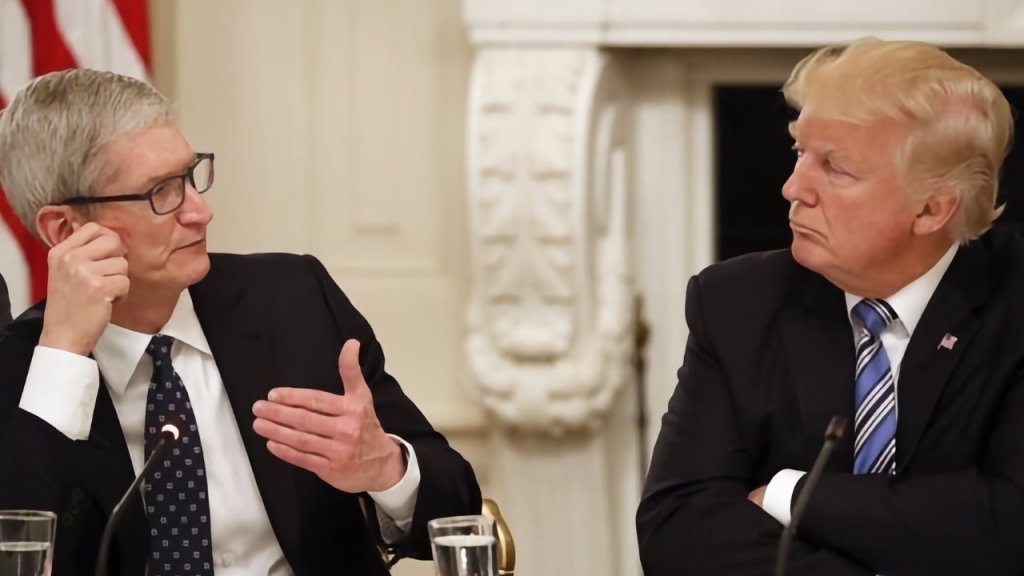
Apple’s CEO Tim Cook, who has cultivated a relationship with President Trump despite policy disagreements, now faces the challenge of navigating these turbulent waters while protecting the company’s financial performance and market position. The two leaders have met multiple times during Trump’s presidency, with Cook emphasizing Apple’s contributions to the U.S. economy through jobs and investment. However, the latest tariff escalation suggests that personal relationships may carry limited weight in Trump’s trade calculations.
The broader economic implications extend beyond individual companies. Higher tariffs on electronics and components could lead to increased prices for consumers, potentially slowing adoption of new technologies and impacting economic growth. Small and medium-sized tech companies, lacking Apple’s resources and pricing power, may find themselves particularly vulnerable to the increased costs.
Financial markets have reacted nervously to the tariff developments, with technology stocks experiencing volatility as investors assess the potential impact on corporate earnings. The uncertainty surrounding trade policy has created challenges for business planning and investment decisions across the tech sector.
As the 150-day period specified under Section 122 begins to tick down, all eyes will be on whether Trump uses the time to negotiate new trade agreements or whether he seeks congressional extension of the higher tariff rates. The answer will have profound implications not just for Apple and other tech giants, but for the entire landscape of global technology manufacturing and trade.
For now, the tech industry finds itself in a state of heightened alert, watching Washington closely and preparing contingency plans for multiple scenarios. The rapid escalation from 10% to 15% demonstrates that in Trump’s trade policy, yesterday’s resolution can quickly become today’s new baseline, leaving companies to navigate an environment of constant uncertainty and adaptation.
tags
Trump tariffs, Apple trade war, Section 122 tariffs, global import tax, tech industry tariffs, iPhone tariffs, Tim Cook Trump meeting, Supreme Court trade decision, reciprocal tariffs struck down, 15% global tariff, technology supply chain, trade policy uncertainty, Apple manufacturing costs, electronics tariffs, Trump trade escalation
viral sentences
Trump just hit the gas on trade war, Apple’s $2B problem just got $1B worse, Supreme Court said no but Trump said watch this, 10% to 15% overnight, tech giants scrambling as tariff bomb drops, Cook’s charm offensive fails against tariff machine, 150 days to rewrite global tech supply chains, your next iPhone might cost way more, small tech companies brace for impact, Wall Street nervous as tariff clouds gather, Trump plays hardball with Section 122, Apple caught in crossfire of trade battle, manufacturing exodus accelerates as costs spike, consumers may pay price for trade showdown, uncertainty becomes the only certainty in tech trade.
,

Leave a Reply
Want to join the discussion?Feel free to contribute!