
Scientists Simulated The Big Bang’s Aftermath, And Found The Universe Was Like Soup : ScienceAlert
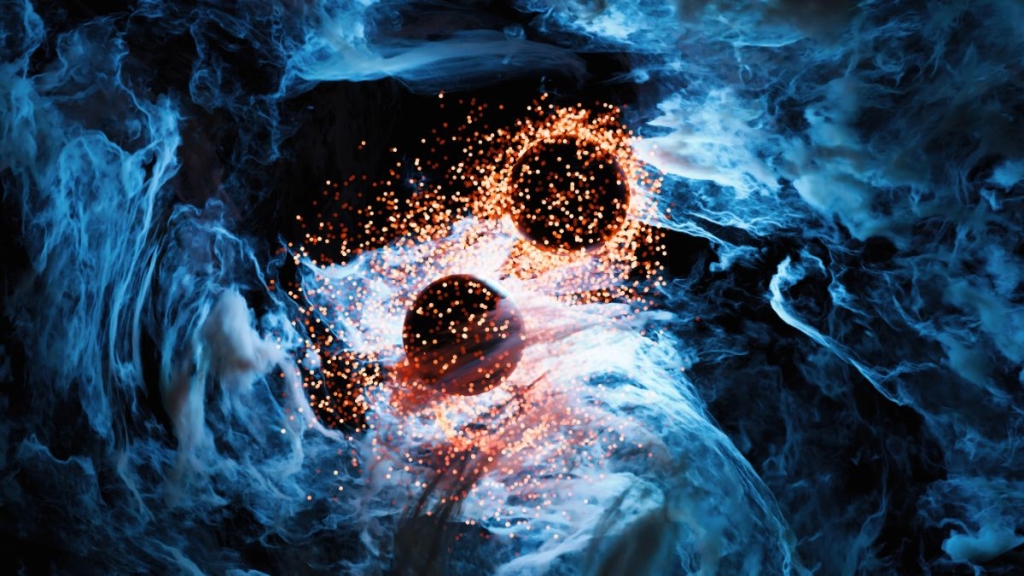
Unlocking the Secrets of the Universe’s Primordial Soup: Scientists Confirm the Big Bang’s Gooey Plasma Sloshed Like a Liquid
In a groundbreaking discovery that peels back the layers of cosmic history, physicists have provided the first definitive evidence that the Universe’s earliest state of matter—the quark-gluon plasma (QGP)—actually sloshed and swirled like a liquid soup. This ultra-hot, ultra-dense substance existed for just a fraction of a second after the Big Bang, reaching temperatures over a billion times hotter than the surface of the Sun.
The research, conducted by an international team from MIT and CERN, used data from the Large Hadron Collider (LHC) to recreate the extreme conditions of the early Universe. By smashing lead particles together at nearly the speed of light, the scientists were able to produce tiny droplets of QGP and observe how particles behaved as they moved through this primordial medium.
The Cosmic “Soup” That Shaped Everything
Immediately after the Big Bang, the Universe was a trillion-degree “soup” of unimaginably dense plasma. This substance, known as quark-gluon plasma, was the first and hottest liquid ever to exist. For a few millionths of a second, this exotic goo permeated the infant Universe before expanding, cooling, and eventually coalescing into the atoms that make up everything we see today.
The question that has puzzled physicists for decades is: what exactly did this primordial soup behave like? Did it act as a cohesive liquid, or did it scatter randomly like a collection of particles? The new research provides compelling evidence that it behaved as a true liquid, complete with wakes, splashes, and swirls.
The Experiment That Cracked the Cosmic Code
To investigate the properties of QGP, the researchers analyzed data from over 13 billion collisions between lead particles at CERN’s Large Hadron Collider. These collisions produce sprays of energetic particles, including quarks, as well as tiny droplets of the quark-gluon plasma that once filled the early Universe.
The challenge was immense. When quarks are produced in these high-energy collisions, they never exist alone—they’re typically paired with antiquarks, their oppositely charged counterparts. Both the quark and antiquark fly off in opposite directions at the same speed, each creating a wake in the plasma and complicating detection efforts.
To overcome this challenge, the physicists employed a clever strategy. Instead of searching for quark-antiquark pairs, they looked for collisions that produced a quark paired with a Z boson—a neutral elementary particle that doesn’t interact with the QGP and therefore doesn’t create a wake.
Out of 13 billion collisions analyzed, only about 2,000 produced a Z boson, but this rarity proved to be the key to unlocking the mystery. Because the Z boson doesn’t interact with the plasma, the researchers could finally isolate and analyze the wake caused by a single speeding quark.
The Discovery: QGP Really Was a “Primordial Soup”
The results were stunning. As predicted by theoretical models, the quark-gluon plasma reacted exactly like a liquid. When a quark moved through the plasma, it transferred some of its energy to the surrounding medium, losing speed and creating a wake similar to a boat moving through water.
“By analogy, when you have a boat moving through a lake, the wake is water behind the boat that is moving in the direction of the boat,” explained Krishna Rajagopal, a physicist at MIT who developed the theoretical model predicting QGP’s fluid properties. “The boat has transferred momentum to some region of water, which is ‘following’ it.”
This “wake effect” in the quark-gluon plasma provides definitive, unmistakable evidence that this primordial substance behaved as a liquid rather than a collection of independent particles. The plasma was incredibly dense, able to slow down a quark and produce splashes and swirls like any other liquid.
Why This Matters: Peering Into the Universe’s Infancy
This discovery isn’t just about satisfying scientific curiosity—it provides crucial insights into the fundamental nature of matter and the evolution of our Universe. The behavior of quark-gluon plasma in the first moments after the Big Bang set the stage for everything that followed, including the formation of protons, neutrons, and eventually, all the matter in the cosmos.
Understanding how this primordial soup behaved helps physicists refine their models of the early Universe and could have implications for other areas of physics, including the study of neutron stars and the behavior of matter under extreme conditions.
The Technical Marvel Behind the Discovery
The experiment required extraordinary precision and technological sophistication. The quark-gluon plasma exists for only a quadrillionth of a second within the LHC, and researchers had to sort through tens of thousands of wildly interacting particles to detect the relatively few particles displaced by the wake.
The data was collected using the Compact Muon Solenoid (CMS) detector at CERN, one of the largest and most complex scientific instruments ever built. The CMS can track the paths of particles moving at nearly the speed of light and measure their energies with incredible precision.
Looking Forward: New Windows Into the Early Universe
This new technique opens up exciting possibilities for future research. By providing a clearer view of heavy-ion collisions than previous experiments, it offers a framework to explore similar processes in other types of high-energy collisions. This could illuminate not just the behavior of quark-gluon plasma, but other mysterious substances and phenomena in the history of the Universe.
“In many other areas of science, the way you learn about the properties of a material is to disturb it in some way, and measure how the disturbance spreads and dissipates,” Rajagopal noted. “And that’s part of what makes physics fun—if you aren’t sure how something works, just smash it at nearly the speed of light.”
The Next Frontier in Cosmic Exploration
While this research provides compelling evidence for the liquid-like behavior of quark-gluon plasma, the scientific debate may not be entirely settled. Other researchers will undoubtedly scrutinize these results and conduct their own experiments to verify the findings.
However, the significance of this discovery cannot be overstated. For the first time, we have direct experimental evidence of how the Universe’s first liquid behaved, confirming theoretical predictions that have stood for decades. This breakthrough represents a major step forward in our understanding of the cosmos and our place within it.
The research has been published in the prestigious journal Physics Letters B, marking another milestone in humanity’s ongoing quest to understand the fundamental nature of reality. As our technological capabilities continue to advance, who knows what other secrets of the early Universe we might unlock?
Tags:
Big Bang, quark-gluon plasma, QGP, CERN, Large Hadron Collider, LHC, MIT, primordial soup, early universe, particle physics, cosmology, plasma physics, high-energy collisions, Z boson, wake effect, cosmic evolution, fundamental forces, matter-antimatter, extreme conditions, scientific breakthrough
Viral Sentences:
“We’ve finally confirmed the Universe’s first liquid sloshed like soup!”
“Scientists recreate the Big Bang’s primordial goo and watch it ripple!”
“The hottest liquid ever existed a billion times hotter than the Sun!”
“13 billion collisions analyzed to find just 2,000 that revealed the secret!”
“Physics fun: if you don’t know how something works, smash it at light speed!”
“We’re literally watching the birth of matter in a CERN laboratory!”
“The wake effect proves the early Universe was one big cosmic soup kitchen!”
“This discovery is like finding the recipe for the Universe’s first meal!”
“Scientists finally see the ripples in the fabric of cosmic history!”
“The primordial soup that made everything we know—now we can watch it swirl!”
,


Leave a Reply
Want to join the discussion?Feel free to contribute!