
Neanderthals Mysteriously Collected Horned Skulls in a Cave, But Why? : ScienceAlert
Neanderthals’ Enigmatic Horned Skull Collection: A Deep Dive into Des-Cubierta Cave’s Ancient Mystery
In a groundbreaking archaeological discovery that’s sending ripples through the scientific community, researchers have uncovered compelling evidence that Neanderthals repeatedly collected and placed horned animal skulls in Spain’s Des-Cubierta Cave over thousands of years. This remarkable find, published in the journal Archaeological and Anthropological Sciences, offers tantalizing clues about the symbolic and cultural practices of our ancient human relatives.
The Discovery That Changed Everything
The investigation began in 2009 when archaeologists first started excavating Des-Cubierta Cave, located in central Spain. What initially appeared to be a typical Middle Paleolithic site quickly revealed itself to be something extraordinary. Among the layers of Mousterian stone tools—artifacts traditionally associated with Neanderthal occupation—researchers discovered an unusual concentration of animal remains that defied conventional explanations.
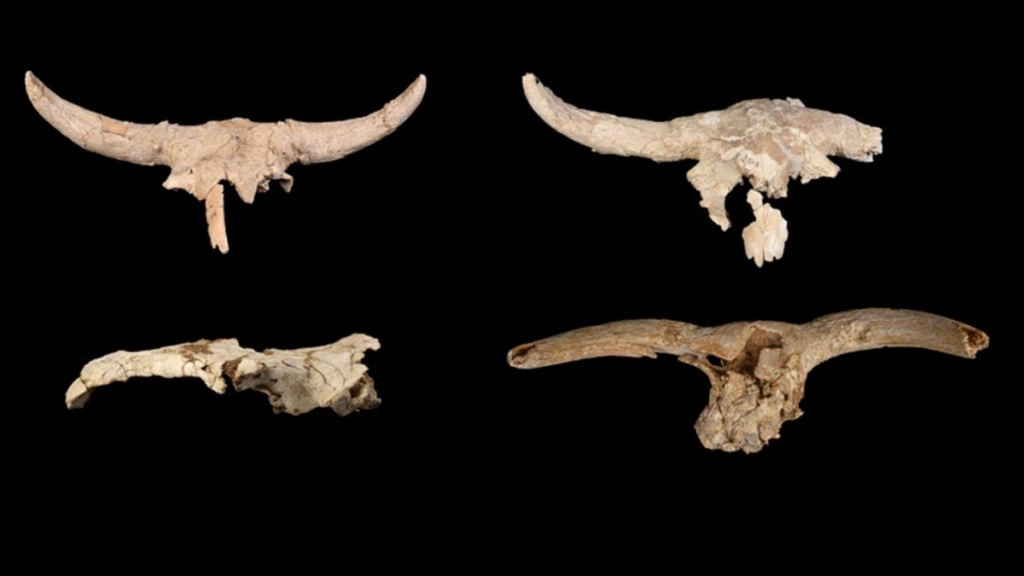
What made this discovery particularly intriguing was the composition of the remains. Unlike typical archaeological sites where animal bones are found scattered and fragmented throughout various layers, the cave contained an unusually high proportion of complete or nearly complete animal skulls. The collection included the cranial remains of at least 35 individual animals: 28 bovines, five deer, and two rhinoceroses.
The Pattern That Defies Chance
The most striking aspect of this discovery is that these weren’t just any animal bones—they were predominantly skulls, and the rest of the skeletons were conspicuously absent. Where were the jawbones, limb bones, and other skeletal elements that typically accompany skull remains at archaeological sites? Their absence suggests deliberate selection rather than natural accumulation.
Researchers led by archaeologist Lucía Villaescusa from the University of Alcalá conducted an exhaustive analysis of the site, examining multiple lines of evidence to understand how and why these skulls came to be in the cave. Their investigation revealed a pattern that challenges our understanding of Neanderthal behavior and cognition.
Dating the Mystery
Through careful stratigraphic analysis, the team determined that the skull accumulation occurred between approximately 70,000 and 50,000 years ago, during the late Middle Paleolithic period. This timeframe places the activity squarely within the Neanderthal era, long before modern humans arrived in Europe in significant numbers.
What’s particularly fascinating is that the evidence suggests these skulls weren’t all placed in the cave simultaneously. Instead, the spatial distribution of artifacts, the geological context, and the preservation patterns all point to repeated episodes of skull deposition over an extended period. This wasn’t a one-time event but rather a sustained practice that spanned potentially thousands of years.
The Geological Context
The cave’s geological history provides crucial context for understanding the skull accumulation. Researchers found that rockfall initially introduced a cone of debris into the gallery, creating a natural accumulation area. It was after this geological event that Neanderthals began their unusual practice of bringing in animal skulls.
The integration of geological, spatial, and taphonomic data—the study of how organisms decay and become fossilized—demonstrates that the accumulation of large herbivore crania was not a single depositional event. Instead, it was the result of repeated episodes embedded within a long-term process of gallery use.
What This Tells Us About Neanderthal Culture
This discovery adds a significant piece to the broader discussion about the complexity and symbolic potential of Neanderthal cultural expressions. The sustained and reiterated nature of this behavior highlights its structured and transmitted character, suggesting that it was more than just opportunistic collection.
The deliberate accumulation of animal crania is relatively rare in the archaeological record, making this find particularly valuable for understanding Neanderthal symbolic behavior. While we may never know the exact motivations behind this practice, the repeated pattern suggests it held significant meaning for the Neanderthal communities that engaged in it.
Beyond the Practical: Evidence of Symbolic Thinking
This discovery joins a growing body of evidence suggesting that Neanderthals possessed sophisticated cognitive abilities and engaged in symbolic behavior previously thought to be unique to modern humans. From the creation of cave paintings to the collection of unusual objects, Neanderthals appear to have had rich inner lives and complex cultural practices.
The skull collection at Des-Cubierta Cave may have served various purposes: ritual activities, territorial markers, spiritual practices, or even early forms of art or decoration. Whatever the purpose, the consistency and duration of the practice indicate it was meaningful and transmitted across generations.
Methodological Breakthroughs
The research team’s approach to studying this site represents a methodological advance in archaeology. By integrating geological analysis with spatial distribution studies and taphonomic assessments, they were able to build a comprehensive picture of site formation processes that goes beyond simple artifact cataloging.
This multi-disciplinary approach allowed researchers to distinguish between natural accumulation processes and human agency, providing stronger evidence for intentional behavior rather than accidental deposition.
Implications for Human Evolution
This discovery has significant implications for our understanding of human evolution and the cognitive capabilities of our extinct relatives. It challenges the long-held view of Neanderthals as primitive and cognitively inferior to modern humans, suggesting instead that they possessed the capacity for symbolic thought and complex cultural practices.
The fact that this behavior was sustained over thousands of years also suggests the presence of cultural transmission—the passing down of knowledge and practices from generation to generation—a hallmark of complex human societies.
Future Research Directions
While this study provides crucial insights, many questions remain unanswered. Future research may focus on detailed isotopic analysis of the skulls to determine the seasons when animals were killed, potentially revealing whether the skull collection was tied to specific seasonal activities or rituals.
Additionally, comparative studies with other Middle Paleolithic sites across Europe could help determine whether this was a localized phenomenon or part of a broader Neanderthal cultural tradition.
Conclusion: A Window into the Neanderthal Mind
The skull collection at Des-Cubierta Cave offers a rare glimpse into the possible symbolic lives of our ancient relatives. While the exact reasons for this practice may remain forever mysterious, the evidence for its sustained and structured nature is compelling.
This discovery reminds us that Neanderthals were not simply primitive versions of modern humans but rather a distinct population with their own cultural traditions, cognitive capabilities, and possibly spiritual beliefs. As archaeological techniques continue to advance and new discoveries emerge, we may find that the line between “us” and “them” was far more blurred than previously imagined.
The skulls of Des-Cubierta Cave stand as silent witnesses to a practice that spanned millennia, challenging us to reconsider our understanding of Neanderthal cognition and culture. In doing so, they invite us to expand our definition of what it means to be human.
Tags: Neanderthals, ancient skulls, Des-Cubierta Cave, Middle Paleolithic, symbolic behavior, archaeological discovery, human evolution, Spain archaeology, cranial remains, Mousterian culture, prehistoric rituals, Neanderthal culture, ancient mysteries, cave discoveries, Paleolithic archaeology
Viral Sentences:
- Neanderthals collected horned skulls in caves for thousands of years—but why?
- Ancient mystery solved? New evidence reveals Neanderthals’ strange skull-collecting habit
- Groundbreaking discovery challenges everything we thought we knew about Neanderthal intelligence
- The cave that holds secrets to Neanderthal symbolic thinking
- 35 animal skulls, 20,000 years of mystery: What were Neanderthals really doing?
- Archaeologists uncover evidence of sophisticated Neanderthal cultural practices
- This prehistoric skull collection might change how we view human evolution
- The ancient ritual that proves Neanderthals were smarter than we thought
- Why did our ancient cousins collect animal heads? Science may finally have answers
- A 50,000-year-old mystery that’s rewriting the story of human cognition
,


Leave a Reply
Want to join the discussion?Feel free to contribute!