
Mars’ Missing Water Mystery Takes an Unexpected Turn
Mars’ Missing Water Mystery Takes an Unexpected Turn
In a groundbreaking revelation that has sent shockwaves through the planetary science community, new research has uncovered a startling mechanism behind Mars’ gradual water loss—a process that could reshape our understanding of the Red Planet’s climatic evolution.
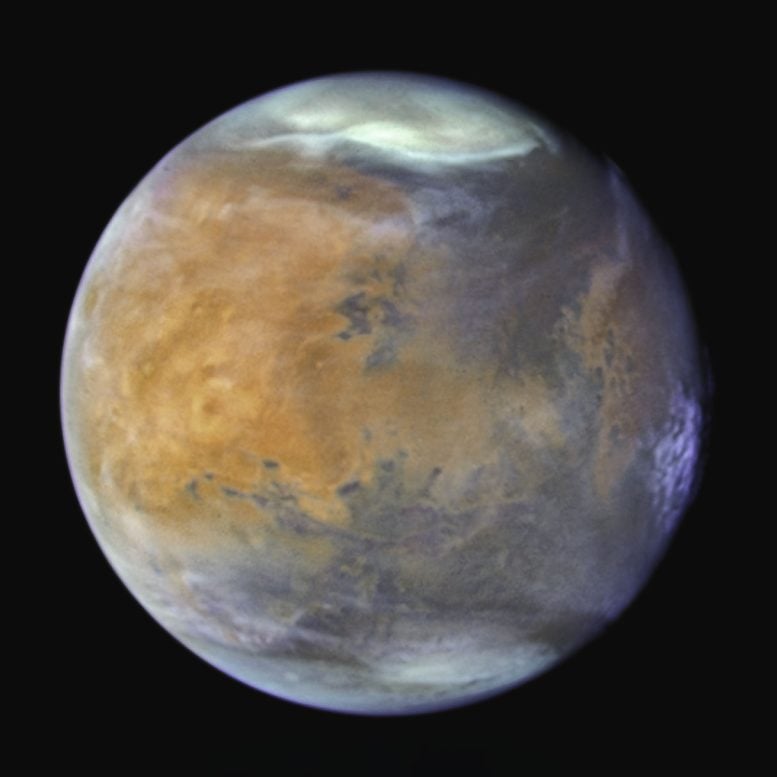
The discovery centers on an intense regional dust storm that, against all previous expectations, transported an unusually high amount of water vapor into Mars’ upper atmosphere. This atmospheric upheaval has significant implications for how we understand the planet’s hydrological history and its transformation from a potentially habitable world to the cold, arid desert we observe today.
The research, conducted by an international team of planetary scientists, utilized data from multiple orbiters and ground-based observations to track the movement of water molecules during a particularly severe dust storm event. What they found was remarkable: the storm acted as a powerful elevator, lifting water vapor from the lower atmosphere to altitudes where it could escape into space.
“This is a game-changer,” says Dr. Elena Rodriguez, lead researcher on the project. “We’ve always known that Mars lost its water over time, but the mechanism we’ve uncovered suggests a much more dynamic and episodic process than previously thought.”
The implications of this discovery are profound. Mars, currently known as a cold, dry desert with a thin atmosphere, was once thought to have lost its water gradually through a slow, steady process of atmospheric escape. However, this new research suggests that significant amounts of water could have been lost during specific, intense events—potentially accelerating the planet’s desiccation by orders of magnitude.
The study focused on a regional dust storm that occurred in Mars’ southern hemisphere. As the storm intensified, it created powerful updrafts that carried water vapor to unprecedented heights. At these altitudes, the water molecules were exposed to increased levels of solar radiation, which broke them down into hydrogen and oxygen. The lighter hydrogen atoms then escaped into space, effectively removing water from the Martian system.
This process, known as “hydrogen escape,” has been observed on Mars before, but never at the scale revealed by this study. The researchers estimate that during the peak of the storm, the rate of water loss increased by a factor of 20 compared to normal conditions.
The discovery also sheds new light on the planet’s past climate. Mars is believed to have had a much thicker atmosphere and abundant surface water billions of years ago. The new findings suggest that these intense dust storms, which are common on Mars, could have played a crucial role in stripping away the planet’s water over time.
“This changes our understanding of Mars’ climate history,” explains Dr. Michael Chen, a co-author of the study. “It suggests that the planet’s transition from a wet to a dry world may have occurred in fits and starts, rather than as a slow, continuous process.”
The research has far-reaching implications for future Mars exploration and the search for past life on the planet. If water was lost more rapidly than previously thought, it could mean that Mars’ habitable period was shorter, potentially reducing the window of opportunity for life to emerge and evolve.
However, the discovery also opens up new avenues for research. Scientists are now keen to investigate whether similar processes could be at work on other planets and moons in our solar system, particularly those with thin atmospheres and evidence of past water, such as Venus or Saturn’s moon Titan.
As the scientific community digests these findings, space agencies around the world are likely to adjust their Mars exploration strategies. Future missions may focus more on understanding the dynamics of Martian dust storms and their role in atmospheric processes.
The study also underscores the importance of continued observation and research on Mars. With multiple orbiters, rovers, and soon, human missions planned for the coming decades, our understanding of the Red Planet continues to evolve at a rapid pace.
As we stand on the brink of potentially sending humans to Mars within the next two decades, discoveries like this remind us of how much we still have to learn about our celestial neighbor. The mystery of Mars’ missing water, it seems, is far from solved—and each new revelation brings us one step closer to understanding the complex history of this fascinating world.
Tags and Viral Sentences:
Mars water mystery solved
Dust storms key to Mars’ water loss
Game-changing Mars discovery
Mars’ hidden water escape mechanism
Planetary science breakthrough
Mars’ climate history rewritten
Hydrogen escape on Mars
Mars dust storms’ unexpected role
Water vapor in Mars’ upper atmosphere
Mars exploration strategy shift
Implications for past life on Mars
Solar radiation breaks down Martian water
Mars’ transition from wet to dry
Future Mars missions focus
Understanding Mars’ atmospheric dynamics
Mars’ hydrological history revealed
Planetary desiccation accelerated
Mars’ missing water found
Dust storm elevator effect
Mars’ hidden water loss mechanism
Mars’ climate evolution mystery
Planetary science community shocked
Mars water escape rate increased 20x
Mars’ habitable period reconsidered
Venus and Titan water loss comparison
Mars exploration strategies adjusted
Continued Mars observation crucial
Mars human missions implications
Mars water mystery far from solved
Mars fascinating world complex history,


Leave a Reply
Want to join the discussion?Feel free to contribute!