
Meet Scotland’s Whisky-Sniffing Robot Dog
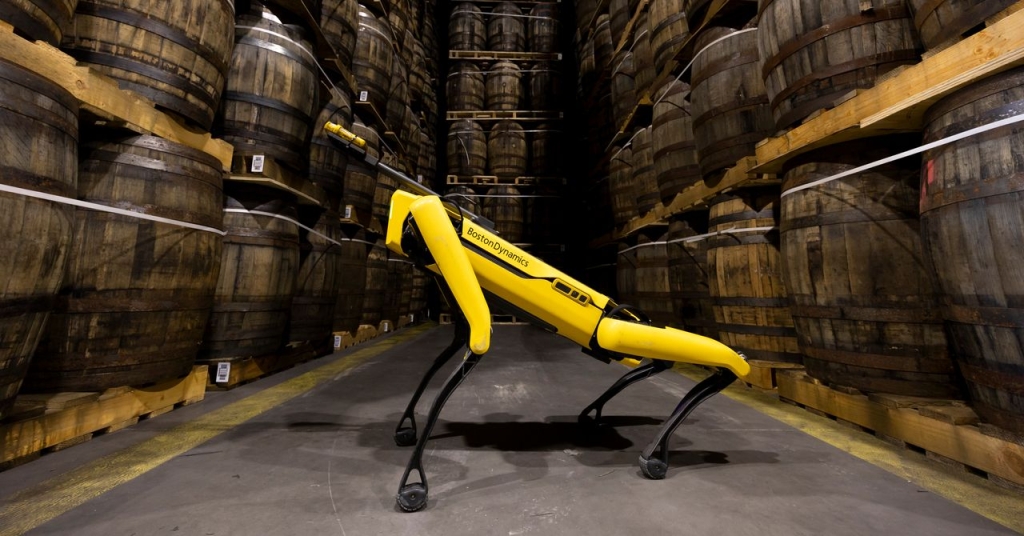
The Robotic Dog Sniffing Out Whisky Leaks at Bacardi
In a groundbreaking fusion of traditional craftsmanship and cutting-edge technology, Bacardi Limited has deployed a robotic canine to solve one of the spirits industry’s most persistent problems: leaky whisky barrels.
At the heart of every great whisky lies the humble wooden barrel, the alchemical vessel where spirits transform into the complex, amber-hued elixirs we cherish. But these barrels, often made of oak and holding liquid gold worth thousands of dollars, have a dirty little secret—they leak. And when you’re dealing with over 2.5 million barrels aging across dozens of warehouses, those leaks add up to a significant problem.
“We’re talking about potentially losing thousands of liters of whisky that’s been aging for years,” explains Angus Holmes, whisky category director at Bacardi. “When you consider that some of our barrels mature for up to a decade, a leak discovered too late represents not just lost product, but lost time and investment.”
The challenge is particularly acute for Bacardi’s Dewar’s blended Scotch whisky, which requires meticulous aging in vast warehouses where barrels sit in silent rows, slowly maturing. Traditional inspection methods involve manual checks—a labor-intensive process that’s both time-consuming and prone to human error. By the time a leak is discovered through conventional means, significant product loss may have already occurred.
Enter the National Manufacturing Institute Scotland (NMIS), which Bacardi approached with this barrel-leak conundrum. The solution they proposed was as innovative as it was unexpected: Boston Dynamics’ Spot robot, a four-legged mechanical marvel that resembles something out of a science fiction film.
But this isn’t just any robot dog patrolling the aisles. The NMIS team equipped Spot with specialized sensors capable of detecting the subtle chemical signatures of evaporating whisky—those ethereal vapors that constitute the “angel’s share.” While some evaporation is normal and even desirable in whisky maturation, excessive loss indicates a compromised barrel that needs attention.
“The robot can detect minute changes in air composition that would be imperceptible to human inspectors,” says Andrew Hamilton, head of the Digital Process Manufacturing Centre for NMIS. “It’s essentially giving the robot a super-powered sense of smell.”
The implementation has been nothing short of revolutionary. Spot systematically navigates the warehouse, its sensors constantly analyzing the air for telltale signs of leakage. When it detects an anomaly, it can precisely locate the affected barrel, allowing maintenance teams to address the issue before significant product loss occurs.
Holmes describes the robot’s movements with a touch of humor: “It makes that horrible, horror-movie, floor-scratching sound as it chases after you.” But beneath the levity lies genuine appreciation for the technology’s effectiveness.
The economic implications are substantial. Whisky that might have been written off as a loss can now be saved, and the precision of robotic inspection means fewer false positives and more efficient use of maintenance resources. For an industry where products often appreciate in value the longer they age, preventing even small leaks can translate to millions in saved inventory.
This technological intervention represents a fascinating intersection of tradition and innovation. Whisky making remains one of the most time-honored crafts in the world, with methods passed down through generations. Yet here we see a robotic dog, a symbol of our technological future, preserving the integrity of this ancient art.
The success at Bacardi has sparked interest across the spirits industry, with other distilleries exploring similar technological solutions to age-old problems. It’s a testament to how even the most traditional industries can benefit from embracing cutting-edge technology.
As whisky continues to enjoy global popularity, with premium and super-premium segments seeing particularly strong growth, innovations like Bacardi’s robotic inspector may become increasingly common. The marriage of tradition and technology ensures that when you pour yourself a dram of well-aged Scotch, more of that precious liquid makes it to your glass rather than evaporating into the warehouse rafters.
Tags
whisky technology, robotic dog, Boston Dynamics Spot, barrel leakage, spirits industry innovation, Bacardi Limited, Dewar’s Scotch, whisky aging, angel’s share, National Manufacturing Institute Scotland, warehouse automation, traditional craftsmanship meets technology, spirits preservation, evaporation detection, industrial robotics, whisky production efficiency, technological disruption in traditional industries, smart manufacturing, inventory protection, spirits technology solutions
Viral Sentences
Robotic dog sniffs out expensive whisky leaks, saving spirits industry millions; Traditional whisky making meets futuristic technology; The angel’s share just got a robotic guardian; When your whisky inspector has four legs and a computer brain; Whisky barrels beware: the robot dog is on patrol; Saving centuries-old spirits with 21st-century technology; From angel’s share to robot’s care; The future of whisky making walks on four legs; Robotic inspector ensures your dram isn’t evaporating away; Technology that would make even the most traditional distiller raise a glass; When Silicon Valley meets Scotch whisky country; The mechanical nose that’s changing how we age spirits; Robot dog: the new best friend of whisky makers everywhere; Innovation that keeps both angels and accountants happy; The robotic solution to a problem as old as wooden barrels; When tradition needs a technological helping paw; The four-legged guardian of liquid gold; Robotic technology that’s worth raising a glass to; How a robot dog is revolutionizing the whisky industry; The mechanical marvel saving millions in evaporated spirits
,


Leave a Reply
Want to join the discussion?Feel free to contribute!