
Brutal Iron Age massacre may have targeted women and children
Prehistoric Massacre Unveils Brutal Chapter in Iron Age Europe: Women and Children Deliberately Targeted in Largest Known Mass Killing
In a chilling discovery that rewrites our understanding of Iron Age violence, archaeologists have uncovered evidence of one of Europe’s largest prehistoric mass killings—a brutal massacre where women and children were deliberately targeted in what appears to have been a calculated act of terror rather than battlefield warfare.
The grim scene was unearthed at Gomolava, an early Iron Age site nestled in the Carpathian basin of present-day Serbia. This ancient artificial mound, known as a tell, stands as a testament to thousands of years of human habitation dating back to the late 6th millennium BC. Built layer upon layer from collapsed mud-brick structures, discarded pottery, and organic debris, the mound concealed a horrific secret beneath its earthen surface.
When researchers from the University of Edinburgh, led by bioarchaeologist Linda Fibiger, examined the skeletal remains stored at the Museum of Vojvodina in Novi Sad, Serbia, they discovered a nightmare preserved in bone. Of the 77 individuals buried together in a single grave over 2,800 years ago, a staggering 51 were children and adolescents. Among the 72 individuals whose biological sex could be determined, 51 were female.
“The initial analysis in 1976 attributed these deaths to a pandemic,” Fibiger explains. “But our detailed skeletal analysis tells a far more disturbing story.” The bones bore unhealed injuries consistent with extreme violence—wounds that spoke of close-contact combat and projectile strikes. Many injuries were concentrated on the head, showing signs of uninhibited force that could only result from intentional killing.
“I think it was quite a brutal event,” Fibiger states matter-of-factly, underscoring the clinical horror of the discovery.
The investigation deepened when the team conducted DNA analysis on 25 individuals and examined isotopic ratios of strontium, oxygen, and carbon in the dental enamel of 24 people. These analyses revealed that most individuals weren’t closely related—in fact, many weren’t even related going back 12 generations. They also showed varied childhood diets, suggesting these people came from different regions and backgrounds.
“This indicates we’re looking at a widespread society sharing common cultural practices but not necessarily intermarrying between groups,” explains Barry Molloy from University College Dublin. “They were part of a broader cultural network, but maintained distinct identities.”
The massacre occurred during the 9th century BC, a period of profound social upheaval in the region. Mobile pastoralists from the Eurasian steppe were crossing the Carpathian mountains, bringing new ways of life and territorial claims. Simultaneously, local populations were reoccupying ancient tell sites, establishing enclosed settlements, and intensifying agricultural practices.
“You’ve got these two conflicting ways of using landscape,” Molloy observes. “This territorial tension may have sparked conflict between groups and displaced people from their homes.”
What makes this discovery particularly haunting is the demographic profile of the victims. Traditional warfare typically focuses on combatants—able-bodied men fighting on battlefields. The deliberate targeting of women and children suggests something far more sinister was at play.
Molloy proposes a disturbing theory: the perpetrators may have intended to send a message of absolute dominance. “Younger children could have been taken as slaves, but killing them instead was likely meant to subdue resistance and assert control over the land,” he suggests. This interpretation transforms the massacre from a military engagement into an act of psychological warfare—a calculated display of power meant to terrorize entire communities.
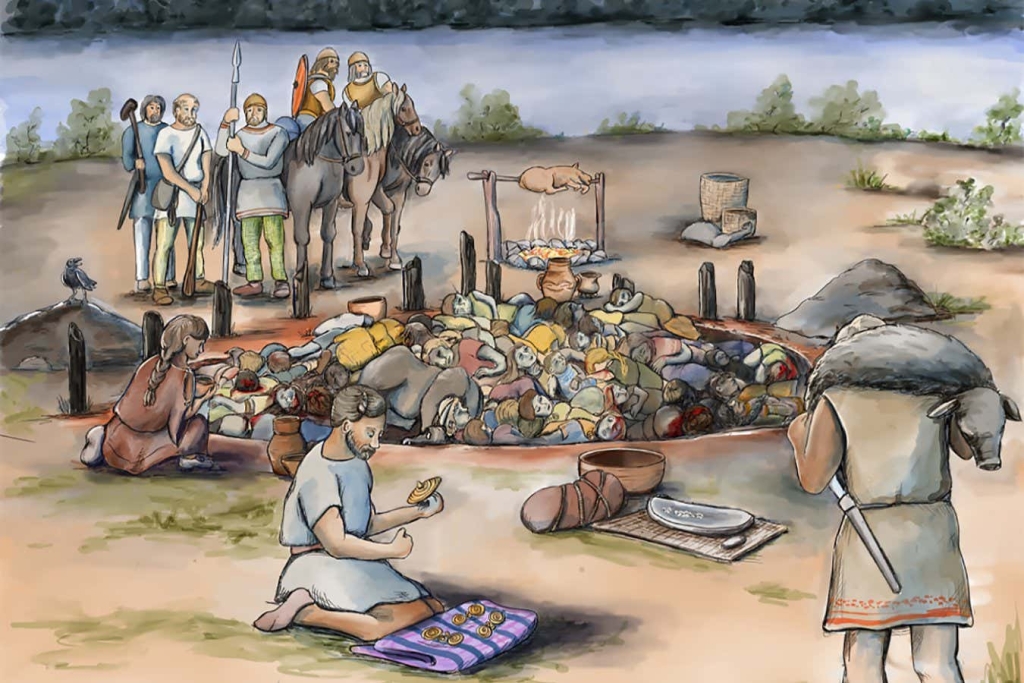
However, the story takes unexpected turns. Despite the brutality of their deaths, the victims were buried with remarkable care and symbolism. Personal possessions accompanied them to the grave—bronze jewelry, ceramic vessels for drinking and food storage, even the remains of a butchered calf. Broken grinding stones and burnt seeds were placed on the grave, representing “the entire food cycle,” as Molloy describes it.
“This suggests the burial was careful and symbolic,” Molloy notes. “The killers and those giving the funeral rites may have been different groups.” This detail adds layers of complexity to an already intricate narrative, hinting at possible reconciliation rituals or at least acknowledgment of shared humanity in death.
Pere Gelabert from the University of Vienna offers additional perspectives on the interpretation. “The Iron Age was a period of extreme instability across Europe, a period of multiple armed conflicts, or wars as we would call them nowadays.” He suggests alternative explanations: the massacre could have been ritualistic, with women and children specifically selected for killing, or it’s possible that only these individuals died because the men were elsewhere—perhaps away at war or on seasonal migrations.
The discovery at Gomolava forces us to confront uncomfortable truths about human nature and the cyclical nature of violence. It reveals that organized brutality, territorial conflict, and the weaponization of terror have deep roots in our collective history. The fact that such sophisticated psychological warfare tactics existed over 2,800 years ago suggests that the capacity for calculated cruelty is not a modern invention but a persistent feature of human conflict.
As researchers continue to piece together the fragments of this ancient tragedy, the mass grave at Gomolava stands as a somber monument to lives cut short and a society torn apart by violence. It challenges us to reflect on how little some aspects of human conflict have changed over millennia, even as our weapons and methods have evolved beyond recognition.
Tags: prehistoric massacre, Iron Age violence, ancient warfare, archaeological discovery, mass grave, gender-based violence, territorial conflict, psychological warfare, human brutality, historical trauma, Carpathian basin, Bronze Age collapse, ritualistic killing, ancient DNA analysis, isotopic analysis, cultural conflict, nomadic invasion, settled societies, archaeological forensics, human remains
Viral Phrases: “Europe’s largest prehistoric mass killing revealed,” “Women and children deliberately targeted 2,800 years ago,” “Brutal Iron Age massacre uncovered,” “Ancient psychological warfare tactics exposed,” “Prehistoric genocide in the Carpathian basin,” “Archaeological horror story from 9th century BC,” “Mass grave reveals calculated cruelty of ancient societies,” “DNA analysis solves 2,800-year-old murder mystery,” “Isotopic evidence uncovers ancient migration patterns,” “Bronze Age conflict reaches new levels of brutality,” “Prehistoric terror tactics discovered,” “Ancient societies practiced sophisticated psychological warfare,” “Massacre victims buried with symbolic possessions,” “Archaeological evidence of gender-based violence in ancient times,” “Prehistoric conflict between nomads and settlers,” “2,800-year-old crime scene yields shocking revelations,” “Ancient DNA reveals unrelated massacre victims,” “Archaeological forensics solves ancient murder mystery,” “Prehistoric mass killing challenges our understanding of ancient warfare,” “Bronze Age society torn apart by territorial conflict”
,
Leave a Reply
Want to join the discussion?Feel free to contribute!