
More Space Junk Is Plummeting to Earth. Earthquake Sensors Can Track It by the Sonic Booms.
China’s Shenzhou-15 Spacecraft Turns California Sky into Light Show, Sparks Global Space Debris Crisis
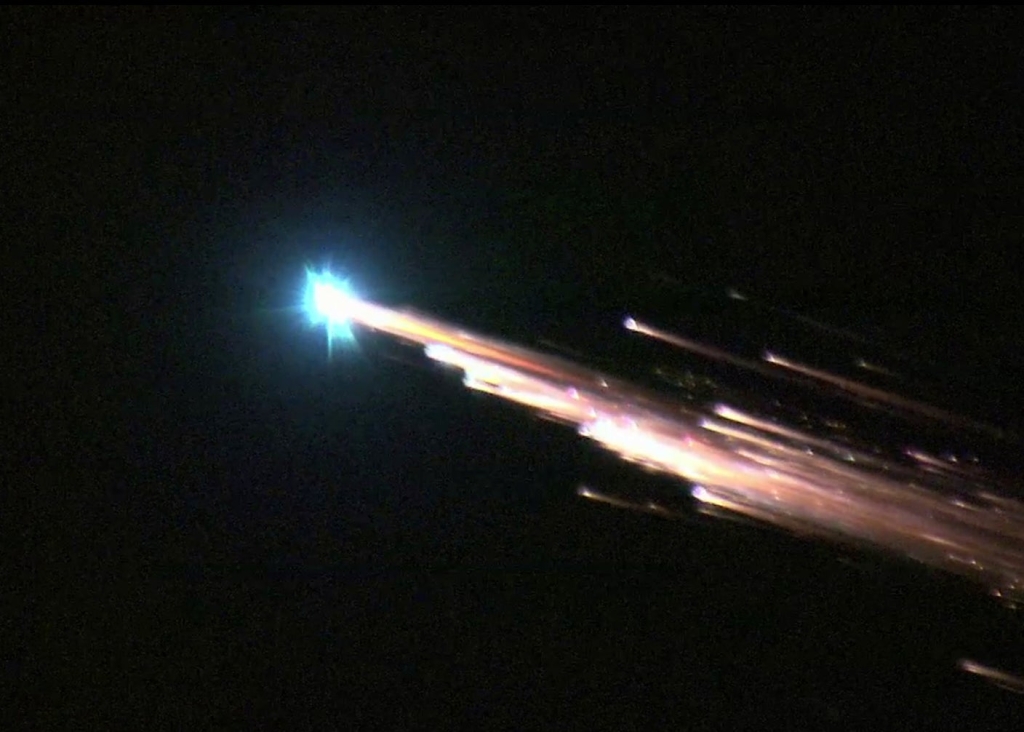
In the early morning hours of April 2, 2024, Southern California residents witnessed a breathtaking yet terrifying spectacle as the night sky erupted with blazing streaks of light. Social media exploded with videos showing multiple fireballs streaking across the darkness, with terrified witnesses wondering if they were witnessing a missile attack, plane crash, or some other catastrophic event.
The truth was both more mundane and more alarming: it was the disposable orbital module of China’s Shenzhou-15 spacecraft burning up during atmospheric reentry. What made this event particularly unsettling was that scientists had predicted the debris would splash down harmlessly in the northern Atlantic Ocean—thousands of miles away from the metropolitan sprawl of Los Angeles.
“No one was hurt, but this incident laid bare a terrifying reality we’re all ignoring,” said Dr. Benjamin Fernando of Johns Hopkins University, lead researcher on groundbreaking new technology to track space debris. “We’re flying blind when it comes to predicting where space junk will actually land. As we launch more satellites and spacecraft, it’s not a matter of if but when someone gets hurt or critical infrastructure gets damaged.”
The Space Junk Time Bomb
The Shenzhou-15 incident wasn’t an isolated event—it was a warning shot. With companies like SpaceX planning to deploy tens of thousands of satellites in mega-constellations, and national space agencies launching missions at unprecedented rates, Earth’s orbit is becoming dangerously crowded.
“Since 2020, we’ve seen an explosion in satellite mega-constellations,” Fernando explained in an interview with Science magazine. “We’re talking about companies putting up not just a dozen spacecraft, but potentially a thousand or even ten thousand over just a few years. This isn’t science fiction anymore—it’s happening right now.”
The numbers are staggering. In 2025 alone, experts estimate there were roughly four to five uncontrolled reentries every single day. Each one represents a potential disaster waiting to happen. Unlike controlled deorbiting, where spacecraft are guided to burn up over uninhabited ocean areas, most space debris follows unpredictable paths as atmospheric drag and other forces send them tumbling toward Earth.
When Space Tech Meets Earthquake Science
The solution to tracking this growing menace came from an unexpected quarter: earthquake sensors. Fernando and his colleague Dr. Constantinos Charalambous at Imperial College London realized that as space debris plummets through the atmosphere at hypersonic speeds—often 25 to 30 times the speed of sound—it creates powerful sonic booms that shake the ground below.
“It’s essentially like detecting an earthquake, except the waves are coming from above rather than below,” Fernando said. “When that Shenzhou-15 module was screaming through the atmosphere, it was generating seismic waves that our network of ground sensors could pick up with incredible precision.”
Their system works by analyzing data from dense networks of seismic sensors, mapping the largest sonic boom each sensor detected and when it arrived. This creates a detailed reconstruction of the spacecraft’s final journey—its speed, altitude, disintegration pattern, and ultimate destination.
A Forensic Map of Destruction
The results were nothing short of revolutionary. The seismic map revealed that the Shenzhou-15 module didn’t simply explode all at once, as many had assumed. Instead, it gradually disintegrated, with the sensors first recording large, discrete signals that became increasingly scattered and complex as the breakup progressed.
“This wasn’t just theoretical modeling,” Fernando emphasized. “Our seismic data matched perfectly with on-ground observations, including videos and witness reports of multiple fireballs streaking across the sky. We could actually see the moment-by-moment breakup of the spacecraft.”
Even more impressively, the team discovered their technology could distinguish between human-made space debris and natural meteorites based on their unique sonic signatures. This differentiation is crucial because while meteorites pose kinetic risks from chunks slamming into the ground, human space debris might contain toxic materials, flammable components, or in rare cases, radioactive substances.
The Race Against Time
Here’s the catch: this isn’t an early warning system. Because sonic booms travel slower than the objects creating them, the technology is more like a forensic reconstruction tool than a predictive system. By the time the ground sensors detect the sonic boom, the debris has already passed overhead.
However, the speed and accuracy of the reconstruction make it invaluable for rapid response. Within minutes of detecting a reentry event, authorities could identify potential fallout zones, enabling faster retrieval and cleanup operations. This is especially critical when dealing with potentially hazardous materials that could contaminate soil, water supplies, or populated areas.
Chris Carr from Los Alamos National Laboratory, who wasn’t involved in the research, called it “a crucial step toward near-real-time monitoring of natural and anthropogenic objects entering from space.” The implications extend far beyond just tracking Chinese spacecraft—this technology could help monitor everything from falling satellites to potential asteroid impacts.
The Bigger Picture: Our Orbital Trash Problem
The Shenzhou-15 incident highlights a growing crisis that most people don’t even realize exists. Every satellite, every rocket stage, every piece of space hardware eventually becomes space debris. Some burn up completely, but many don’t. Those that survive reentry can be dangerous, and the problem is accelerating exponentially.
Engineers are working on solutions, including designing spacecraft that completely burn up during reentry or moving defunct satellites to “graveyard orbits” where they’ll remain stable for thousands of years. But these are stopgap measures at best. What we really need is comprehensive tracking of everything in orbit and everything coming down.
The seismic sensor approach offers hope, but it has limitations. It works best in areas with dense sensor networks—something Southern California has in abundance but most of the world lacks. There’s a push to deploy more affordable seismic sensors in vulnerable areas, particularly those with sensitive ecology or geology, as a cost-effective alternative to building expensive radar systems.
The Bottom Line
The brilliant light show over Southern California was beautiful but terrifying—a reminder that our rush to conquer space is creating dangers we’re not prepared to handle. As we continue launching thousands of new satellites and spacecraft, the question isn’t whether more debris will fall on populated areas, but when and how catastrophic it will be.
The technology developed by Fernando and Charalambous represents a crucial first step in managing this growing threat. By turning earthquake sensors into space debris detectors, they’ve given us a powerful new tool to understand and potentially mitigate the risks of our increasingly cluttered orbital environment. But technology alone won’t solve this problem—it will take international cooperation, better spacecraft design, and perhaps most importantly, public awareness of the very real dangers lurking in our increasingly crowded skies.
Tags: #SpaceDebris #Shenzhou15 #CaliforniaLightShow #SatelliteMegaConstellations #EarthquakeSensors #HypersonicReentry #SpaceJunkCrisis #OrbitalPollution #SonicBoomDetection #SpaceSafety #SpaceX #ChinaSpaceProgram #AtmosphericReentry #SpaceTechnology #EnvironmentalHazard #FutureOfSpace #OrbitalCleanup #SpaceInfrastructure #ScientificBreakthrough #TechNews #ViralVideo #SpaceRace #Astronomy #Meteorology #EngineeringInnovation
Viral Sentences: “The sky over California lit up with blazing light as Chinese space debris rained down unexpectedly” | “Scientists predicted the junk would land in the Atlantic—it hit LA instead” | “Earthquake sensors are now tracking falling spacecraft in revolutionary new way” | “We’re flying blind when it comes to space debris, and someone’s going to get hurt” | “SpaceX and others plan thousands more satellites—the problem is about to explode” | “This isn’t science fiction anymore—mega-constellations are launching right now” | “The technology can distinguish between meteorites and toxic human space junk” | “It’s like detecting an earthquake, except the waves come from above” | “The Shenzhou-15 module gradually disintegrated, not exploded all at once” | “Every satellite eventually becomes space debris—it’s a matter of when, not if” | “The brilliant light show was beautiful but terrifying—a warning we can’t ignore”
,

Leave a Reply
Want to join the discussion?Feel free to contribute!