
Invisible to the Human Eye: Scientists Create the World’s Smallest QR Code
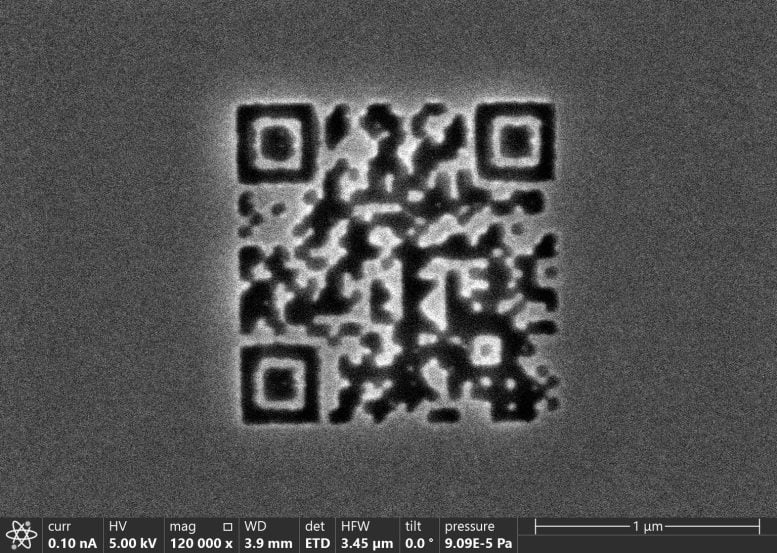
Scientists Shatter Size Limits: World’s Smallest QR Code Now Invisible to the Naked Eye
In a breakthrough that pushes the boundaries of miniaturization and data storage, researchers at TU Wien have created the world’s smallest QR code—a microscopic marvel so tiny it can only be seen through an electron microscope. Measuring just 1.98 square micrometers, this ultra-compact code is etched into a ceramic thin film and has been officially verified by Guinness World Records as the smallest QR code ever made.
This isn’t just a novelty; it’s a glimpse into the future of ultra-dense, long-term data storage. Traditional QR codes, which we scan daily with our smartphones, are typically printed at sizes visible to the human eye. But this new creation is on an entirely different scale—so small that if scaled up, it would be like shrinking a billboard down to the size of a single grain of sand.
The team at TU Wien achieved this feat by using advanced nanofabrication techniques to etch the QR code into a ceramic thin film. The process involves precise laser or ion beam technology to carve out the intricate black-and-white patterns that make up the code. The result is a structure so fine that it challenges the very limits of what’s possible in micro-engineering.
What makes this development particularly exciting is its potential applications. Imagine storing vast amounts of data in an area smaller than a pinhead, with the ability to preserve it for decades or even centuries. This could revolutionize fields like archival storage, where space and longevity are critical. It could also pave the way for new forms of secure, tamper-proof data encoding, as the microscopic size makes the codes extremely difficult to replicate or alter without specialized equipment.
The verification by Guinness World Records adds an extra layer of credibility and excitement to the achievement. It’s a testament to the precision and innovation behind the project, and it highlights how far nanotechnology has come in recent years. The team’s work doesn’t just set a new record—it opens the door to a future where data storage is limited only by the laws of physics, not by the size of our devices.
As we look ahead, the implications of this breakthrough are vast. From medical implants that store patient data to space missions that require ultra-compact storage solutions, the world’s smallest QR code could be the key to unlocking new possibilities in science and technology. For now, though, it remains a stunning example of human ingenuity—a reminder that even the smallest things can have the biggest impact.
Tags & Viral Phrases:
- World’s smallest QR code
- Invisible to the naked eye
- Electron microscope only
- Guinness World Record
- TU Wien breakthrough
- Nanofabrication technology
- Ultra-dense data storage
- Microscopic marvel
- Future of data storage
- Revolutionary nanotechnology
- Tiny but mighty
- Data storage at the atomic scale
- Pushing the limits of miniaturization
- Next-gen archival solutions
- Science meets art in the smallest QR code
- Breaking records, breaking boundaries
- The future is microscopic
- Data storage redefined
- Innovation at its smallest
- From smartphones to electron microscopes
,


Leave a Reply
Want to join the discussion?Feel free to contribute!