
Honor teases its next-gen silicon-carbon battery that’s as thin as a playing card
Honor’s Silicon-Carbon Blade Battery: A Game-Changing Leap in Foldable Power
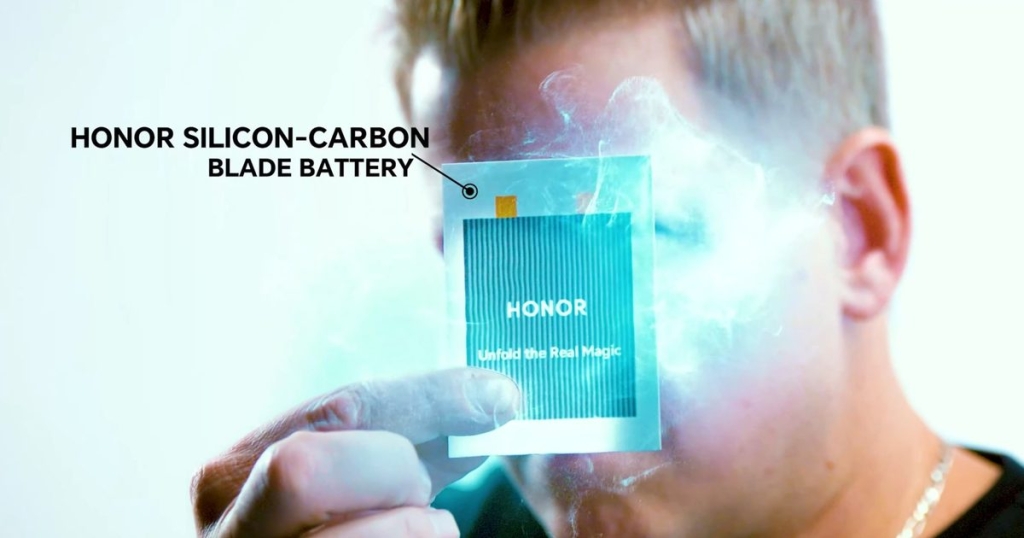
Honor is once again pushing the boundaries of mobile technology, this time with a revolutionary power solution that could redefine how we think about batteries in ultra-slim devices. The company has just unveiled a tantalizing teaser for its upcoming Silicon-Carbon Blade Battery—a power pack so thin it’s being thrown through the air like a playing card by a Guinness World Record holder.
The Playing Card That Packs a Punch
The dramatic demonstration video shows a battery wafer-thin enough to slice through fruit mid-flight, showcasing both its incredible slim profile and surprising durability. This isn’t just marketing theatrics—it represents a fundamental shift in battery engineering that could solve one of the biggest challenges in modern mobile design: how to pack massive power into increasingly slender devices.
Honor’s teaser reveals a battery that appears almost impossibly thin, yet the company claims it delivers substantially more capacity than conventional solutions. This Silicon-Carbon Blade Battery represents the culmination of years of research into silicon-carbon chemistry, a field that promises to overcome the energy density limitations of traditional lithium-ion technology.
The Science Behind the Magic
While specific technical details remain under wraps, Honor has hinted at several key innovations. The battery reportedly features a higher silicon content than previous generations, which is crucial because silicon can theoretically store ten times more lithium ions than graphite—the material traditionally used in battery anodes. However, silicon also expands significantly during charging cycles, which has historically led to degradation issues.
Honor’s solution appears to address this challenge through advanced engineering of the silicon-carbon composite structure. The “Blade” designation suggests a novel form factor that maximizes surface area while minimizing thickness—possibly through stacked or folded electrode configurations that pack more active material into a smaller volume.
From Magic V5 to Magic V6: A Battery Revolution
The timing of this announcement is particularly significant as it coincides with the upcoming launch of the Honor Magic V6 foldable smartphone. To understand the magnitude of this advancement, consider the progression: last year’s Magic V5 featured a 5,820mAh silicon-carbon battery in what was then the world’s thinnest foldable. The new Magic V6 is expected to house a massive 6,600mAh battery—a 13.5% capacity increase—without any increase in device thickness.
This achievement becomes even more impressive when compared to the competition. Samsung’s Galaxy Z Fold 7, despite being a technological marvel in its own right, is limited to a 4,400mAh battery. Google’s Pixel 10 Pro Fold manages 5,015mAh. Honor’s approach could deliver nearly 50% more capacity than Samsung’s flagship foldable while maintaining an ultra-slim profile.
Partnership Power: The ATL Connection
Honor’s battery breakthrough isn’t happening in isolation. The company has partnered with ATL (Amperex Technology Limited), a Chinese battery manufacturer with deep expertise in advanced power solutions. This collaboration brings together Honor’s design innovation with ATL’s manufacturing prowess and material science expertise.
The partnership has already yielded impressive results, with the fifth-generation silicon-carbon battery in the Magic V6 featuring 25% silicon content—substantially higher than what’s typically found in commercial devices. This high silicon ratio is key to achieving the dramatic capacity improvements Honor is promising.
Why This Matters for Foldable Technology
Foldable smartphones represent the cutting edge of mobile design, but they’ve historically struggled with battery life due to their unique form factors. The folding mechanism requires complex hinge systems that consume internal space, while the large, high-resolution displays demand significant power. This has created a perfect storm where users expect all-day battery life from devices that are inherently challenging to power efficiently.
Honor’s Silicon-Carbon Blade Battery could be the solution that finally cracks this problem. By dramatically increasing energy density while maintaining slim dimensions, Honor is addressing the core tension between form and function that has limited foldable adoption.
The March 1 Reveal: What to Expect
Honor has scheduled its Mobile World Congress (MWC) keynote for March 1, where the Magic V6 and Silicon-Carbon Blade Battery will be officially unveiled. Industry insiders expect the company to share comprehensive technical specifications, including exact dimensions, capacity figures, charging speeds, and cycle life estimates.
The MWC showcase will likely include demonstrations of the battery’s real-world performance, potentially featuring endurance tests, charging demonstrations, and comparisons with competing solutions. Given Honor’s history of dramatic product reveals, we might also see additional applications of this technology beyond smartphones—perhaps in tablets, laptops, or even wearable devices.
The Broader Impact on Mobile Technology
If successful, Honor’s battery innovation could have ripple effects throughout the entire mobile industry. Higher energy density enables thinner devices without compromising battery life, or alternatively, allows manufacturers to maintain current thicknesses while dramatically extending usage time. This could accelerate the adoption of power-hungry features like always-on displays, advanced camera systems, and AI processing capabilities.
The silicon-carbon chemistry also points toward more sustainable battery production, as silicon is more abundant and potentially less environmentally damaging to extract than some alternative materials. Additionally, higher energy density means fewer batteries needed over time, reducing electronic waste.
Looking Beyond Smartphones
While the immediate application is in the Honor Magic V6, the Silicon-Carbon Blade Battery technology has implications far beyond foldable phones. Electric vehicles, drones, portable medical devices, and countless other applications could benefit from batteries that offer more power in less space.
Honor’s achievement demonstrates that significant innovation is still possible in battery technology—an area that many had assumed was approaching theoretical limits. This breakthrough suggests that the era of incremental battery improvements may be giving way to more dramatic leaps forward.
The Competitive Landscape
Honor’s aggressive push into advanced battery technology comes at a time of intense competition in the global smartphone market. Chinese manufacturers have been particularly innovative in battery design, with companies like Xiaomi, Oppo, and Vivo also investing heavily in next-generation power solutions.
However, Honor’s focus on ultra-thin, high-capacity batteries for foldables positions the company uniquely in the premium segment. While competitors focus on conventional smartphone designs, Honor is betting that superior battery technology will be a key differentiator for foldables as they move toward mainstream adoption.
Tags: Honor Silicon-Carbon Blade Battery, foldable smartphone battery, Magic V6 battery capacity, ultra-thin battery technology, silicon-carbon battery innovation, MWC 2026 Honor announcement, ATL battery partnership, next-generation mobile power, Honor battery breakthrough, foldable endurance solution
Viral Phrases: “battery thinner than a playing card,” “slicing through fruit mid-flight,” “50% more capacity than Galaxy Z Fold,” “the end of battery anxiety,” “Honor just changed the game,” “this will blow your mind,” “the battery revolution is here,” “thinner, lighter, longer-lasting,” “game over for competitors,” “the future of mobile power”
Viral Sentences: Honor just unveiled a battery so thin it can be thrown like a playing card—and it might change everything we know about mobile power. This isn’t just another battery upgrade; it’s a complete reimagining of what’s possible in ultra-slim devices. While everyone else is fighting over minor improvements, Honor just dropped a nuclear bomb on the competition. The Magic V6 could deliver nearly 50% more battery life than Samsung’s flagship foldable—without getting any thicker. This technology could finally solve the biggest problem holding back foldable phones. Honor isn’t just making better batteries; they’re making the batteries of the future.
,


Leave a Reply
Want to join the discussion?Feel free to contribute!