
The Fatal Flaw That Killed The US Army’s XM803 Prototype Tank
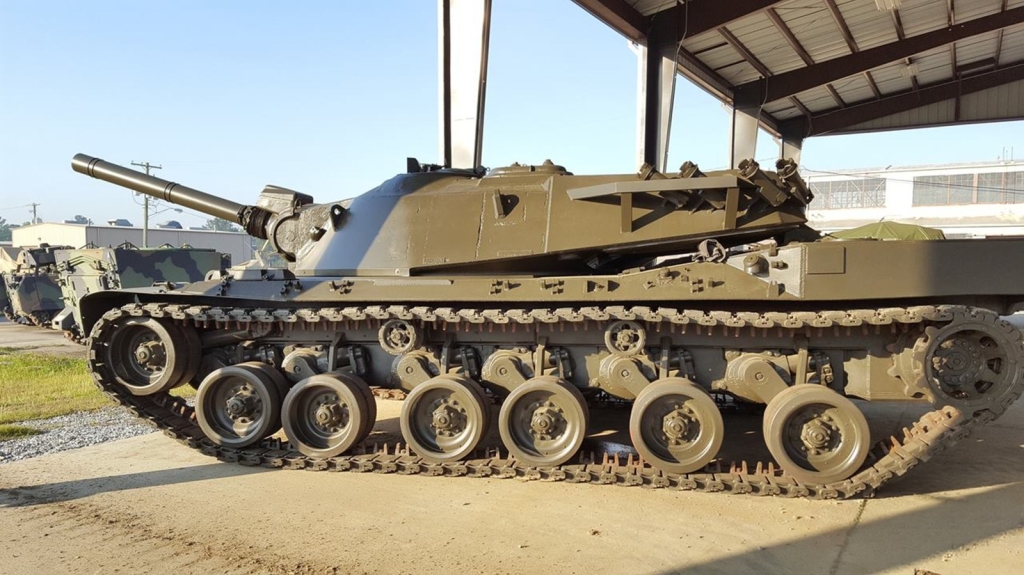
The XM803: The Forgotten Tank That Paved the Way for the Legendary M1 Abrams
In the high-stakes world of military technology during the Cold War, few stories are as fascinating—and frustrating—as that of the XM803, a tank that never quite made it to production but left an indelible mark on armored warfare history.
The MBT-70: A Promising Start That Went Off the Rails
Picture this: It’s the 1960s, and the United States and West Germany are locked in a technological arms race with the Soviet Union. Both nations decide to pool their resources and expertise to create a revolutionary main battle tank that could counter the growing Soviet threat. What emerged was the MBT-70—a bold vision of what a modern tank could be.
The MBT-70 was packed with cutting-edge features: an advanced hydropneumatic suspension system that could raise or lower the entire tank, a 152mm gun capable of firing both conventional rounds and anti-tank missiles, and an autoloader that would reduce the crew size. It was, in many ways, decades ahead of its time.
But dreams and reality often collide in military procurement, and the MBT-70 was no exception. The joint project quickly became mired in disagreements. The Americans wanted to stick with imperial measurements while the Germans insisted on metric. The U.S. prioritized crew survivability, while Germany focused more on lethality. Costs spiraled out of control, and by 1969, West Germany had had enough. They pulled out of the project, leaving behind roughly a dozen prototypes and a whole lot of questions.
Enter the XM803: America’s Solo Attempt
Not ready to abandon the dream entirely, the United States decided to forge ahead on its own. The result was the XM803—essentially an Americanized version of the MBT-70, built exclusively with U.S.-made components. General Motors took the lead on development, tasked with creating a tank that could meet the Army’s needs without breaking the bank.
On paper, the XM803 looked impressive. Weighing in at 57 tons, it could reach speeds of up to 40 mph on flat terrain and still manage 14 mph climbing a 10% grade. Its primary armament was the XM150E6 152mm gun, a versatile weapon capable of firing conventional shells or MGM/MTM-51C Shillelagh missiles with a range of over 5,200 meters. The autoloader could hold 24 rounds and fire at a rate of eight rounds per minute. For secondary weapons, it featured an M85 heavy machine gun and a remote-controlled General Electric M73 machine gun.
But here’s where the fatal flaw emerged—and it’s a flaw that has doomed countless military projects before and since: money.
The Money Problem That Killed a Tank
Congress had set a clear budget expectation: the XM803 needed to save approximately $200,000 per vehicle compared to the existing M60 Patton tanks already in service. This wasn’t just about saving money; it was about getting more bang for the buck in an era of escalating defense spending.
As development progressed, however, costs began to climb. And climb. And climb some more. Despite efforts to streamline the design and cut corners where possible, the XM803 simply couldn’t meet the budgetary targets. The project had been running for about two years when Congress finally pulled the plug, redirecting the funds to a new initiative: the XM-1.
It’s worth pausing here to appreciate the irony. The XM803 was designed to be more cost-effective than its predecessor, yet it couldn’t even manage that basic requirement. In military procurement, sometimes the most advanced technology loses out to the most basic constraint: affordability.
The Phoenix Rises: From XM803 to M1 Abrams
While the XM803 itself faded into obscurity, its legacy lived on in ways no one could have predicted. When Congress killed the XM803, they didn’t just throw away the money—they invested it in something new. The Army received $20 million to develop what would become the XM-1 project.
The M1 Abrams, which emerged from this initiative, became one of the most successful and iconic main battle tanks in history. First entering service in February 1980, the Abrams has seen combat in Operation Desert Storm, the Iraq War, and beyond, consistently proving its worth on the battlefield.
Interestingly, the Abrams owes more to the MBT-70 than to the XM803 in terms of design philosophy. Many of the advanced features that made the MBT-70 revolutionary—like its powerful gun system and emphasis on mobility—found their way into the Abrams. But it was the cancellation of the XM803 that freed up the resources and political will to make the Abrams a reality.
The Sole Survivor
Today, only one XM803 prototype exists. Built from one of the remaining MBT-70 prototypes, this solitary tank sits in the U.S. Army Armor & Cavalry Collection at Fort Knox, Kentucky. It stands as a silent monument to ambition, international cooperation, and the harsh realities of defense budgeting.
Tags and Viral Phrases
XM803 tank history, failed military projects, M1 Abrams origins, Cold War tank development, military procurement failures, General Motors military vehicles, MBT-70 joint project, U.S. Army tank evolution, Fort Knox military museum, defense budget overruns, tank design failures, military technology dead ends, XM-1 to M1 Abrams, Cold War military competition, armored vehicle development, military industrial complex, tank that never was, XM803 prototype, Abrams tank legacy, military project cancellations, cost overruns in defense, tank development history, U.S. military hardware, Cold War technology race, military vehicle archives, XM803 vs M60 Patton, General Dynamics M1 Abrams, military spending controversies, tank warfare evolution, defense procurement lessons, XM803 specifications, military prototype preservation, tank development failures, Cold War military strategy, armored vehicle innovation, military budget constraints, tank design evolution, defense project failures, military technology dead ends, XM803 final fate, military vehicle collections, tank development history, Cold War military failures, military procurement challenges, XM803 legacy, M1 Abrams success story, military project cancellations, tank development challenges, defense budget realities, military prototype preservation, XM803 historical significance, tank design evolution, military spending lessons, defense procurement history, XM803 tank story, M1 Abrams origins, military technology failures, tank development failures, Cold War military projects, defense budget overruns, military vehicle development, XM803 tank history, M1 Abrams legacy, military procurement failures, tank development challenges, defense project cancellations, military technology evolution, XM803 specifications, tank design failures, military prototype history, defense spending controversies, XM803 final fate, military vehicle preservation, tank development history, Cold War military failures, military procurement lessons, XM803 historical significance, tank design evolution, military spending realities, defense procurement challenges, XM803 tank story, M1 Abrams origins, military technology failures, tank development failures, Cold War military projects, defense budget overruns, military vehicle development, XM803 tank history, M1 Abrams legacy, military procurement failures, tank development challenges, defense project cancellations, military technology evolution, XM803 specifications, tank design failures, military prototype history, defense spending controversies, XM803 final fate, military vehicle preservation, tank development history, Cold War military failures, military procurement lessons, XM803 historical significance, tank design evolution, military spending realities, defense procurement challenges
,


Leave a Reply
Want to join the discussion?Feel free to contribute!