
Discovery of Colossal ‘Super-Jupiters’ Puzzles Scientists : ScienceAlert
JWST Uncovers Massive Exoplanets’ Secrets: Core Accretion Triumphs Over Gravitational Collapse
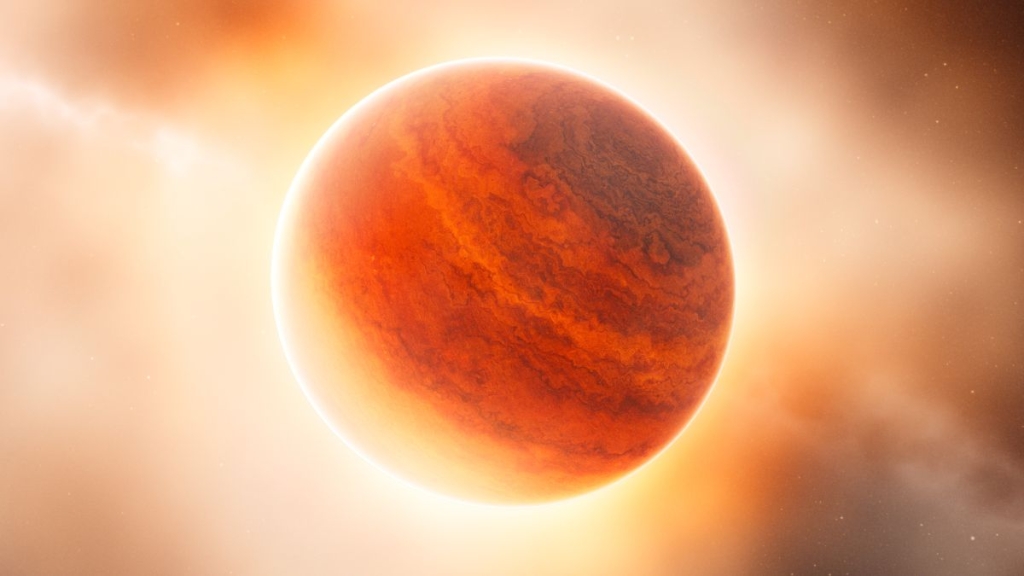
In a groundbreaking study that could reshape our understanding of planetary formation, the James Webb Space Telescope (JWST) has revealed that three enormous gas giants orbiting the distant star HR 8799 likely formed through the same core accretion process that created Jupiter and Saturn—despite being five to ten times more massive.
Located approximately 130 light-years away in the constellation Pegasus, the HR 8799 system hosts four known gas giants ranging from 5 to 10 times Jupiter’s mass. These planetary behemoths orbit at staggering distances between 15 and 70 astronomical units from their host star—roughly 15 to 70 times farther from their star than Earth is from the Sun.
Using JWST’s Near-Infrared Spectrograph (NIRSpec), an international team of astronomers conducted detailed atmospheric analysis of the system’s three innermost planets at wavelengths between 3 and 5 microns. The observations revealed something remarkable: strong evidence of hydrogen sulfide in HR 8799 c and d, with atmospheric models suggesting similar sulfur enrichment across all three planets.
“With its unprecedented sensitivity, JWST is enabling the most detailed study of the atmospheres of these planets, giving us clues to their formation pathways,” explained Jean-Baptiste Ruffio, astronomer at UC San Diego and co-first author of the study published in Nature Astronomy.
The detection of sulfur proved to be the key to unlocking this cosmic mystery. Sulfur is a refractory element that remains largely locked into solid grains within protoplanetary disks. Finding it in these planets’ atmospheres indicates that substantial amounts of solid material were incorporated during their formation—a hallmark of the core accretion process.
“Despite being 5 to 10 times more massive than Jupiter, these planets likely formed in a similar way,” Ruffio noted, describing the finding as unexpected. The planets show uniform enrichment in heavy elements including carbon, oxygen, and sulfur compared to their host star, suggesting efficient incorporation of solid material during their early development.
This discovery challenges conventional wisdom about planetary formation at extreme distances. Core accretion theory suggests that planet formation should proceed more slowly the farther a planet orbits from its star, potentially leaving insufficient time for massive planets to form before the protoplanetary disk dissipates. Some astronomers had proposed that such massive, distant worlds might instead form through gravitational collapse—the same top-down process that creates brown dwarfs and stars.
However, the chemical fingerprints detected by JWST tell a different story. The heavy-element enrichment levels observed in HR 8799’s planets are difficult to reconcile with gravitational collapse models, which would predict different chemical compositions.
“There’s no way planetary formation should be that efficient,” said Michael Meyer, astronomer at the University of Michigan. “It’s a conundrum. We’re really left with a mystery here.”
The research team overcame significant technical challenges to make these discoveries. The planets are thousands of times fainter than their host star, making them extremely difficult to observe directly. JWST’s extraordinary sensitivity allowed researchers to separate the planets’ faint signals from the overwhelming stellar glare, while complex atmospheric models helped interpret the data.
“In the end, we detected several molecules in these planets—some for the first time, including hydrogen sulfide,” added Jerry Xuan, astronomer at UCLA and co-first author of the study.
This breakthrough represents more than just a fascinating astronomical discovery—it fundamentally reshapes our understanding of how giant planets can form across the universe. If massive planets can successfully form through core accretion at such extreme distances, it suggests that planetary systems may be far more diverse and complex than previously imagined.
The implications extend beyond HR 8799. As astronomers continue to discover exoplanets in increasingly diverse environments, understanding the full range of formation mechanisms becomes crucial for interpreting these alien worlds and their potential for hosting life.
The study, published in Nature Astronomy under the title “Elemental abundances of the HR 8799 planets as tracers of their formation,” marks another milestone for JWST, which continues to revolutionize our understanding of the cosmos just three years after its launch.
Tags: JWST discoveries, exoplanet formation, HR 8799, gas giants, planetary science, James Webb Space Telescope, core accretion, atmospheric chemistry, brown dwarfs, protoplanetary disks, sulfur detection, astronomy breakthrough, distant solar systems, heavy element enrichment
Viral Sentences:
- JWST just solved a cosmic mystery that’s baffled astronomers for decades
- These planets are 10x bigger than Jupiter but formed the same way
- Scientists found hydrogen sulfide on distant worlds for the first time ever
- The universe just got way more mysterious than we thought
- This discovery changes everything we know about how planets form
- Astronomers are calling it “a conundrum” that defies all expectations
- JWST’s sensitivity is so incredible it can detect molecules on planets thousands of times fainter than their stars
- The efficiency of these planets’ formation is “impossible” according to current models
- We may need to rewrite the textbooks on planetary formation
- This is why we built JWST—to answer questions we didn’t even know to ask
,


Leave a Reply
Want to join the discussion?Feel free to contribute!