
Researchers Get Human Brain Cells Running Doom
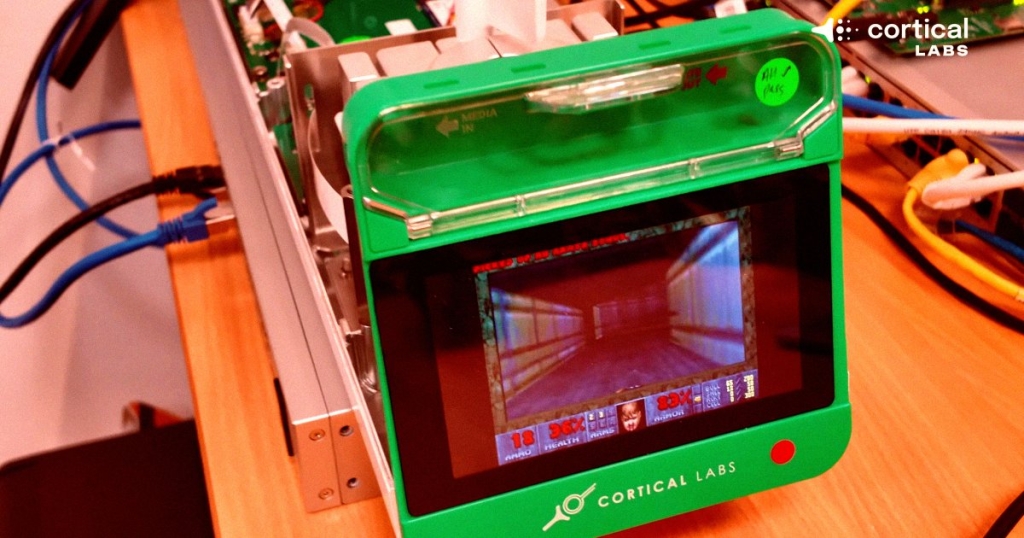
Human Brain Cells Play “Doom” in Scientific Breakthrough That Blurs Line Between Biology and Computing
In a development that sounds like science fiction but is very much real science, Australian biotech startup Cortical Labs has achieved what many thought impossible: teaching living human brain cells to play the classic video game “Doom” inside their revolutionary biological computer system.
This isn’t just another viral tech demo—it represents a fundamental shift in how we think about computing, learning, and the relationship between biological and artificial intelligence.
From “Pong” to “Doom”: A Quantum Leap in Biological Computing
The journey to this moment began in October 2022, when Cortical Labs first captured global attention by demonstrating that clusters of human brain cells—what they call “mini-brains” containing 800,000 to one million living neurons—could learn to play the simple 1970s arcade game “Pong.”
“The amazing aspect is how quickly it learns, in five minutes, in real time,” Cortical Labs chief scientific officer Brett Kagan told New Scientist at the time. “That’s really an amazing thing that biology can do.”
But as impressive as that was, “Pong” is a relatively simple game—a two-dimensional paddle-and-ball affair that even basic computer programs mastered decades ago. The real test would be something far more complex.
Enter “Doom,” the seminal 1993 first-person shooter that revolutionized gaming with its 3D environments, enemy AI, and immersive gameplay. If “Pong” was the training wheels, “Doom” is the Tour de France.
The CL1: World’s First Deployable Biological Computer
At the heart of this breakthrough is the CL1, Cortical Labs’ “world’s first code-deployable biological computer” launched in 2023. This isn’t your typical silicon-based machine—it’s a hybrid system that combines living biological neurons with traditional computing hardware.
The CL1 represents four years of intense research and development, pushing the boundaries of what’s possible when biology meets technology. While other companies have experimented with biological computing, Cortical Labs is the first to create a system that’s both practical and deployable.
How Do You Teach Brain Cells to Play Video Games?
The process of teaching neurons to play “Doom” required Cortical Labs to solve a fundamental problem: how do you communicate with living brain cells in a way they can understand?
“We had to translate the digital world of Doom into the biological language of neurons, which is electricity,” Kagan explained in the company’s announcement video.
The solution was elegant in its simplicity. The video feed from the game was converted into patterns of electrical stimulation that could be delivered to the neural culture. Different visual elements—walls, enemies, the player’s weapon—were translated into specific electrical patterns that the neurons could process.
When the neurons fire in particular patterns, the Doom character responds accordingly. “If the neurons fire in a specific pattern, the Doom guy shoots,” Cortical Labs CTO David Hogan explained. “If they fire in another pattern, he moves right, and so on.”
The Learning Process: Faster Than Expected
Perhaps most remarkably, the neurons learned to play “Doom” through Cortical Labs’ cloud platform in less than a week. This was accomplished using the company’s Application Programming Interface (API), which allowed independent developer and collaborator Sean Cole to train the system remotely.
This speed of learning is particularly impressive when you consider that it took 18 months with earlier hardware and software to get the neurons playing “Pong” successfully.
“Doom was much more complex,” Kagan noted. “It’s 3D. It has enemies. It needs to explore, it’s an environment, and it’s hard.”
How Good Are These Biological Gamers?
Before you imagine Skynet-level gaming prowess, it’s important to understand the current limitations. According to Kagan, the neurons currently play “Doom” at a beginner level—someone who’s never seen a computer before.
“Right now, the cells play a lot like a beginner who’s never seen a computer,” he admitted. “And in all fairness, they haven’t. But they show evidence that they can seek out enemies, they can shoot, they can spin.”
This is still a significant achievement. The neurons are demonstrating goal-directed behavior, exploration, and basic tactical thinking—all hallmarks of learning and adaptation that go far beyond simple pattern recognition.
The Science Behind the Spectacle
While the “Doom” demo makes for spectacular headlines, the underlying science is even more fascinating. This work is part of a broader field exploring how biological neurons can be harnessed for computation.
“Neural networks” in artificial intelligence are named after biological neural networks, but they’re actually quite different. Biological neurons communicate through complex chemical and electrical signals, can form new connections, and exhibit plasticity that silicon-based systems struggle to replicate.
The CL1 system leverages these natural advantages. Biological neurons are incredibly energy-efficient, can process information in parallel in ways that silicon struggles with, and can adapt to new situations in real-time.
What This Means for the Future of Computing
This demonstration isn’t just about playing video games—it’s about exploring new paradigms for computation. Traditional computers excel at many tasks but struggle with others that biological systems handle effortlessly, like pattern recognition in noisy environments or adapting to completely novel situations.
Cortical Labs sees applications far beyond gaming. The company is already looking at using these biological systems for controlling complex robotic arms, where the adaptability and learning capabilities of neurons could provide significant advantages over traditional programming.
The long-term vision includes using biological computing for tasks that require real-time adaptation, energy efficiency, and the ability to learn from minimal data—areas where current AI and computing systems often fall short.
The Ethical Dimension
As with any breakthrough involving living brain cells, there are ethical considerations to ponder. These aren’t conscious beings in the way humans are, but they are living biological material capable of processing information and learning.
The scientific community continues to debate the implications of creating systems that blur the line between biological and artificial intelligence. While the current applications are relatively benign (playing video games), the technology could eventually raise more complex questions about consciousness, rights, and the nature of intelligence itself.
Industry Reaction and Public Response
The gaming community’s reaction to this news has been predictably enthusiastic, with many expressing both awe and unease. “I know this is a technical achievement far greater than anything I will ever achieve, but I gotta admit… Something about this feels very wrong to me,” one Reddit user commented.
Others took a lighter approach: “What’s the big deal, my brain cells play Doom as well,” another user quipped.
The scientific community has been more measured in its response. University of Manchester computer science professor Steve Furber noted that we still don’t fully understand how the neurons are playing the game or how they know what’s being expected of them.
The Road Ahead
Cortical Labs isn’t stopping with “Doom.” According to Kagan, the company is now looking to have its neurons “really begin to excel at [Doom] and then take on even more complicated tasks.”
This could include more complex games, real-world control tasks, or entirely new applications that we haven’t yet imagined. The key advantage of biological computing—its ability to learn and adapt in ways that silicon cannot—suggests that we’re only scratching the surface of what’s possible.
Why This Matters
This breakthrough represents more than just a technical achievement; it’s a philosophical shift in how we think about intelligence and computation. For decades, the computing industry has been locked into the silicon paradigm, with biological systems seen as fundamentally different and separate.
Cortical Labs is demonstrating that these boundaries are more permeable than we thought. By creating systems that combine the best of both worlds—the adaptability and efficiency of biology with the precision and scalability of engineering—they’re opening up entirely new possibilities for computing.
As we look to the future, with challenges ranging from climate change to space exploration to personalized medicine, having access to new forms of computation could be crucial. Biological computing might offer solutions to problems that traditional approaches cannot solve.
The neurons playing “Doom” today might be the foundation for breakthroughs we can’t yet imagine—a reminder that sometimes the most revolutionary advances come from the most unexpected places.
Tags: biological computing, neural networks, Cortical Labs, CL1, human brain cells, Doom, Pong, biotech breakthrough, synthetic biology, computer science, gaming, artificial intelligence, neuroscience, emerging technology, scientific innovation
Viral Phrases: “living human brain cells play Doom,” “biological computer,” “neurons learn to game,” “Cortical Labs breakthrough,” “brain cells vs. AI,” “the future of computing is alive,” “gaming gets biological,” “neurons don’t need controllers,” “science fiction becomes reality,” “the line between biology and tech blurs”
Viral Sentences: “They learned to play Doom in less than a week,” “Biology just beat silicon at its own game,” “These brain cells have never seen a computer before,” “The future of gaming might be alive,” “We taught living neurons to shoot demons in Doom,” “This isn’t AI—it’s real intelligence,” “The gaming industry just got a biological upgrade,” “Your brain cells could be the next gaming console,” “Science just made gaming weirdly ethical,” “The neurons are learning faster than we expected”
,


Leave a Reply
Want to join the discussion?Feel free to contribute!