
Jupiter’s Moons May Have Been Born With Life’s Building Blocks
Jupiter’s Moons May Have Been Born With Life’s Building Blocks
An international team of planetary scientists has uncovered compelling evidence that Jupiter’s four largest moons—Io, Europa, Ganymede, and Callisto—collectively known as the Galilean moons—may have been born with the essential chemical ingredients for life already embedded in their composition.
The groundbreaking research, conducted by a collaboration that included scientists from the Southwest Research Institute, suggests that complex organic molecules (COMs)—widely regarded as the critical precursors to life as we know it—were incorporated into these moons during their formation billions of years ago. The findings, published in two companion papers in The Planetary Science Journal, could fundamentally reshape our understanding of the potential habitability of icy moons throughout our solar system and beyond.
A Cosmic Recipe for Life
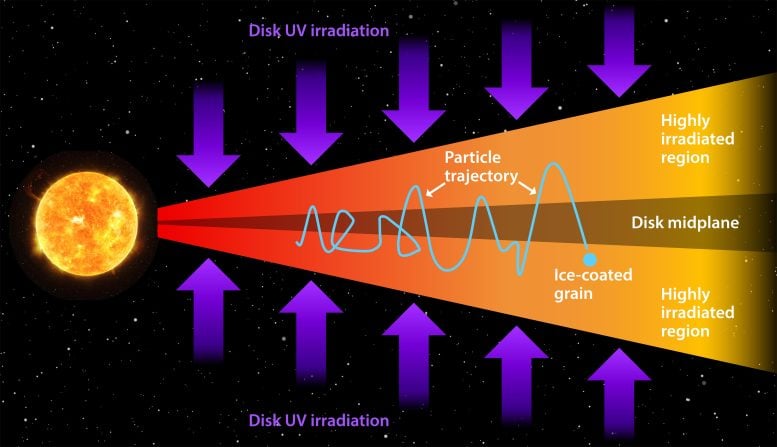
The study centers on the idea that the birth environment of Jupiter’s moons was far more chemically rich than previously assumed. According to the research, the circumplanetary disk—the swirling ring of gas and dust that surrounded the young Jupiter—was not just a passive nursery of rock and ice. Instead, it was a dynamic chemical reactor, bombarded by high-energy radiation from Jupiter’s intense magnetic field and solar radiation.
This radiation, the team proposes, could have driven chemical reactions that transformed simple molecules like methane, ammonia, and water into more complex organic compounds. These COMs would then have been incorporated into the growing moons as they accreted material from the disk.
“The key insight is that the moons didn’t just form from inert material,” explained Dr. Thomas Greathouse, a co-author of the study. “They formed in an environment where chemistry was actively taking place, producing the kinds of molecules that life needs to get started.”
Europa and Ganymede: Oceans of Possibility
Of particular interest are Europa and Ganymede, both of which are believed to harbor vast subsurface oceans beneath their icy crusts. Europa, with its smooth, cracked surface and potential hydrothermal activity, has long been considered one of the most promising places in the solar system to search for extraterrestrial life. Ganymede, the largest moon in the solar system, also shows evidence of a subsurface ocean and a complex internal structure.
If these moons were indeed born with complex organic molecules already present, it would mean that the chemical prerequisites for life were in place from the very beginning. This doesn’t guarantee that life exists or ever existed on these moons, but it does significantly increase the odds that the conditions for life’s emergence were met.
A New Lens on Planetary Formation
The implications of this research extend far beyond Jupiter’s immediate neighborhood. If the Galilean moons formed with complex organics already present, it raises the possibility that other moons in the outer solar system—such as Saturn’s Enceladus and Titan, or even Neptune’s Triton—may have similarly inherited life-friendly chemistry from their birth environments.
Moreover, the findings could inform the search for habitable worlds around other stars. Many of the exoplanets discovered so far are gas giants, and if these giants have moons, those moons might also form in chemically rich environments capable of producing complex organics.
“This is a paradigm shift in how we think about the origins of life’s building blocks,” said Dr. Yasuhito Sekine, lead author of one of the papers. “It suggests that the seeds of life might be more common in the universe than we ever imagined.”
The Road Ahead
While the findings are compelling, the researchers caution that much work remains to be done. Future missions, such as NASA’s Europa Clipper and the European Space Agency’s JUICE (JUpiter ICy moons Explorer), will be crucial in testing these hypotheses. These missions will carry instruments capable of analyzing the surface and subsurface composition of these moons in unprecedented detail, potentially confirming the presence of complex organics.
In the meantime, the study opens up a new frontier in planetary science—one where the origins of life are not just a question of Earth’s history, but a cosmic puzzle that spans the entire solar system and beyond.
Tags & Viral Phrases:
Jupiter’s moons, life’s building blocks, complex organic molecules, Galilean moons, Europa, Ganymede, subsurface oceans, circumplanetary disk, planetary formation, habitability, extraterrestrial life, Southwest Research Institute, The Planetary Science Journal, cosmic chemistry, radiation-driven reactions, hydrothermal activity, Enceladus, Titan, Triton, exoplanets, gas giants, Europa Clipper, JUICE mission, life’s origins, cosmic puzzle, paradigm shift, planetary science, astrobiology, solar system exploration, interstellar chemistry, life-friendly environments, scientific breakthrough, space discovery, cosmic evolution.
,


Leave a Reply
Want to join the discussion?Feel free to contribute!