
Black Hole Collisions May Finally Resolve the Hubble Tension
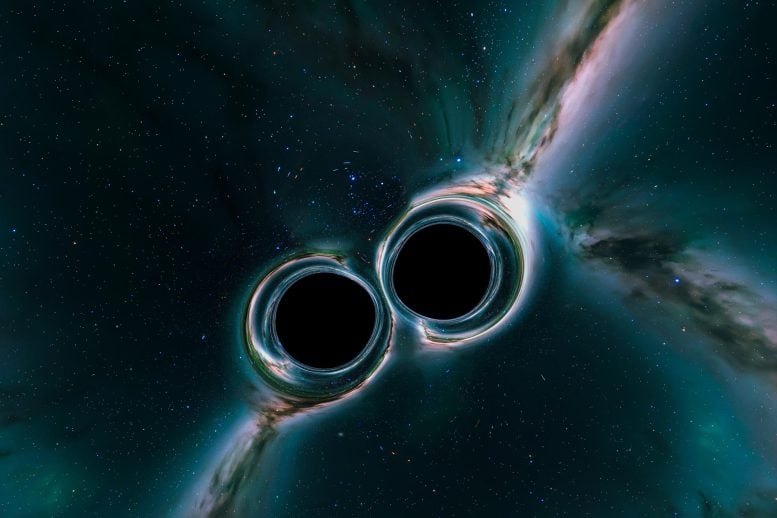
Astronomers have long been captivated by the cosmos’ most profound mysteries, and one of the most persistent puzzles in modern astrophysics is the so-called “Hubble tension.” This enigma revolves around a fundamental question: How fast is the universe expanding? For decades, scientists have relied on the Hubble constant to measure this cosmic growth, but recent observations have revealed a troubling discrepancy—different measurement methods yield different values. Now, a groundbreaking new approach using the faint gravitational-wave “hum” from colliding black holes may finally provide the key to resolving this cosmic conundrum.
The Hubble constant, named after the pioneering astronomer Edwin Hubble, quantifies the rate at which the universe is stretching. Traditionally, astronomers have calculated this value using two primary methods: one involves observing the cosmic microwave background (CMB), the faint afterglow of the Big Bang, while the other relies on measuring the distances and velocities of nearby galaxies. However, these methods have produced conflicting results. Measurements based on the CMB suggest a Hubble constant of about 67 kilometers per second per megaparsec (km/s/Mpc), while observations of galaxies indicate a faster rate of around 73 km/s/Mpc. This discrepancy, known as the Hubble tension, has left the scientific community grappling with the possibility that our understanding of the universe’s fundamental physics might be incomplete.
Enter gravitational waves—ripples in the fabric of spacetime caused by cataclysmic events such as the merger of black holes. These waves, first predicted by Albert Einstein’s theory of general relativity, were directly detected for the first time in 2015 by the Laser Interferometer Gravitational-Wave Observatory (LIGO). Since then, astronomers have been using gravitational waves to probe the universe in ways that were previously unimaginable. Now, a team of researchers has proposed a novel method to measure the Hubble constant by analyzing the subtle “hum” of gravitational waves produced by black hole mergers.
The idea is as elegant as it is revolutionary. When two black holes collide, they emit gravitational waves that carry information about their masses, spins, and the distance to the event. By studying the properties of these waves, astronomers can infer the distance to the black holes and, in turn, calculate the Hubble constant. The beauty of this approach lies in its independence from traditional methods. Unlike measurements based on the CMB or galaxies, gravitational-wave observations are not subject to the same systematic uncertainties, making them a potentially more reliable tool for resolving the Hubble tension.
The process begins with the detection of gravitational waves from black hole mergers. Each event provides a wealth of data, including the frequency and amplitude of the waves, which can be used to determine the distance to the source. By combining this information with the redshift of the host galaxy—a measure of how much the universe has expanded since the light left the galaxy—astronomers can calculate the Hubble constant. The challenge, however, lies in the sheer number of black hole mergers required to achieve a precise measurement. Fortunately, the advent of next-generation gravitational-wave detectors, such as the proposed Cosmic Explorer and the Einstein Telescope, promises to revolutionize this field by detecting thousands of events per year.
This new approach has the potential to bridge the gap between the two conflicting values of the Hubble constant. If the gravitational-wave measurements align with one of the existing values, it could confirm the accuracy of that method and rule out the other. Alternatively, if the results fall somewhere in between, it might suggest that both methods have unaccounted-for systematic errors or that new physics is at play. Either way, the implications for our understanding of the universe are profound.
The resolution of the Hubble tension could have far-reaching consequences for cosmology. It might shed light on the nature of dark energy, the mysterious force driving the universe’s accelerated expansion, or reveal new insights into the early universe’s evolution. It could also challenge the foundations of the standard model of cosmology, prompting a reevaluation of our most cherished theories.
As astronomers continue to refine their techniques and gather more data, the gravitational-wave “hum” from black hole mergers offers a tantalizing glimpse into the universe’s deepest secrets. This innovative approach not only exemplifies the ingenuity of modern science but also underscores the importance of exploring multiple avenues to unravel the cosmos’ mysteries. With each new discovery, we move one step closer to understanding the universe’s grand design—and perhaps, in the process, uncover truths that will forever change our perception of reality.
Tags: Black Hole Collisions, Gravitational Waves, Hubble Tension, Cosmic Expansion, Universe Mysteries, General Relativity, Dark Energy, Astrophysics, Cosmology, LIGO, Einstein Telescope, Cosmic Explorer, Space-Time Ripples, Scientific Breakthrough, Universe Growth Rate, Standard Model of Cosmology, Cosmic Microwave Background, Redshift, Megaparsec, Astronomical Measurements, Space Science, Physics Revolution, Cosmic Questions, Gravitational-Wave Astronomy, Universe Secrets, Scientific Innovation, Cosmic Explorer, Einstein Telescope, Space-Time, Black Hole Mergers, Universe Expansion, Hubble Constant, Dark Energy, Cosmic Microwave Background, Redshift, Megaparsec, Gravitational-Wave “Hum”, Cosmic Questions, Space-Time Ripples, Scientific Breakthrough, Universe Mysteries, Astrophysics, Cosmology, General Relativity, LIGO, Einstein Telescope, Cosmic Explorer, Space Science, Physics Revolution, Scientific Innovation, Universe Secrets, Black Hole Collisions, Gravitational Waves, Hubble Tension, Cosmic Expansion, Universe Mysteries, General Relativity, Dark Energy, Astrophysics, Cosmology, LIGO, Einstein Telescope, Cosmic Explorer, Space-Time Ripples, Scientific Breakthrough, Universe Growth Rate, Standard Model of Cosmology, Cosmic Microwave Background, Redshift, Megaparsec, Astronomical Measurements, Space Science, Physics Revolution, Cosmic Questions, Gravitational-Wave Astronomy, Universe Secrets, Scientific Innovation.,

Leave a Reply
Want to join the discussion?Feel free to contribute!