
New Device Detects Brain Waves in Mini Brains Mimicking Early Human Development
Pea-Sized Brain Blobs Are Now the Talk of Neuroscience—And They’re Chirping Away Like Crazy
Imagine something smaller than a pea, yet alive with electrical chatter—neurons firing in concert, creating wave patterns eerily reminiscent of a human brain. That’s exactly what’s happening inside the latest generation of lab-grown “brain organoids,” and scientists are now listening in like never before.
These miniature marvels, often dubbed “mini brains,” are no longer just static cell clusters in a dish. They’re dynamic, electrically active models of brain tissue, some mirroring early human brain development, others carrying the very genetic mutations linked to autism, schizophrenia, and other neurological conditions. Researchers are racing to decode their signals in hopes of uncovering disease patterns and testing treatments—without ever touching a human brain.
But here’s the catch: recording activity from these 3D blobs is a nightmare. Traditional electrode arrays are clunky and rigid, smashing through delicate tissue like a bulldozer through a sandcastle. Even newer soft, flexible electronics can only tap into a tiny fraction of the organoid at a time, leaving scientists blind to the big picture.
Until now.
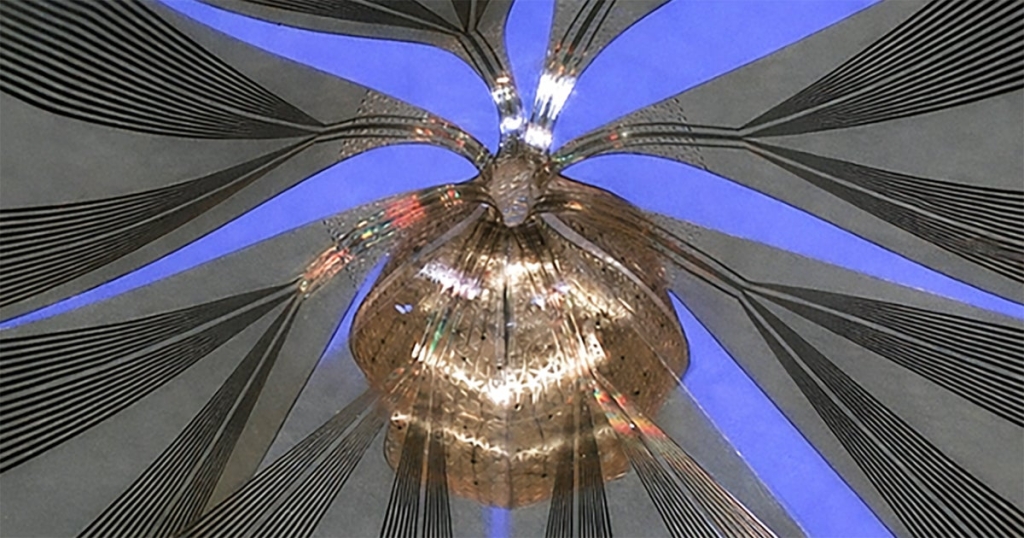
A team at Northwestern University, in collaboration with other institutions, has unveiled a game-changing device: a pop-up electrode mesh that gently envelops entire brain organoids like a breathable, high-tech blanket. This isn’t just an incremental upgrade—it’s a revolution in how we interface with living brain tissue.
The device starts life as a delicate, flower-like lattice, no bigger than a US quarter. Then, like a magical origami trick, it transforms into a 3D net studded with 240 microelectrodes, each one just 10 microns wide—about the size of a single neuron. These electrodes spread out evenly across the organoid’s surface, capturing electrical activity from nearly every angle at once.
The result? A panoramic, high-resolution map of neural chatter—waves of synchronized electrical activity rippling across the mini brain’s surface, patterns that mirror those seen in developing human brains. These synchronized oscillations, previously undetectable in organoids, are now laid bare in stunning detail.
But the innovation doesn’t stop at recording. The mesh is porous, allowing nutrients—and drugs—to flow freely. In a series of experiments, the team dosed organoids with compounds known to either boost or suppress neural activity. The device picked up the changes instantly, across the entire organoid, hinting at its potential as a powerful drug testing platform.
“This advance is really about building the right tools,” said study author Colin Franz. “We can now record from and stimulate hundreds of locations across the surface at once. This allows us to study neural activity at the level of whole networks rather than isolated signals.”
The challenge was immense. Brain-computer interfaces have exploded in sophistication, with some devices sitting atop the brain to monitor large areas, others diving deep to record single neurons. Non-invasive methods like EEG have mapped whole-brain activity for over a century. But organoids are a different beast—recording from them requires a level of delicacy and precision that traditional tech simply can’t deliver.
The Northwestern team’s solution borrows from the art of paper folding and the science of soft electronics. Previous attempts at flexible electrode arrays—basket-like designs inspired by Japanese origami, flower-shaped devices that morph into electrode-studded claws—were groundbreaking, but still fell short of full coverage. To truly decipher mini brain activity, you need hardware that can wrap around the entire organoid without damaging it.
Their device is like a drawstring coin purse. When flat, it’s a delicate flower. When deployed, it cinches into a soft, flexible mesh that molds perfectly to the organoid’s shape. The electrodes move in predictable ways as the device changes form, ensuring even distribution and minimal gaps. The mesh is breathable, letting nutrients flow in but keeping rogue cells from escaping the electrode grid.
“The device’s structure needs to support these metabolic processes to sustain the viability of the tissue,” said John Rogers, another study author. “Basically, the organoid needs to breathe. The hardware must not significantly constrain or suffocate it.”
The results are breathtaking. The device covered about 91% of an average-sized organoid’s surface after 60 days in culture. Because each electrode’s location was known, the team could reconstruct the neural oscillations into a 3D, widescreen view of the organoid’s activity.
In one striking experiment, triggering activity in a small region led to highly synchronized, wave-like activity across most surface neurons. These patterns, previously hidden, mimic those seen in developing human brains. But when the team introduced botulinum toxin—a chemical known to dampen brain activity by blocking connections between neurons—the synchronized waves collapsed, revealing the fragility and complexity of the organoid’s wiring.
The device also captured brain-wide activity changes triggered by neurochemical imbalances, offering a window into diseases like Parkinson’s, multiple sclerosis, and ALS. It even worked in tandem with other observation methods, reliably recording electrical signals alongside technologies that track brain chemicals, and responding to light beams that activate groups of neurons (a technique called optogenetics).
By mixing and matching different strategies—and inventing entirely new ones—scientists are inching closer to a comprehensive understanding of mini brains, and by extension, our own.
This isn’t just a technical achievement. It’s a new lens through which we can watch the brain’s earliest electrical conversations unfold, a tool that could accelerate the search for cures to some of humanity’s most devastating neurological diseases. And it all starts with a pea-sized blob that’s finally learning to speak—loud and clear.
Tags: brain organoids, mini brains, neural activity, electrode mesh, neuroscience, brain development, neurological diseases, drug testing, optogenetics, botulinum toxin, synchronized waves, 3D recording, soft electronics, Northwestern University, John Rogers, Colin Franz
Viral Sentences:
- “Pea-sized brain blobs are now chirping away like never before.”
- “This isn’t just an upgrade—it’s a revolution in brain recording.”
- “Imagine wrapping an entire mini brain in a breathable, high-tech blanket.”
- “Scientists are finally hearing the full symphony of neural chatter.”
- “This device could be the key to unlocking the secrets of autism, schizophrenia, and more.”
- “It’s like a magical origami trick—but for neuroscience.”
- “The future of brain research just got a whole lot smaller—and smarter.”
- “These synchronized waves mimic those seen in developing human brains.”
- “The organoid needs to breathe. The hardware must not suffocate it.”
- “This is neuroscience’s new lens into the brain’s earliest electrical conversations.”
,


Leave a Reply
Want to join the discussion?Feel free to contribute!