
Iranian Exchange Outflows Jump 700% as USDT Sanctions Alert Intensifies
Crypto Exodus: Iranian Exchange Outflows Explode 700% as US Strikes Trigger Capital Flight
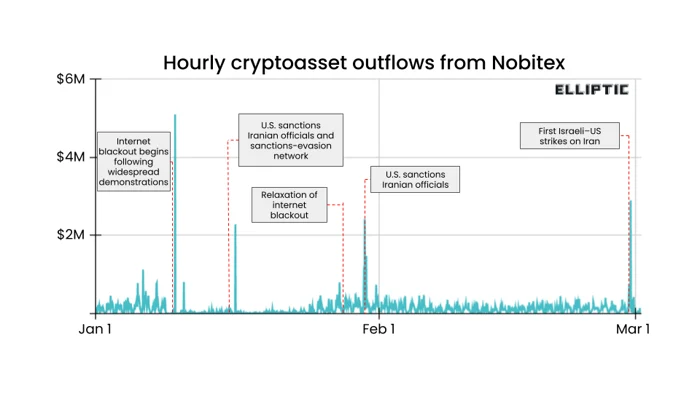
In a stunning development that’s sending shockwaves through the cryptocurrency world, Iranian crypto exchange outflows have skyrocketed by a mind-blowing 700% following coordinated military strikes by the United States and Israel, according to new data from blockchain analytics powerhouse Elliptic.
The numbers are staggering: nearly $3 million in digital assets fled Iran’s largest exchange, Nobitex, in a desperate rush to safety that’s exposing the fragile underbelly of crypto markets in sanctioned nations.
The Perfect Storm: Military Conflict Meets Digital Gold Rush
When the missiles started flying, Iranian crypto traders didn’t hesitate. They made a beeline for the exits, moving assets off-platform at a rate that’s left analysts stunned.
“This isn’t just trading behavior—it’s capital flight on steroids,” says an Elliptic analyst who spoke on background. “These users are treating crypto like digital gold, and they’re not waiting around to see what happens next.”
The timing couldn’t be more critical. While global Bitcoin markets rebounded quickly from the Iran strike shock, erasing a $5,000 drop within 24 hours, Iranian traders were playing a completely different game. They weren’t interested in price discovery or market timing—they wanted their money out, and they wanted it out now.
Internet Blackout Creates Perfect Chaos
Here’s where it gets really interesting: this massive outflow happened despite an 80% collapse in overall trading volumes across Iranian platforms. Thanks to severe internet restrictions imposed by Iranian authorities, most crypto activity ground to a halt.
But here’s the kicker—those who could still access the network prioritized one thing above all else: getting their money to safety. TRM Labs attributes the volume drop to “mechanical access limitations,” but the simultaneous spike in withdrawals tells a completely different story.
Think about that for a second. While the vast majority of traders were locked out, a determined minority found ways to move nearly $3 million in crypto assets. That’s not just trading—that’s survival instinct kicking in.
USDT Under Fire: The Dollar’s Digital Doppelganger
The escape route of choice? Tether (USDT), the stablecoin that’s become the unofficial dollar substitute for millions of people living under sanctions.
Iran’s central bank caught wind of this and pulled the trigger on a dramatic move: they ordered major platforms including Nobitex and Wallex to temporarily suspend all USDT/toman trading pairs. Translation? They just cut off the main bridge between Iranian currency and the global crypto economy.
Why USDT? Because it’s liquid, it’s stable, and most importantly—it works. For people trying to move money across borders without going through traditional banking systems, USDT has become the go-to solution. It’s the digital equivalent of smuggling cash across borders, except it happens at the speed of light.
The Dark Side: Illicit Activity Hits 5.9%
But here’s where things get really dicey. Elliptic’s data shows that 5.9% of current crypto volume in Iran is now linked to illicit or sanctioned activity. That’s not a small number—that’s a red flag waving in the face of global regulators.
This concentration of risk has put a massive target on Iran’s crypto infrastructure. The U.S. Treasury’s Office of Foreign Assets Control (OFAC) has been getting increasingly sophisticated at mapping on-chain relationships between exchanges and sanctioned entities. They’re watching, and they’re not happy about what they’re seeing.
The Compliance Nightmare: What This Means for Everyone Else
If sanctions enforcement tightens on Tether rails, Iranian exchanges could be cut off from global liquidity pools entirely. And that’s when things get really messy.
We’re talking about a scenario where flows would be forced into less transparent, peer-to-peer shadow banking networks. For major exchanges worldwide, that means compliance firewalls need to be higher than ever. One wrong transaction, one missed sanction check, and suddenly you’re on the wrong side of international law.
The Fork in the Road: Two Possible Futures
Right now, the crypto market in Iran is at a crossroads, and the path it takes could reshape the entire landscape of digital finance in sanctioned nations.
Scenario One: The Escalation Trap
If tensions continue to escalate, we could see a second, even more desperate wave of capital flight. The oil price impact from the Iran war could further devalue the rial, driving Iranians to dump their local currency for whatever crypto they can get their hands on. This would likely trigger aggressive secondary sanctions from the U.S., targeting any protocol or platform facilitating these flows.
Scenario Two: The Containment Play
If internet restrictions ease and the central bank restores USDT pairings, the market might return to a “risk containment mode.” But here’s the thing—that 700% outflow spike has already signaled that confidence in domestic platforms is fragile. Once trust is broken, it’s really hard to rebuild.
The Bottom Line: Liquidity is Becoming Toxic
For global traders and investors, the message is crystal clear: liquidity in the Iranian crypto market is becoming increasingly toxic. The region that was once seen as a potential growth market is now a compliance minefield.
The implications are massive. We’re watching in real-time as geopolitical conflict, economic sanctions, and digital finance collide in ways that nobody fully anticipated. This isn’t just about Iran anymore—it’s about how the entire crypto ecosystem handles sanctioned nations, capital flight, and the tension between financial freedom and regulatory control.
One thing’s for sure: the crypto market in Iran will never be the same. Whether that’s a good thing or a bad thing depends entirely on which side of the sanctions you’re sitting on.
Tags: Iranian crypto exchange, Nobitex outflows, USDT sanctions, capital flight crypto, Iran-US conflict crypto, blockchain analytics, Elliptic data, Tether suspension, OFAC compliance, illicit crypto volume, digital asset sanctions, crypto market volatility, geopolitical crypto impact, stablecoin restrictions, financial freedom vs control
Viral Sentences:
- “When missiles fly, crypto traders hit the exits faster than you can say ‘blockchain'”
- “700% outflow spike reveals the true face of capital flight in the digital age”
- “USDT just became the most dangerous dollar substitute on the planet”
- “Iranian exchanges are bleeding liquidity while the world watches”
- “The crypto market just got a front-row seat to geopolitical chaos”
- “Sanctions are pushing crypto into the shadows—and regulators are losing sleep”
- “Digital gold rush meets military conflict: the perfect storm nobody saw coming”
- “When trust breaks in crypto, the exits get crowded real fast”
- “The compliance nightmare is here, and it’s wearing an Iranian flag”
- “Crypto’s wild west just got a whole lot wilder”
,


Leave a Reply
Want to join the discussion?Feel free to contribute!